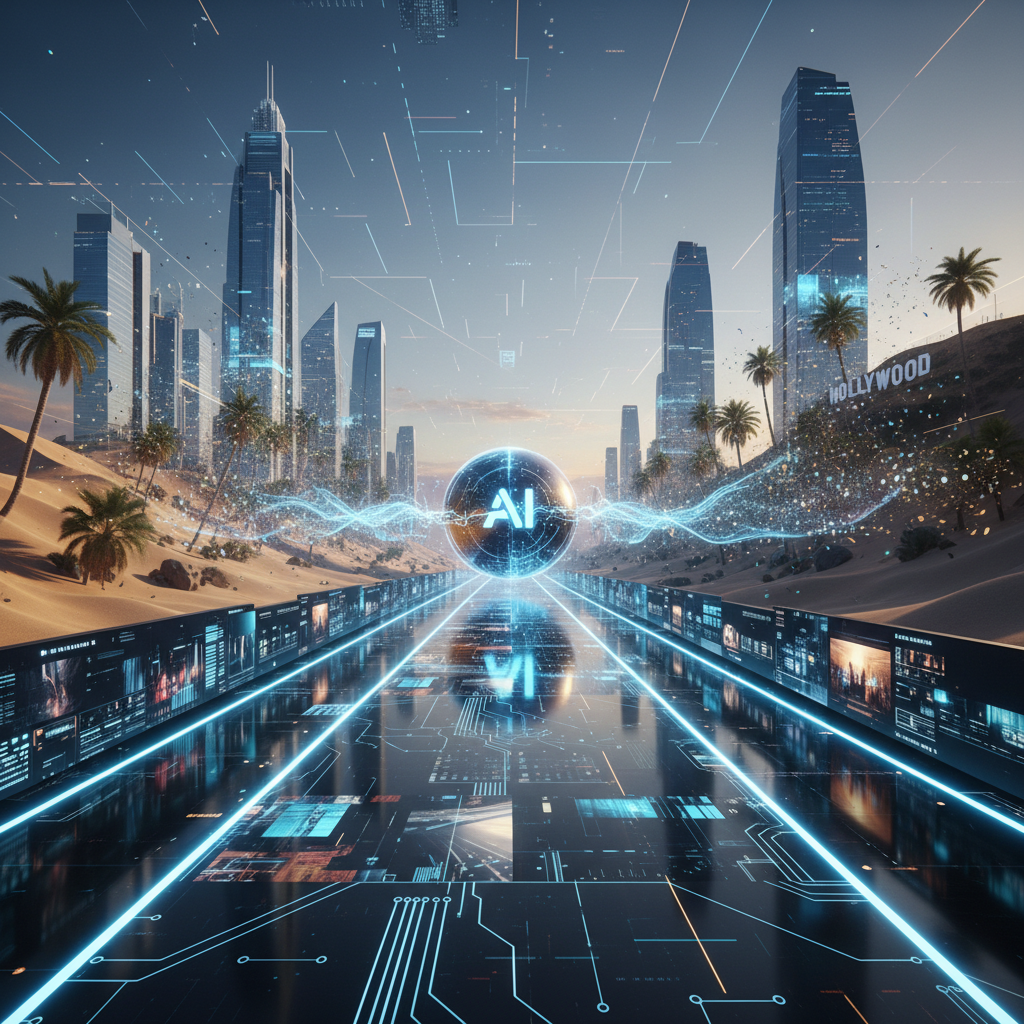

The flickering images on a screen have always held a certain magic, a testament to human ingenuity and painstaking effort. For decades, the creation of moving pictures, especially at the quality demanded by Hollywood, has been an endeavor requiring vast resources, specialized equipment, and an army of skilled professionals. Today, however, a new force is reshaping this landscape: generative artificial intelligence, with platforms like Runway ML leading the charge. The Kingdom's Vision 2030 demands results, not promises, and understanding these technological shifts is paramount for our own burgeoning creative and digital sectors.
The technical challenge at the heart of AI video generation is formidable. Unlike static images, video introduces the dimension of time, requiring models to maintain temporal coherence, consistency in object identity, and realistic motion dynamics across a sequence of frames. Early attempts often produced jittery, artifact-laden results that were far from production-ready. The problem is not merely generating individual high-quality frames, but synthesizing a narrative flow that is both visually compelling and logically consistent, a task that has historically been the exclusive domain of human animators and visual effects artists.
Runway ML, among others, addresses this by leveraging sophisticated deep learning architectures. At its core, the system typically employs a variant of diffusion models, often conditioned on textual prompts or existing image/video inputs. The architecture can be conceptualized as a multi-stage pipeline. Initially, a text-to-image model might generate a foundational frame or keyframes. Subsequent stages then interpolate between these keyframes or extend the sequence, ensuring temporal stability. This often involves a U-Net architecture, a convolutional neural network known for its effectiveness in image-to-image translation tasks, adapted for video by incorporating 3D convolutions or attention mechanisms that span both spatial and temporal dimensions.
Key algorithms and approaches include the use of latent diffusion models, which operate in a compressed latent space rather than directly on pixel data. This significantly reduces computational overhead. The process begins with a noise vector, which is iteratively denoised by the model, guided by a conditioning input such as a text prompt, an initial image, or a style reference. For video, this denoising process is extended across frames. Consider a conceptual example: to generate a video of a 'desert oasis at sunset,' the model might first generate a high-quality static image of the oasis. Then, a temporal module learns to predict the next frame based on the current frame and the overall prompt, ensuring the sun realistically descends and shadows lengthen. This is not a simple frame-by-frame generation, but a holistic approach where the model understands and propagates motion and scene dynamics.
# Conceptual pseudocode for a simplified video diffusion process
function generate_video(text_prompt, initial_frame=None, num_frames, steps_per_frame):
 latent_video = initialize_noise(num_frames, latent_dim)
 conditioning_vector = encode_text(text_prompt)

if initial_frame is not None:
 latent_video[0] = encode_image(initial_frame) # Embed initial frame

for t from total_timesteps down to 1:
 predicted_noise = video_denoising_model(latent_video, t, conditioning_vector)
 latent_video = update_latent_with_predicted_noise(latent_video, predicted_noise, t)

return decode_latent_to_video(latent_video)

# video_denoising_model would internally use 3D convolutions or spatio-temporal attention
# Conceptual pseudocode for a simplified video diffusion process
function generate_video(text_prompt, initial_frame=None, num_frames, steps_per_frame):
 latent_video = initialize_noise(num_frames, latent_dim)
 conditioning_vector = encode_text(text_prompt)

if initial_frame is not None:
 latent_video[0] = encode_image(initial_frame) # Embed initial frame

for t from total_timesteps down to 1:
 predicted_noise = video_denoising_model(latent_video, t, conditioning_vector)
 latent_video = update_latent_with_predicted_noise(latent_video, predicted_noise, t)

return decode_latent_to_video(latent_video)

# video_denoising_model would internally use 3D convolutions or spatio-temporal attention
Implementation considerations for such systems are vast. Training these models requires immense computational power, typically involving hundreds or thousands of NVIDIA GPUs. Data curation is another critical aspect, as high-quality, diverse video datasets with corresponding text descriptions are essential for robust model performance. Fine-tuning pre-trained models on specific styles or content domains, a technique known as transfer learning, is a common strategy to adapt these general models for niche applications. Performance is measured not just by visual fidelity, but also by temporal consistency, frame rate, and the ability to adhere to complex prompts. Generating a few seconds of high-resolution, coherent video can still take minutes, or even hours, depending on the model complexity and hardware.
When comparing Runway ML's capabilities to alternatives, it is important to consider the trade-offs. Traditional CGI and visual effects pipelines offer unparalleled control and precision, but at a significantly higher cost and time investment. Other generative AI approaches, such as those based on Generative Adversarial Networks (GANs) or auto-regressive models, have shown promise but often struggle with temporal coherence over longer sequences or exhibit mode collapse, where the model generates limited diversity. Diffusion models, as employed by Runway ML, have demonstrated superior capabilities in generating high-fidelity and diverse outputs, particularly for complex scenes and realistic motion. According to MIT Technology Review, the advancements in diffusion models have been a game-changer for generative media.
Code-level insights reveal a reliance on popular deep learning frameworks like PyTorch or TensorFlow. Libraries such as Hugging Face's Diffusers provide accessible building blocks for experimenting with diffusion models, abstracting away much of the low-level complexity. Developers working with these systems often utilize distributed training strategies, employing tools like DeepSpeed or Fsdp (Fully Sharded Data Parallel) to scale model training across multiple GPUs. The optimization of memory usage, particularly for high-resolution video, involves techniques such as gradient checkpointing and mixed-precision training.
Real-world use cases are emerging rapidly. Hollywood studios are exploring AI video generation for pre-visualization, allowing directors to quickly iterate on scene concepts without costly physical shoots. Independent filmmakers are using it to create stunning visual effects that would otherwise be out of budget. Marketing agencies are leveraging it for rapid content creation, generating diverse ad variations in a fraction of the time. Even in the gaming industry, AI can generate dynamic background elements or non-player character animations. For instance, a small Saudi animation studio, 'Desert Dreams Digital,' recently utilized Runway ML to prototype several short films, significantly cutting down their initial concept development time. This demonstrates how oil money meets machine learning, creating new opportunities in our region.
However, there are significant 'gotchas' and pitfalls. Ethical concerns surrounding deepfakes and misinformation remain prominent. The carbon footprint of training and operating these large models is substantial, a concern that resonates particularly in our region where sustainable energy solutions are a priority. The intellectual property implications, especially concerning the use of copyrighted material in training data, are still being debated in courts globally. Furthermore, while AI can generate impressive visuals, infusing them with genuine emotion and narrative depth still largely requires human artistic direction. The models can hallucinate, producing illogical or nonsensical elements that require careful human oversight and correction.
For those looking to delve deeper, a wealth of resources exists. Research papers on spatio-temporal diffusion models and video transformers on arXiv.org provide the theoretical underpinnings. Online courses from platforms like Coursera or edX cover practical aspects of deep learning and generative AI. Open-source repositories on GitHub offer implementations of various models, allowing hands-on experimentation. Industry blogs and technical publications, such as those found on TechCrunch, frequently publish updates on the latest advancements and applications.
The revolution in video generation is not merely about automating tasks, it is about democratizing access to complex visual storytelling tools. While the technology is still maturing, its trajectory suggests a future where the barriers to high-quality video production are significantly lowered. For Saudi Arabia, with its ambitious digital transformation agenda and investments in creative industries, understanding and integrating these advanced AI capabilities is not just an option, it is a strategic imperative. The desert is blooming with data centers, and these digital infrastructures will be crucial for harnessing the power of generative AI to tell our own stories on the global stage.
Ultimately, the human element remains irreplaceable. AI provides the brush, but the artist still holds the vision. The most impactful applications will likely involve a symbiotic relationship, where AI augments human creativity rather than replacing it entirely. This is a pragmatic view, one that acknowledges both the immense power and the inherent limitations of these sophisticated algorithms.