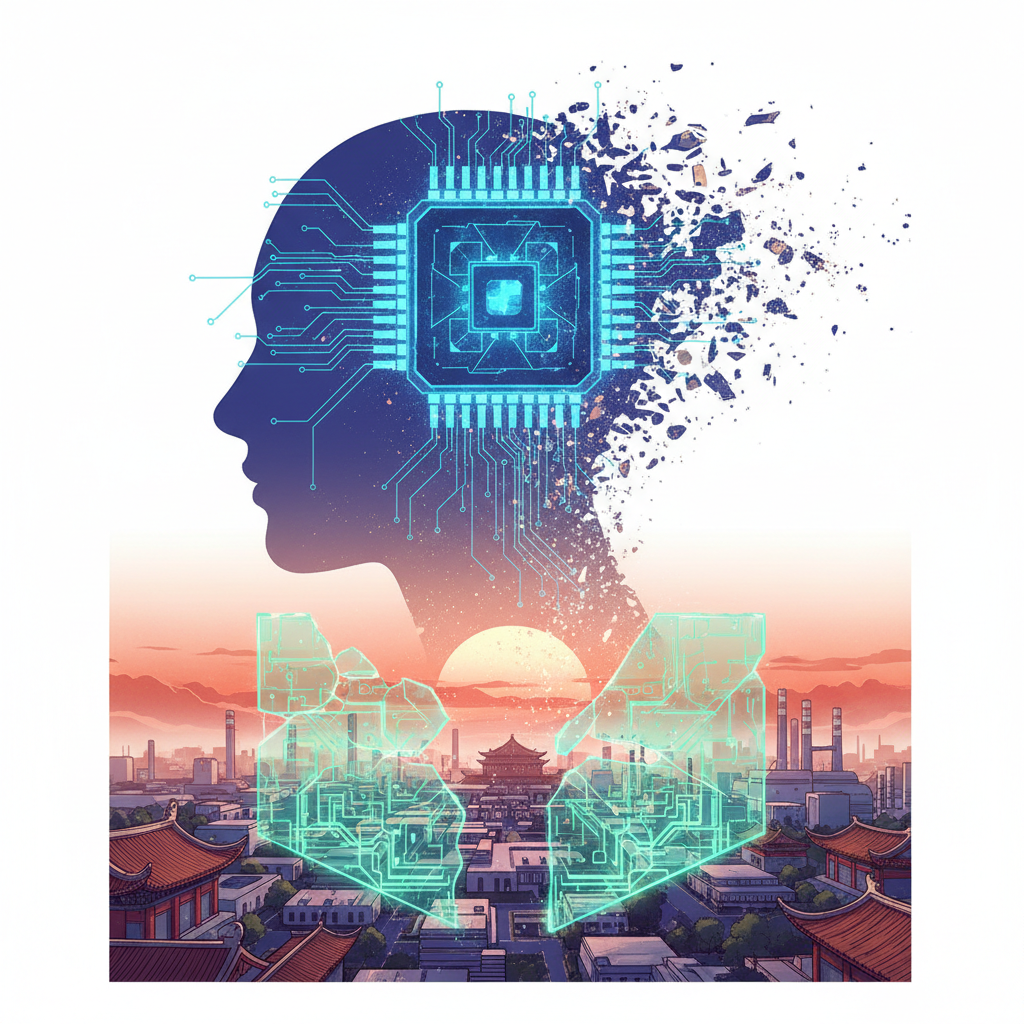

The air in Hsinchu is thick with innovation, a constant hum of advanced manufacturing and relentless research. Here, amidst the very foundries that power much of the world's digital ambition, the pronouncements from distant labs about quantum computing and artificial intelligence often feel like echoes from a parallel universe. While the West and certain mainland entities champion the imminent fusion of these two transformative technologies, promising an era of unprecedented computational power, I find myself asking the familiar question: but does this actually work, or are we merely constructing another towering narrative on a foundation of speculative physics and venture capital? Let's separate fact from narrative.
The rhetoric surrounding quantum AI is certainly compelling. Imagine algorithms that can sift through astronomical datasets in seconds, optimizing supply chains with perfect foresight, or developing new materials with properties currently beyond our wildest dreams. Proponents argue that quantum computers, leveraging phenomena like superposition and entanglement, will unlock AI capabilities that classical silicon architectures simply cannot achieve. They point to quantum machine learning algorithms, quantum neural networks, and quantum optimization techniques as the inevitable next step. Indeed, theoretical papers from institutions like Google and IBM routinely showcase potential exponential speedups for specific computational tasks, fueling the excitement. MIT Technology Review often covers these breakthroughs, presenting a vision of a future where quantum advantage is not just a theory, but a practical reality for AI.
However, the data tells a more nuanced story. Quantum computers, as they exist today, are temperamental, error-prone machines operating in highly controlled, cryogenic environments. They are not general-purpose computers. Their 'qubits' are notoriously fragile, suffering from decoherence within microseconds. Building a quantum computer with a sufficient number of stable, error-corrected qubits to tackle real-world AI problems remains a monumental engineering challenge, one that many experts believe is decades away. We are currently discussing machines with tens or perhaps a few hundred noisy qubits, not the millions required for truly complex AI applications. Consider the sheer scale of the semiconductor industry here in Taiwan, meticulously perfecting billions of transistors on a single chip. The gap between that established, reliable technology and the current state of quantum hardware is vast, almost astronomical.
Dr. Chen Ming-Chung, a distinguished professor of electrical engineering at National Taiwan University, articulated this skepticism succinctly in a recent private seminar. "The leap from demonstrating quantum supremacy on a highly specific, contrived problem to applying it robustly to, say, training a 100-billion-parameter large language model, is not merely quantitative; it is qualitative. We are talking about fundamentally different orders of magnitude in error correction and hardware stability. The current quantum devices are more akin to scientific instruments than practical computers." His assessment underscores the chasm between theoretical potential and engineering reality.
Furthermore, the algorithms themselves are still in their infancy. While quantum machine learning is an exciting field, many proposed quantum algorithms for AI tasks offer only polynomial speedups, not the exponential ones often highlighted. And even these speedups are often contingent on specific problem structures that may not always align with real-world AI challenges. The classical AI community, meanwhile, continues to innovate at a blistering pace, optimizing existing architectures and developing new techniques that extract ever more performance from conventional hardware. NVIDIA's continuous advancements in GPU technology, for instance, demonstrate the remarkable resilience and adaptability of classical computing for AI workloads. NVIDIA's AI blog regularly details these incremental yet impactful improvements.
Some might argue that this is precisely the point: the initial stages of any revolutionary technology are always fraught with challenges. They would point to the early days of classical computing, or even the internet, as examples of technologies that overcame significant hurdles to become ubiquitous. They might suggest that the current investment from global tech giants like Google and IBM, coupled with national initiatives in the US, China, and Europe, will inevitably accelerate progress. They might cite the rapid pace of AI development in the last decade as proof that seemingly insurmountable problems can be overcome with enough capital and talent.
My rebuttal is not to deny the long-term potential of quantum computing, nor to dismiss the brilliance of the researchers working in this field. Rather, it is a call for a more pragmatic, less hyperbolic assessment of its immediate impact on AI. The analogy to early classical computing is flawed; the fundamental physics and engineering challenges in quantum computing are arguably more profound and less amenable to traditional scaling laws. While the capital investment is substantial, the returns on that investment, in terms of practical AI applications, remain largely theoretical. We are not just building faster chips; we are trying to tame quantum mechanics itself.
Taiwan's position is more complex than headlines suggest in this global technological race. While we are a powerhouse in classical semiconductor manufacturing, our direct involvement in quantum hardware development is nascent compared to the giants. However, our expertise in precision engineering, advanced materials, and high-volume manufacturing could prove invaluable if and when quantum technology matures enough to require industrial-scale production. For now, our focus remains firmly on perfecting the silicon that underpins today's AI revolution, a tangible and immediate impact.
Consider the practicalities. If a quantum computer could indeed revolutionize drug discovery or financial modeling, the economic implications would be staggering. But until we move beyond demonstrations of quantum advantage on highly specialized problems, often designed to highlight quantum capabilities rather than solve pressing real-world issues, the impact on mainstream AI remains negligible. The current AI landscape, dominated by large language models and deep learning, relies heavily on massive datasets and classical parallel processing. The path for quantum computing to meaningfully contribute to this paradigm is still largely theoretical and riddled with unsolved engineering puzzles.
We must temper our enthusiasm with a healthy dose of realism. The fusion of quantum computing and AI is a long-term aspiration, not an immediate reality. While researchers continue to push the boundaries, industry leaders and policymakers should focus on the tangible advancements in classical AI and the ethical, societal, and economic implications they present today. The quantum AI revolution, if it ever truly arrives, will not be a sudden flash, but a slow, arduous climb, powered by breakthroughs that are yet to be made. Until then, the silicon foundries of Taiwan will continue to churn out the chips that actually run the world's AI, a testament to reliable, scalable engineering over speculative grandeur. For those interested in the foundational aspects of AI, understanding the current state of machine learning is crucial, as explored in articles like this one on machine learning basics. The future of AI is being built today, largely on classical foundations, and that reality should not be overshadowed by distant quantum dreams.