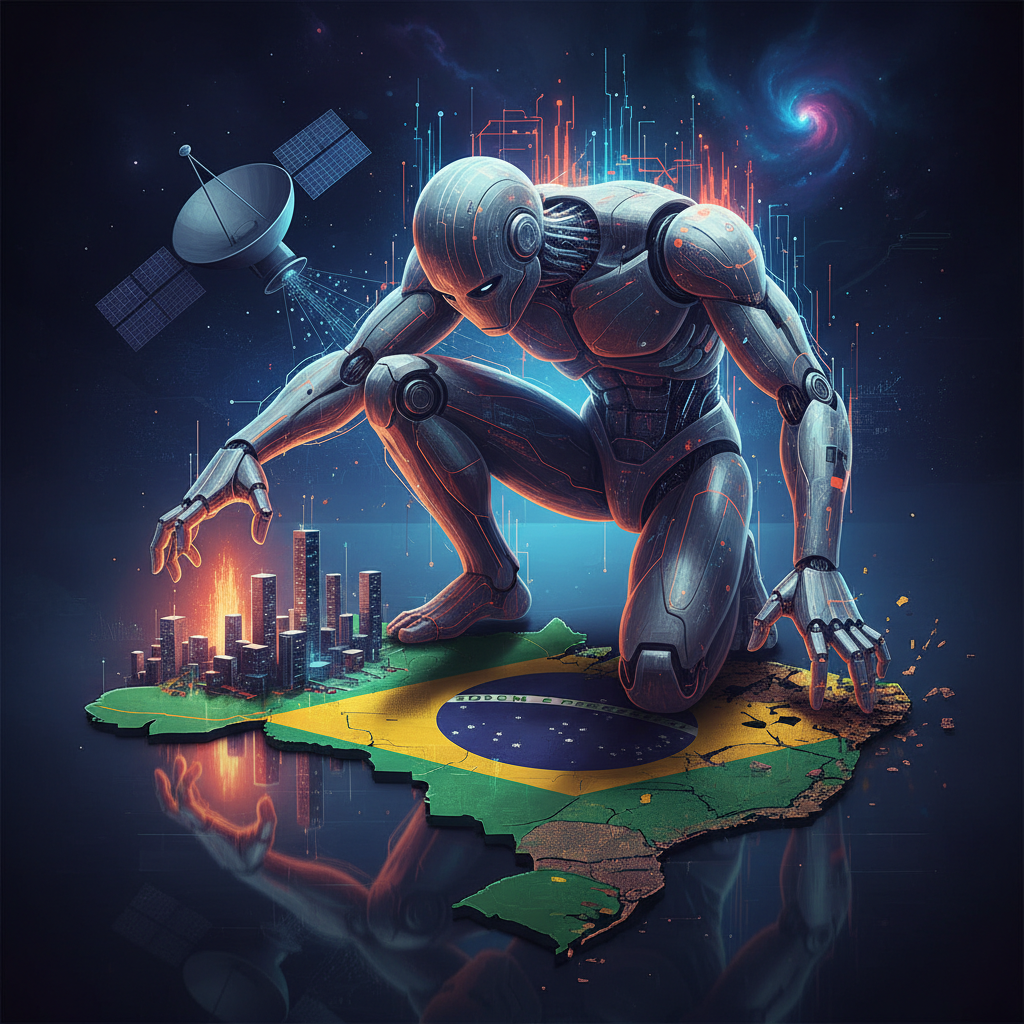
The news hit my inbox like a tropical storm, a familiar pattern in the frenetic world of artificial intelligence: Poolside AI, a company few had heard of a year ago, just landed a colossal $500 million investment. Their mission? To create coding-specific foundation models, essentially AI that can write, debug, and optimize software with unprecedented autonomy. On the surface, it sounds like a developer's dream, a digital assistant that handles the grunt work, freeing up human minds for innovation. But here in Brazil, where our developer community is massive and talented, a different kind of question emerges: what happens when the tools become the architects themselves?
Let me explain the architecture of this potential disruption. Imagine a future where a significant portion of software development, from initial concept to deployment, is handled by an AI. This isn't just about Copilot suggesting a line of code; this is about an AI agent understanding a high-level request, breaking it down into subtasks, writing the necessary code across multiple languages and frameworks, testing it, and even deploying it to the cloud. Poolside AI's ambition is to build the foundational models that make this possible, trained on an unimaginable corpus of public and private codebases, documentation, and development practices. The code tells the real story, and soon, much of that story might be written by machines.
The Risk Scenario: A Monoculture of Code and Digital Dependency
My primary concern, and one echoed by many of my colleagues in Latin America, revolves around the potential for a 'monoculture of code.' If a single or a few dominant AI models become the de facto standard for generating software, what happens to diversity, innovation, and local adaptability? Think of it like our agricultural history: relying too heavily on a single crop can lead to widespread vulnerability. If these powerful AI models are primarily trained on data reflecting the practices and priorities of Silicon Valley, will the software they produce truly serve the unique needs and cultural contexts of places like Brazil, or even the diverse regulations across the European Union?
"The risk isn't just about job displacement, though that's a valid concern for many," states Dr. Sofia Mendes, a leading AI ethicist at the Federal University of Minas Gerais. "It's about the erosion of local expertise and the potential for embedded biases. If the AI learns from predominantly English language codebases and Western development paradigms, the solutions it generates might not be optimal, or even appropriate, for our specific challenges, from public health systems to financial inclusion platforms tailored for the favelas." Her point is critical; our digital future should not be a one-size-fits-all import.
Technical Explanation: From Code Completion to Autonomous Agents
To understand the depth of this risk, we need to differentiate between current AI coding assistants and what Poolside AI is aiming for. Today's tools, like GitHub Copilot or Google's Gemini Code Assistant, are essentially sophisticated autocomplete functions. They predict and suggest code snippets based on context, significantly boosting developer productivity. They are powerful, yes, but they are still tools wielded by human hands. The Verge has covered many of these recent advancements.
Poolside AI, however, is pushing towards something more akin to autonomous AI agents. These agents wouldn't just suggest; they would act. They would interpret complex natural language prompts, generate entire software architectures, write modules, integrate APIs, and perform testing, all with minimal human oversight. This requires foundation models far more sophisticated than current large language models, specifically optimized for the structured, logical, and often unforgiving domain of code. They need to understand not just syntax, but semantics, intent, and the intricate dependencies within complex systems. This is a leap from a very smart parrot to a nascent digital engineer.
Expert Debate: Efficiency Versus Control
The debate among experts is fierce, mirroring the classic tension between efficiency and control. On one side, proponents argue that these models will unlock unprecedented productivity, allowing smaller teams to build more, faster. "This is about democratizing development," claims Ricardo Silva, CEO of a São Paulo-based fintech startup. "Imagine a small startup in the Northeast of Brazil being able to build enterprise-grade software with a fraction of the traditional engineering cost. This could level the playing field, not flatten it." He believes that with proper human oversight, these tools will empower, not replace.
However, others are more cautious. Professor Ana Paula Costa, a computer science lecturer at the University of Brasília, raises concerns about auditability and intellectual property. "Who owns the code generated by an AI trained on vast public and private datasets? What if the AI inadvertently introduces vulnerabilities or copies proprietary patterns? The legal and ethical frameworks simply haven't caught up," she warns. This is not a trivial matter; the provenance of code is fundamental to its security and commercial viability. The implications for open source are also profound. If AI models ingest and reproduce open source code, how do we ensure proper attribution and license compliance?
Real-World Implications for Brazil
For Brazil, the implications are multifaceted. Our vibrant tech scene, from São Paulo's bustling startups to the burgeoning innovation hubs in Recife, relies heavily on a skilled human workforce. While some tasks might be automated, the demand for high-level architects, AI trainers, and specialized engineers who can guide these AI systems will likely skyrocket. The challenge is ensuring our education system adapts quickly enough to produce this new generation of talent.
Furthermore, there's the question of digital sovereignty. If critical infrastructure, from banking systems to government services, becomes reliant on code generated by foreign-owned, black-box AI models, it introduces a new layer of geopolitical risk. We've seen this play out with hardware dependency; software dependency could be even more insidious. "Brazil needs to invest heavily in its own AI research and development, particularly in areas like explainable AI and robust governance frameworks," argues Dr. Mendes. "We cannot afford to be mere consumers of this technology. We must be co-creators, shaping it to our values and needs." This sentiment resonates deeply within our tech community, which has long championed open source and local innovation.
What Should Be Done
So, what is the path forward? Alarmism serves no one, but serious consideration is paramount. First, Brazil, and indeed all nations in the global South, must advocate for transparency in AI development. We need to understand the training data, the architectural choices, and the ethical guardrails built into these coding-specific foundation models. MIT Technology Review often highlights the need for greater transparency in AI.
Second, we must prioritize technical education and retraining. Our universities and technical schools need to adapt their curricula to prepare developers not just for writing code, but for orchestrating and validating AI-generated code. This includes a strong emphasis on AI ethics, cybersecurity, and critical thinking. We need people who can discern when the AI is brilliant, and when it's simply confidently wrong. Brazil's developer community is massive and talented, but we need to equip them for this new frontier.
Finally, we should explore developing our own localized, open source coding AI models, perhaps through collaborative efforts across Latin America. This would ensure that we have alternatives, that our unique cultural and linguistic nuances are respected, and that we maintain a degree of control over our digital destiny. The half-billion dollars Poolside AI just raised is a testament to the power of this technology. Now, it's up to us to ensure that power is wielded responsibly, and for the benefit of all, not just a select few. The future of code, and our digital independence, depends on it.