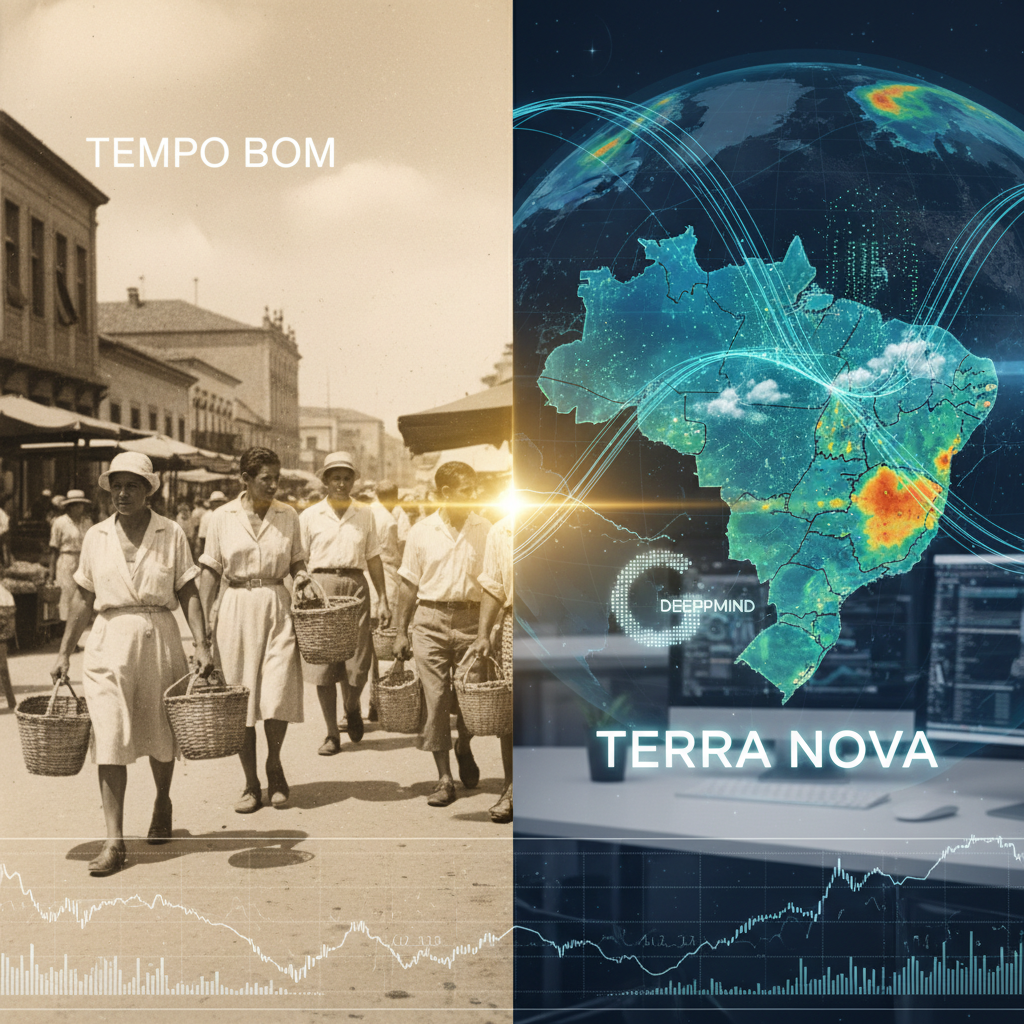

Let's be honest, my friends. We are living through a moment that will define the next fifty years, maybe even a century. The air in São Paulo, thick with ambition and the scent of opportunity, also carries a faint whisper of unease. It's the sound of the future arriving, but for whom, and at what cost? We talk about AI, about its transformative power, and yes, Brazil is the sleeping giant of AI and it's waking up. But what kind of world are we building when the very tools meant to uplift humanity seem to be concentrating wealth at an alarming rate, creating what I call a digital apartheid?
This isn't just about a few Silicon Valley billionaires buying bigger yachts. This is a systemic issue, deeply embedded in the technical architecture of modern AI. It's about how these systems are designed, deployed, and, crucially, owned. We need to go beyond the headlines and peer into the algorithms themselves, understanding the mechanics of this growing disparity.
The Technical Challenge: Centralized Power, Decentralized Pain
The core problem we face is the immense capital expenditure and specialized knowledge required to build and deploy cutting-edge AI. Training a large language model, for instance, isn't something you do with a laptop and a dream. It requires thousands of NVIDIA H100 GPUs, massive data centers, and an army of highly skilled engineers. This creates an insurmountable barrier to entry for smaller players, for startups in emerging markets, and certainly for the average worker.
Consider the scale. OpenAI's GPT models, Google's Gemini, Anthropic's Claude, these are not just software products; they are national infrastructure projects in terms of their resource consumption. The technical challenge is not just making AI smarter, but making its benefits accessible and its development distributed. We are solving for intelligence, but inadvertently creating a new form of economic centralization.
Architecture Overview: The Monolithic AI Stack
At the heart of this wealth concentration is what I call the 'Monolithic AI Stack.' It's a vertically integrated system, controlled by a few dominant players, encompassing several layers:
- Hardware Foundation: This is the bedrock, primarily dominated by NVIDIA's GPUs. Their Cuda platform and specialized tensor cores are the de facto standard for deep learning. Without access to these, large-scale AI training is practically impossible. The scarcity and cost of these chips mean only well-capitalized entities can compete.
- Data Infrastructure: Petabytes, even exabytes, of curated data are essential. This includes vast text corpora, image datasets, and multimodal information. Companies like Google, Meta, and Microsoft have unparalleled access to user-generated data, which acts as a proprietary moat. Data ingestion pipelines, storage solutions (think cloud services like AWS S3, Google Cloud Storage), and data governance frameworks are complex and expensive.
- Model Architecture and Training: This involves designing and training foundation models, often transformer-based architectures with billions or trillions of parameters. The compute required for pre-training these models is astronomical. For example, training GPT-3 reportedly cost tens of millions of dollars, and subsequent models are far more expensive. This phase is where the core intellectual property resides, often protected by patents and trade secrets.
- Deployment and Inference: Once trained, these models are deployed on cloud infrastructure for inference, serving millions or billions of requests. This requires sophisticated MLOps pipelines, efficient serving frameworks (e.g., NVIDIA Triton Inference Server, TensorFlow Serving), and robust scaling capabilities. The cost per inference, though small, accumulates rapidly at scale, creating another revenue stream for the giants.
- Application Layer: This is where the models are integrated into user-facing products like chatbots, content generators, or enterprise tools. While this layer can be more open, its dependence on the underlying proprietary or semi-proprietary models means the value often flows back to the foundation model providers.
This architecture, while incredibly powerful, inherently favors those with deep pockets and existing infrastructure. It's a closed loop, reinforcing the power of the few.
Key Algorithms and Approaches: The Transformer's Double Edge
The transformer architecture, particularly its self-attention mechanism, is the algorithmic engine behind most large language models. Its ability to process long-range dependencies in sequential data revolutionized natural language processing. However, its computational demands are a significant factor in the wealth gap.
Consider the self-attention calculation: for a sequence of length L and hidden dimension D, it involves O(L^2 * D) operations. While optimizations exist, the quadratic complexity in L means that scaling up context windows, crucial for sophisticated reasoning, directly translates to exponentially higher compute costs. This is why models like Google's Gemini 1.5 Pro, with its million-token context window, require immense hardware resources.*
Conceptual Example: Attention Mechanism
# Simplified Self-Attention (conceptual)
def self_attention(query, key, value, mask=None):
 # Calculate attention scores
 scores = matmul(query, transpose(key)) / sqrt(dimension_key)

# Apply mask if provided (e.g., for causal masking in LLMs)
 if mask is not None:
 scores = scores.masked_fill(mask == 0, -1e9)

# Apply softmax to get attention weights
 weights = softmax(scores, axis=-1)

# Multiply weights by value to get context vector
 output = matmul(weights, value)
 return output
# Simplified Self-Attention (conceptual)
def self_attention(query, key, value, mask=None):
 # Calculate attention scores
 scores = matmul(query, transpose(key)) / sqrt(dimension_key)

# Apply mask if provided (e.g., for causal masking in LLMs)
 if mask is not None:
 scores = scores.masked_fill(mask == 0, -1e9)

# Apply softmax to get attention weights
 weights = softmax(scores, axis=-1)

# Multiply weights by value to get context vector
 output = matmul(weights, value)
 return output
The optimization of these operations, often through custom hardware kernels and specialized software like cuDNN, is a highly guarded secret and a competitive advantage for the dominant players. This technical sophistication, while impressive, creates a knowledge and resource chasm.
Implementation Considerations: The Cost of Doing Business
For a Brazilian startup, or even a mid-sized company, trying to compete in this space, the implementation considerations are daunting. Access to sufficient GPU clusters is a primary hurdle. Cloud providers offer GPU instances, but at a premium. Training a custom model from scratch might be financially impossible, pushing companies towards fine-tuning existing foundation models.
Data acquisition and annotation are also massive undertakings. While Brazil has a rich linguistic and cultural dataset, collecting, cleaning, and labeling it at the scale required for foundation models is a multi-million dollar effort. This is where initiatives like open-source Portuguese language models, perhaps backed by public universities or a consortium of Brazilian tech companies, become crucial. We need to pool resources, embrace federated learning, and build our own data commons to counter the centralization.
Benchmarks and Comparisons: The Performance-Cost Trade-off
When we compare open-source models like Meta's Llama 3 or Mistral's models with proprietary ones like GPT-4, we often see a performance gap, particularly in complex reasoning tasks. This gap is directly correlated with the scale of training data, model parameters, and compute. The proprietary models benefit from larger, more diverse, and often more carefully curated datasets, along with more extensive training runs.
However, the cost of running inference on these proprietary models can be substantial, especially for high-volume applications. This creates a trade-off: higher performance at a higher cost, or slightly lower performance with greater control and potentially lower long-term costs using open-source alternatives. For many Brazilian businesses, the latter is often the only viable path, even if it means compromising on peak performance.
Code-Level Insights: Democratizing Access with Open Source
The antidote to this centralization, at least partially, lies in open-source frameworks and models. Hugging Face's Transformers library, PyTorch, and TensorFlow are democratizing access to model development. Libraries like bitsandbytes enable quantization, allowing larger models to run on less powerful hardware. Techniques like Low-Rank Adaptation (LoRA) enable efficient fine-tuning of massive models with minimal compute.
# Conceptual LoRA fine-tuning
from transformers import AutoModelForCausalLM, AutoTokenizer
from peft import LoraConfig, get_peft_model

model_name = "mistralai/Mistral-7B-v0.1"
tokenizer = AutoTokenizer.from_pretrained(model_name)
model = AutoModelForCausalLM.from_pretrained(model_name)

# Configure LoRA
lora_config = LoraConfig(
 r=8, # Rank of the update matrices
 lora_alpha=16, # Scaling factor for LoRA weights
 target_modules=["q_proj", "v_proj"], # Modules to apply LoRA to
 lora_dropout=0.05,
 bias="none",
 task_type="CAUSAL_LM"
)

# Get Peft model (parameter efficient fine-tuning)
peft_model = get_peft_model(model, lora_config)
peft_model.print_trainable_parameters()

# Now, fine-tune peft_model with your specific dataset
# Conceptual LoRA fine-tuning
from transformers import AutoModelForCausalLM, AutoTokenizer
from peft import LoraConfig, get_peft_model

model_name = "mistralai/Mistral-7B-v0.1"
tokenizer = AutoTokenizer.from_pretrained(model_name)
model = AutoModelForCausalLM.from_pretrained(model_name)

# Configure LoRA
lora_config = LoraConfig(
 r=8, # Rank of the update matrices
 lora_alpha=16, # Scaling factor for LoRA weights
 target_modules=["q_proj", "v_proj"], # Modules to apply LoRA to
 lora_dropout=0.05,
 bias="none",
 task_type="CAUSAL_LM"
)

# Get Peft model (parameter efficient fine-tuning)
peft_model = get_peft_model(model, lora_config)
peft_model.print_trainable_parameters()

# Now, fine-tune peft_model with your specific dataset
These tools allow developers with more modest resources to leverage the power of foundation models without having to build them from scratch. This is crucial for fostering innovation in places like Brazil, where capital might be scarcer but talent is abundant. São Paulo's tech scene rivals any in the world, and our developers are hungry for these tools.
Real-World Use Cases: Where the Gap Manifests
- Fintech Disruption vs. Concentration: Brazilian fintechs like Nubank use AI extensively for fraud detection, credit scoring, and personalized banking. This improves services for millions. However, the underlying AI infrastructure often relies on cloud providers and proprietary models, meaning the core value creation still flows upwards. The smaller, truly disruptive fintechs struggle to build their own AI from the ground up, often becoming customers of the giants.
- Agritech AI and Land Ownership: In Brazil's vast agricultural sector, AI is optimizing crop yields, predicting weather patterns, and managing livestock. Companies like Solinftec use computer vision and machine learning on edge devices. Yet, the benefits often accrue disproportionately to large landowners who can afford these solutions, while small family farmers, who could benefit most from efficiency gains, are left behind due to the upfront investment and technical complexity.
- Healthcare Diagnostics: AI-powered medical imaging analysis can detect diseases earlier, a boon for public health. However, the development of these highly specialized models requires massive, annotated medical datasets, often held by large research institutions or private hospitals. Deploying these solutions in Brazil's public health system, SUS, faces challenges not just of cost, but also of data privacy and integration with legacy systems. The technical expertise for maintenance and adaptation is also concentrated.
- Content Creation and Gig Economy: AI tools like Midjourney and ChatGPT are empowering individual creators, but they also threaten traditional creative roles. Platforms that leverage these AIs often pay creators minimal wages for AI-assisted work, while the platform owners reap the profits from the underlying AI infrastructure and user base. This exacerbates the gig economy's precariousness, turning human creativity into mere prompt engineering.
Gotchas and Pitfalls: The Illusion of Democratization
One major pitfall is the illusion that open-source models fully democratize AI. While they lower the entry barrier, the most powerful models still require significant compute to run effectively, and even more to fine-tune meaningfully. The 'free' model often comes with hidden costs in infrastructure, specialized talent, and ongoing maintenance. Another trap is the reliance on models trained predominantly on English data, leading to performance degradation and cultural biases when applied to Portuguese or other non-English contexts. This is why investing in Portuguese language AI is not just a nicety, it's an economic imperative.
Bias in data and algorithms is another critical issue. If the training data reflects existing societal inequalities, the AI will perpetuate and even amplify them. This is particularly dangerous when AI is used in hiring, lending, or law enforcement, where historical biases can be coded into the future.
Resources for Going Deeper: Arm Yourself with Knowledge
To truly understand and navigate this complex landscape, you need to dive deep. I recommend exploring foundational papers on transformers and attention mechanisms. The Hugging Face documentation is an invaluable resource for practical implementation. For broader context on the societal implications, I often turn to sources like MIT Technology Review and Wired. For the latest in research, arXiv is your friend.
We are at a crossroads, my friends. The technical prowess of AI is undeniable, but its economic consequences are becoming stark. We, as developers, data scientists, and innovators in Brazil, have a responsibility. We cannot just be consumers of technology; we must be creators, shapers, and ethical stewards. This is Brazil's decade, not just for economic growth, but for showing the world how to build an AI future that benefits everyone, not just the few. The challenge is immense, but so is our spirit. Let's get to work. The future, a more equitable one, depends on it.