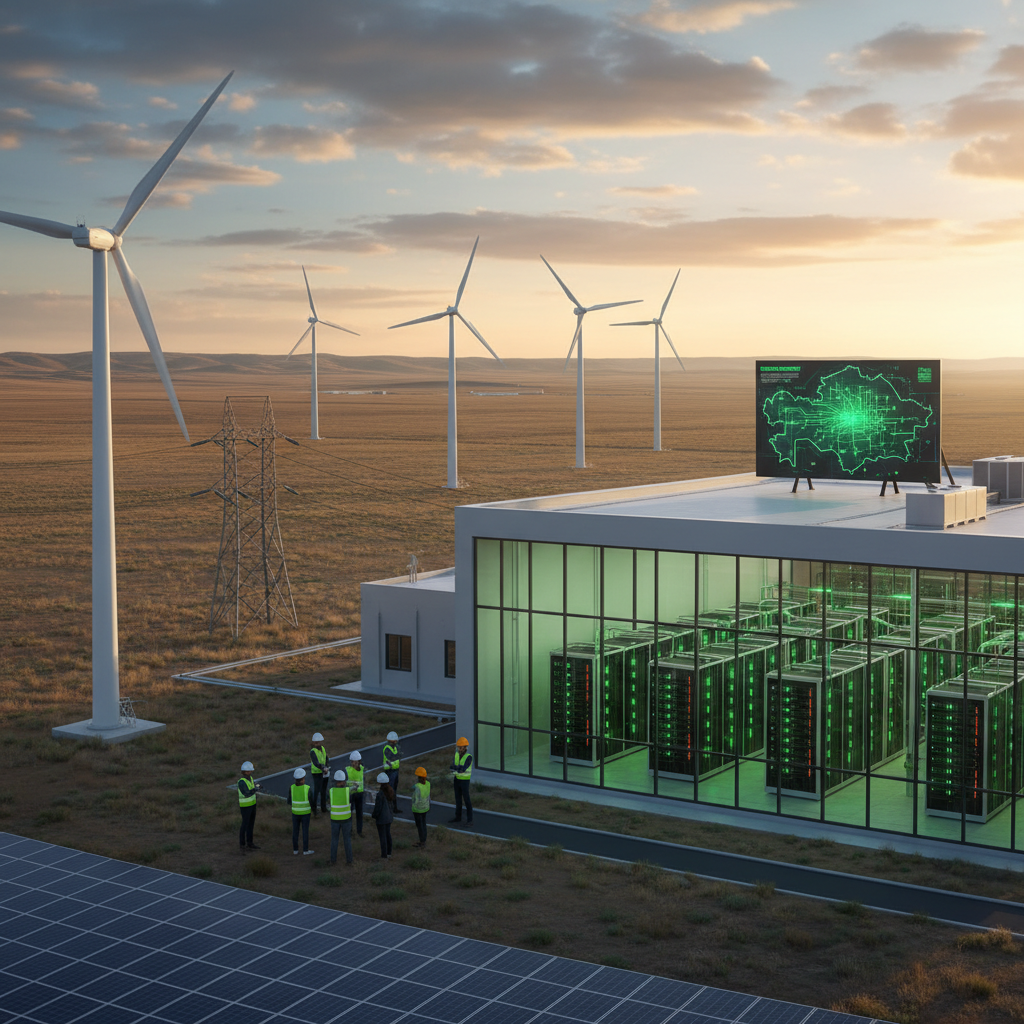

The vast, windswept steppes of Kazakhstan, a land rich in both tradition and natural resources, are increasingly becoming a battleground for the future of artificial intelligence. Global narratives often paint AI as a panacea for climate change, a powerful tool capable of optimizing energy grids, predicting extreme weather, and revolutionizing sustainable agriculture. Yet, beneath this optimistic veneer, a more complex and often contradictory reality emerges, particularly in energy-intensive sectors where the very tools meant to save the planet demand an ever-increasing share of its resources.
My investigation reveals that while companies like NVIDIA, Google, and Microsoft are pouring billions into AI solutions for climate challenges, the physical footprint of this technological revolution is often overlooked, especially in regions like Central Asia. Kazakhstan, with its abundant but often carbon-intensive energy supply, finds itself at a critical juncture. Can AI truly be a net positive for our planet when its own operational demands are so significant?
Consider the recent pronouncements from Jensen Huang, NVIDIA's CEO, who frequently highlights the company's role in accelerating scientific discovery, including climate modeling. "Our GPUs are not just for gaming or data centers," Huang stated in a recent virtual address to investors, "they are the engines driving the world's most complex climate simulations, enabling breakthroughs that were once unimaginable." This sentiment echoes across the industry, with Google DeepMind developing AI to improve energy efficiency in data centers and Meta AI exploring new materials for carbon capture.
However, the money trail leads to a less glamorous truth. The computational power required for these sophisticated AI models is staggering. Training a single large language model, for instance, can consume as much energy as several homes over a year, emitting hundreds of tons of carbon dioxide. As Kazakhstan positions itself as a growing hub for data centers, driven by its strategic location and relatively low energy costs, this energy consumption becomes a critical national concern. The promise of AI optimizing our energy usage must be weighed against the colossal energy required to build and run the AI itself.
"We are seeing a significant increase in demand for high-performance computing infrastructure, much of it driven by AI development," explains Dr. Aidana Zhakipova, Director of the Institute of Digital Economy at Nazarbayev University in Nur-Sultan. "While the applications of this AI promise environmental benefits, the immediate challenge is ensuring that our energy grid, still heavily reliant on coal, can support this growth without exacerbating our carbon footprint. It is a delicate balance, one that requires careful planning and investment in renewables." Dr. Zhakipova's perspective underscores a fundamental tension: the aspiration for a green future powered by AI, versus the brown energy realities of today.
Kazakhstan's digital ambitions hide a complex reality. The government has expressed strong interest in leveraging AI for resource management, particularly in water-scarce regions and for optimizing agricultural yields. The Ministry of Digital Development, Innovations and Aerospace Industry recently announced a pilot project using satellite imagery and AI algorithms, developed in partnership with a consortium including local tech firms and a European AI startup, to monitor glacier melt in the Tian Shan mountains. The goal is to predict water availability for irrigation with greater accuracy, a vital necessity in a country where agriculture is a cornerstone of the economy.
Yet, the infrastructure underpinning such projects, from the data centers processing the satellite images to the high-speed networks transmitting the data, demands constant power. My investigation reveals that many of these burgeoning data centers, while modern in design, are still drawing power from a grid where over 70% of electricity is generated from fossil fuels, predominantly coal. This creates a paradox: AI designed to mitigate climate change is, in its current incarnation, often indirectly contributing to it.
"The enthusiasm for AI's potential is palpable, but we must not be naive," cautions Mr. Timur Bekov, an independent energy policy analyst based in Almaty. "The global push for AI adoption, spearheaded by companies like NVIDIA with their powerful H100 GPUs, means a proportional increase in energy consumption. If Kazakhstan is to truly benefit from AI in its climate fight, we must simultaneously accelerate our transition to renewable energy sources. Otherwise, we are simply shifting the problem, not solving it." Bekov's words resonate with a growing chorus of environmental advocates who argue that without a fundamental shift in energy infrastructure, AI's climate benefits will remain largely theoretical.
Moreover, the geopolitical landscape adds another layer of complexity. Russian tech influence, particularly in cybersecurity and data infrastructure, remains significant across Central Asia. While not directly linked to climate AI, the underlying digital architecture often relies on established regional partnerships. Ensuring that AI development for climate purposes aligns with international best practices for energy efficiency and data ethics, rather than being dictated by less transparent regional standards, is crucial. This is not merely a technical challenge, but a matter of digital sovereignty and responsible governance.
For instance, the development of smart grids, a key AI application for energy efficiency, requires robust and secure digital infrastructure. Companies like Siemens and Schneider Electric are offering AI-powered grid solutions globally, but their adoption in Kazakhstan would necessitate significant investment and a clear regulatory framework to ensure both efficiency and resilience against cyber threats. The promise of AI in this sector is immense: reducing transmission losses, integrating intermittent renewable sources more effectively, and optimizing demand response. However, the initial investment and the energy required to deploy and maintain these systems are not trivial.
My investigation reveals that while climate modeling and agricultural optimization are promising applications, the immediate, tangible benefits of AI in Kazakhstan are often overshadowed by the sheer energy cost of its operation. The narrative of AI as a universal climate savior, propagated by the likes of OpenAI and Google, needs careful scrutiny. It is not enough to simply develop powerful algorithms; we must also develop equally powerful, and truly green, energy solutions to run them.
As the world looks to AI to solve its most pressing environmental crises, the experience of Kazakhstan offers a sober reminder. The digital future, even a green one, is built on physical infrastructure and powered by real energy. The question is not whether AI can help save the planet, but whether we are prepared to pay the true environmental cost of its development and deployment. Without a concerted effort to decarbonize the energy sources powering AI, the promise of a greener future may remain an elusive mirage on the horizon, much like a distant oasis in the vast Kazakh steppe. The conversation must shift from mere potential to tangible, sustainable implementation, ensuring that our pursuit of technological advancement does not inadvertently deepen our environmental debt. For further insights into the broader implications of AI's energy demands, one might consult recent analyses on AI and sustainability. The path forward demands transparency, accountability, and a clear understanding of the energy equation. For more on how AI is shaping global tech, see TechCrunch's AI section. The future of our planet hangs in the balance, and the choices made today regarding AI's energy footprint will determine the landscape of tomorrow. For a deeper dive into AI's ethical considerations, Wired offers extensive coverage.
Ultimately, the journey to a sustainable future with AI is not a sprint, but a marathon across a challenging terrain. It requires more than just innovation; it demands a profound reevaluation of our energy policies and a commitment to genuine environmental stewardship, both locally and globally. Kazakhstan, with its unique blend of traditional resource reliance and modern digital aspirations, stands as a microcosm of this global challenge.