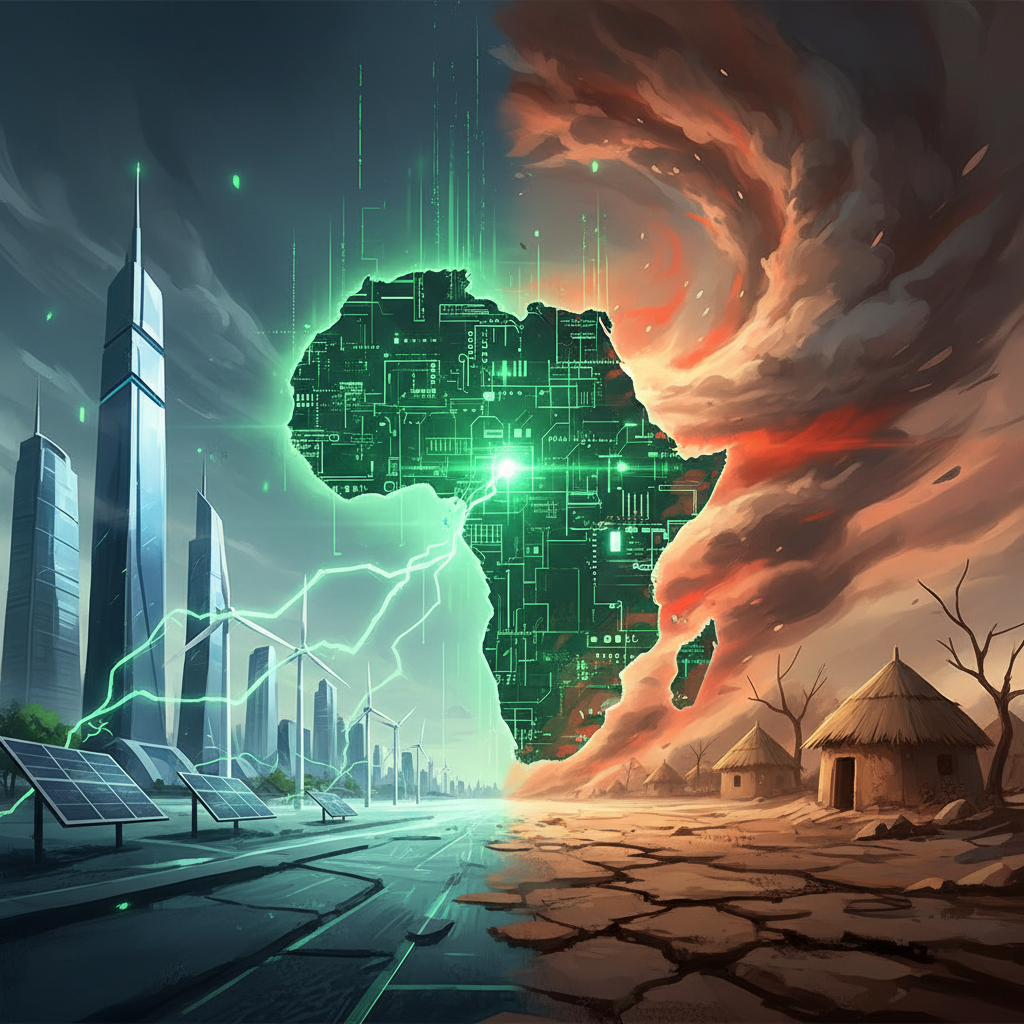

The year is 2031. The air in Lagos, though still thick with the exhaust of millions of vehicles, is noticeably cleaner. The once-annual devastating floods that swallowed entire communities in Ajegunle and Lekki are now predictable, their impact mitigated by sophisticated, AI-driven early warning systems. Farmers in Kano, once at the mercy of erratic rainfall, now use AI models running on robust, locally-managed data centers to optimize planting schedules, predict droughts, and even detect crop diseases before they decimate yields. Across the continent, smart grids, powered by a mosaic of solar, wind, and hydro, dynamically adjust energy distribution, minimizing waste and ensuring equitable access, even in remote villages. This isn't a utopian fantasy, but a future many are eagerly predicting for Africa, largely driven by the promise of artificial intelligence in combating climate change.
But let's talk about what nobody wants to discuss. Who owns this future? Who controls the algorithms that dictate our food security, our energy supply, our very survival? While the headlines today sing praises of NVIDIA's powerful GPUs enabling complex climate models and Google DeepMind's advancements in weather prediction, I see a familiar pattern emerging. The tools are being developed in Silicon Valley, the data often extracted from our lands, and the control remains firmly in the hands of those who already hold economic power. Is this truly salvation, or just a more sophisticated form of digital dependence?
How We Get There From Today: A Precarious Path
The journey to this 2031 scenario began in earnest around 2024-2026. Major players like NVIDIA, with their insatiable hunger for AI compute, started heavily investing in energy-efficient data centers, not just in their home territories but strategically across emerging markets. Their argument was compelling: AI for climate modeling, for optimizing renewable energy grids, for precision agriculture, all require immense computational power. They promised localized infrastructure, job creation, and knowledge transfer. We saw initiatives like the Africa AI Climate Consortium, supposedly a collaborative effort, but often, the bulk of the funding and intellectual property flowed one way.
Today, in April 2026, we are seeing the foundational layers being laid. Governments across Africa, desperate for solutions to escalating climate crises, are signing agreements, often without fully understanding the long-term implications of data ownership and algorithmic sovereignty. We are seeing a proliferation of pilot projects: AI-powered drones monitoring deforestation in the Congo Basin, smart irrigation systems in the Sahel, and predictive analytics for disaster response being tested in coastal cities. These are tangible, often life-saving interventions. The immediate benefits are undeniable, making it incredibly difficult to ask the uncomfortable questions.
Key Milestones: The Unseen Strings
By 2027, we will likely see the first major pan-African AI climate platform emerge. It will be heralded as a triumph of collaboration, a testament to global partnership. This platform, likely backed by a consortium involving a major tech giant and a development bank, will integrate satellite imagery, ground sensor data, and meteorological information to provide actionable insights for climate adaptation and mitigation. Think of it as a continental nervous system for climate resilience. The data will be vast, unprecedented, and incredibly valuable. This is where the rubber meets the road for data ownership.
Around 2029, expect to see the widespread deployment of AI-optimized microgrids. These will be revolutionary for energy access, especially in rural areas. Imagine communities in Niger Delta, long plagued by unreliable power, suddenly having consistent, clean energy managed by intelligent systems that predict demand and optimize supply from local solar farms. The technology will be incredible. But who built the system? Who maintains it? Who holds the keys to its algorithms? If a major outage occurs, will we be dependent on a team of foreign experts to fix it, or will we have built our own local capacity?
By 2031, the scenario I painted earlier will be largely in place. The visible benefits will be immense: reduced climate-related deaths, improved agricultural yields, more stable energy. The narrative will be one of success, of AI saving Africa from the worst impacts of climate change. And on the surface, it will be true.
Who Wins and Who Loses: The Power Imbalance
Clearly, the immediate winners are the vulnerable communities directly benefiting from early warning systems, improved agriculture, and clean energy. The tech companies, like NVIDIA and Google, win by expanding their markets, collecting invaluable data, and cementing their position as indispensable partners in global climate action. They gain immense goodwill, new revenue streams, and a vast playground for their AI models.
But who loses? Unpopular opinion: Africa risks losing its data sovereignty. We risk becoming perpetual consumers of AI solutions, rather than co-creators and owners. When our agricultural data, our weather patterns, our energy consumption habits are all fed into proprietary algorithms owned by foreign entities, we are effectively ceding control over crucial aspects of our national security and economic future. What happens if these companies decide to prioritize their own markets, or if geopolitical tensions lead to restrictions on access to these vital AI services? We become dependent, and dependence is a dangerous game.
There's also the risk of algorithmic bias. If the AI models are trained predominantly on data from developed nations, will they truly understand the nuances of a farmer's field in rural Kenya, or the complex social dynamics of disaster response in a Nigerian mega-city? The potential for misdiagnosis, misallocation of resources, and unintended harm is significant. As Wired often highlights, the ethical implications of AI are profound, and they are magnified when applied across diverse cultural and environmental contexts.
What Readers Should Do Now: Claim Your Future
This isn't a call to reject AI. That would be foolish and self-defeating. This is a call to awaken, to demand better terms, and to build our own capacity. Here's what we must do:
-
Demand Data Sovereignty: African governments must negotiate fiercely for ownership and control of the data generated on our soil. We need robust data governance frameworks that protect our interests and prevent the wholesale extraction of our digital resources. We must learn from past resource extraction models and not repeat the same mistakes in the digital realm. Reuters regularly reports on these types of negotiations, and we need to be at the forefront.
-
Invest in Local Talent and Infrastructure: Instead of merely consuming solutions, we must invest massively in training our own AI researchers, engineers, and data scientists. Institutions like the African Institute for Mathematical Sciences (aims) and local universities need significant funding to build indigenous AI capabilities. We need to build our own data centers, our own cloud infrastructure, and develop our own algorithms tailored to our specific challenges.
-
Foster Regional Collaboration: African nations must collaborate more closely, sharing data, best practices, and resources to build a collective AI climate resilience strategy. A united front will have far more bargaining power with global tech giants than individual nations acting alone. The East African Community, for example, could be a powerful bloc in this regard.
-
Prioritize Ethical AI: We need to ensure that the AI systems deployed are fair, transparent, and accountable. This means actively involving local communities in the design and deployment of these systems, ensuring they reflect our values and address our specific needs, not just generic global solutions. As Professor Moustapha Cissé, head of Google AI's research center in Accra, Ghana, has often stated, "AI for Africa must be built by Africans, for Africans, reflecting our diverse realities and aspirations."
Everyone's celebrating, but I have questions. The promise of AI in combating climate change is immense, a beacon of hope in an increasingly uncertain world. But hope, without vigilance, can quickly turn into another form of subjugation. We have the opportunity to leapfrog past old development models, but only if we are intentional about owning our technological future, not just leasing it. The time for passive acceptance is over. It is time for Africa to claim its rightful place at the table, not just as a beneficiary, but as a leader in shaping the future of AI for climate action. Our survival, and our sovereignty, depend on it.