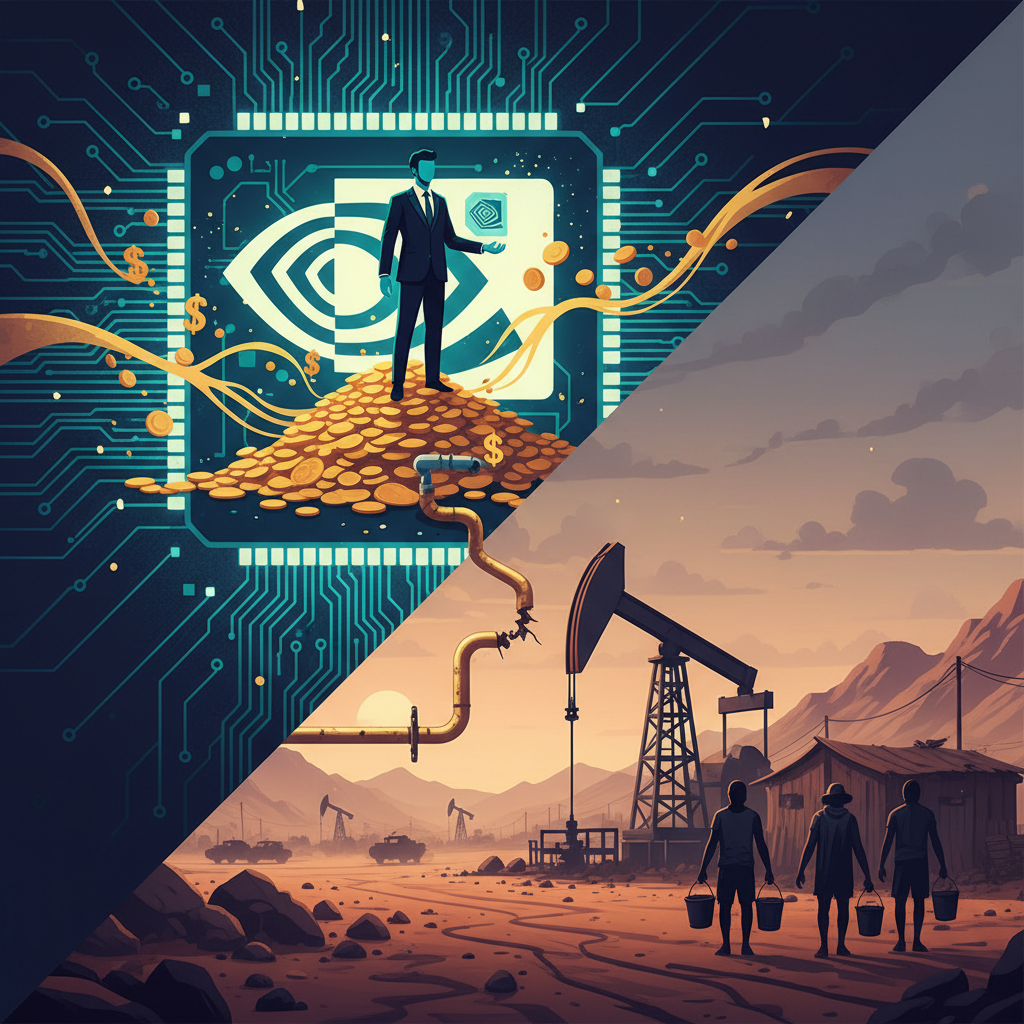
Let me tell you something, from my vantage point here in Caracas, the endless chatter about AI's transformative power often sounds like a cruel joke. While the tech titans in California, the likes of Jensen Huang at NVIDIA or Sam Altman at OpenAI, count their billions and dream of superintelligence, the rest of us are left wondering if this so-called revolution is just another mechanism to concentrate wealth and power in fewer hands. Unpopular opinion from Caracas: the AI wealth gap is not some abstract economic theory, it is a tangible, growing chasm that threatens to destabilize societies far beyond the gilded gates of Silicon Valley.
We are told AI will lift all boats, that it will create new jobs, and revolutionize industries. But what I see, what many of us see, is a relentless drive towards automation that benefits capital owners and a tiny elite of highly specialized engineers, while leaving a trail of precarious work and economic anxiety for the vast majority. Look at NVIDIA, for instance. Their market capitalization has soared past the trillion-dollar mark, fueled by the insatiable demand for their GPUs. This is not just a company, it is the picks and shovels supplier for the AI gold rush, and its investors are reaping unimaginable rewards. But where does that wealth go? Does it trickle down to the factory workers, the data labelers, the service industry employees whose jobs are now squarely in AI's crosshairs? No, it does not. It consolidates.
Consider the average Venezuelan, struggling with hyperinflation and a collapsing infrastructure. We are resourceful, yes, we have to be. Venezuela's tech diaspora is reshaping AI globally, with brilliant minds contributing to projects from Boston to Berlin. But back home, the promise of AI feels distant, almost insulting. When I hear about companies like Google or Microsoft pouring billions into AI research, it is hard not to think about the basic necessities that remain out of reach for so many. The crisis created something unexpected here, a resilience, a drive to innovate with limited resources, but that innovation often finds its home abroad, not here.
Critics will argue, and they always do, that this is the natural progression of technology. They will say that every industrial revolution has displaced workers, only to create new, better jobs. They will point to the burgeoning AI industry itself, citing the high salaries for machine learning engineers and data scientists. They will claim that AI will augment human capabilities, not replace them, and that education and retraining are the answers. They will tell us that the market will adjust, that the invisible hand will guide us to a more prosperous future.
But this argument, while comforting in its simplicity, ignores the fundamental shift happening. This is not just about a few factory jobs being automated away. This is about cognitive labor, the very essence of what many middle-class jobs entail, being increasingly performed by algorithms. Think about customer service, legal research, even parts of journalism. Sam Altman himself, CEO of OpenAI, has spoken about the potential for AI to displace many jobs. He stated in a 2023 interview with The Atlantic that, "The job market is going to change dramatically. We should be very clear about that." This is not some fringe prediction, this is coming from the people building the future. The pace of change is unprecedented, and the social safety nets, particularly in developing nations, are simply not equipped to handle such a rapid, widespread disruption.
Furthermore, the idea that everyone can simply retrain to become an AI engineer is naive, bordering on insulting. Access to quality education, particularly in specialized fields like AI, is a privilege, not a universal right. In countries like ours, where internet access is often unreliable and educational institutions are underfunded, the idea of a mass reskilling effort is a fantasy. The digital divide, far from shrinking, is becoming a canyon, separating those with access to the tools and knowledge of the AI age from those without. This is not just an economic issue, it is a matter of social justice.
The concentration of power is also deeply concerning. A handful of companies, primarily in the United States and China, control the vast majority of AI research, development, and deployment. These are the gatekeepers, deciding what gets built, how it is used, and who benefits. This is not a diverse, decentralized ecosystem. It is an oligopoly, rapidly consolidating its grip on the most powerful technology humanity has ever created. As Reuters has reported extensively, the race for AI dominance is intensifying, with billions flowing into a select few firms.
The real question we should be asking is not if AI will create wealth, but for whom and at what cost. Are we building a future where a small fraction of humanity lives in unprecedented abundance, while the rest struggle for scraps, their labor devalued and their prospects diminished? This is not progress, it is a return to a feudal system, albeit one powered by silicon and algorithms instead of land and serfs.
We need to demand more from our leaders, from the tech giants, and from ourselves. We need policies that ensure the benefits of AI are broadly shared, not hoarded. This means exploring universal basic income, investing massively in public education and infrastructure, and regulating these powerful AI monopolies. It means fostering local AI ecosystems, supporting startups, and empowering communities to build their own AI solutions that address their specific needs, rather than relying solely on the dictates of distant tech hubs. We need to look beyond the hype and confront the uncomfortable truth: if we do not act now, the AI gold rush will leave most of the world poorer, not richer. The future of work, and indeed, the future of equitable society, depends on it. For more on the societal implications of AI, you can find thoughtful discussions on Wired's AI section. The time for polite conversation is over; it is time for a serious reckoning. We cannot afford to let the promise of AI become another tool for inequality. We must demand a future where innovation serves all of humanity, not just the privileged few.