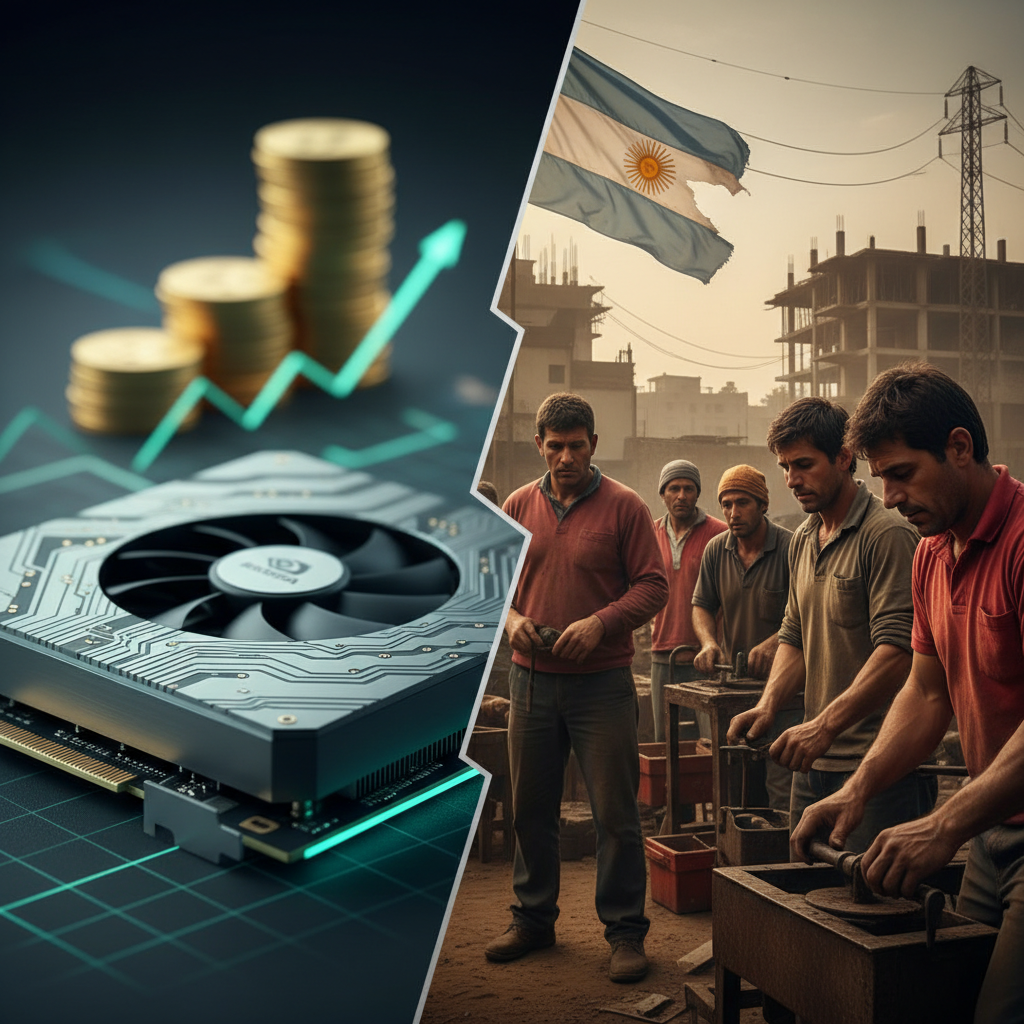

The global discourse surrounding Artificial Intelligence often paints a picture of boundless innovation and prosperity. Yet, from the bustling streets of Buenos Aires, a more nuanced, and perhaps more cynical, perspective emerges. While companies like NVIDIA announce quarterly revenues that dwarf the GDP of smaller nations, the tangible benefits for the average worker, particularly in emerging economies, remain elusive. The question is not merely if AI creates wealth, but for whom, and at what cost to the broader labor force.
Let's look at the evidence. NVIDIA, the undisputed leader in AI chip manufacturing, reported revenues exceeding $22 billion in its fourth fiscal quarter of 2024, a staggering increase of over 265% year over year. This financial surge, largely driven by demand for its H100 and A100 GPUs from hyperscalers and AI developers, has propelled its market capitalization into the trillions. CEO Jensen Huang, a figure often lauded as a visionary, presides over an empire built on the very infrastructure of the AI revolution. Meanwhile, in Argentina, where economic volatility is a constant companion, the conversation is less about generative AI's creative potential and more about its potential for job displacement and exacerbating existing inequalities.
Buenos Aires has questions Silicon Valley can't answer. When we discuss job creation through AI, we must differentiate between highly specialized, capital-intensive roles in research and development, predominantly located in established tech hubs, and the broader impact on sectors like customer service, manufacturing, and even creative industries. The narrative often suggests a seamless transition for displaced workers into new, higher-skilled roles. However, the reality of retraining and upskilling a significant portion of the workforce, particularly in economies with limited educational resources and infrastructure, is far more complex and costly than often acknowledged by tech evangelists.
Consider the agricultural sector, a cornerstone of Argentina's economy. While AI driven precision agriculture promises increased yields and efficiency, the initial investment in sensors, drones, and analytical software is substantial. For small and medium sized producers, already grappling with fluctuating commodity prices and high inflation, adopting such technologies is a distant dream. The benefits accrue first to large agribusinesses, further consolidating their market power and potentially displacing manual labor without offering viable alternatives. This is not innovation for all; it is innovation for those who can afford it.
“The rapid acceleration of AI development, particularly in large language models, presents a dual challenge for developing economies,” stated Dr. Alicia Bárcena Ibarra, Executive Secretary of the United Nations Economic Commission for Latin America and the Caribbean (eclac), in a recent address. “We must ensure that this technological leap does not widen the existing digital and economic divides, but rather serves as a tool for inclusive development. This requires proactive government policies and significant international cooperation.” Her remarks underscore the urgent need for a strategic approach that goes beyond simply adopting technology.
The Argentine perspective is more nuanced. We have witnessed firsthand how economic shifts can rapidly alter the employment landscape. The promise of AI, while alluring, must be tempered with a pragmatic assessment of its immediate and long-term effects on labor markets. Reports from organizations like the International Monetary Fund have indicated that a significant percentage of jobs globally are susceptible to automation. While these are often presented as