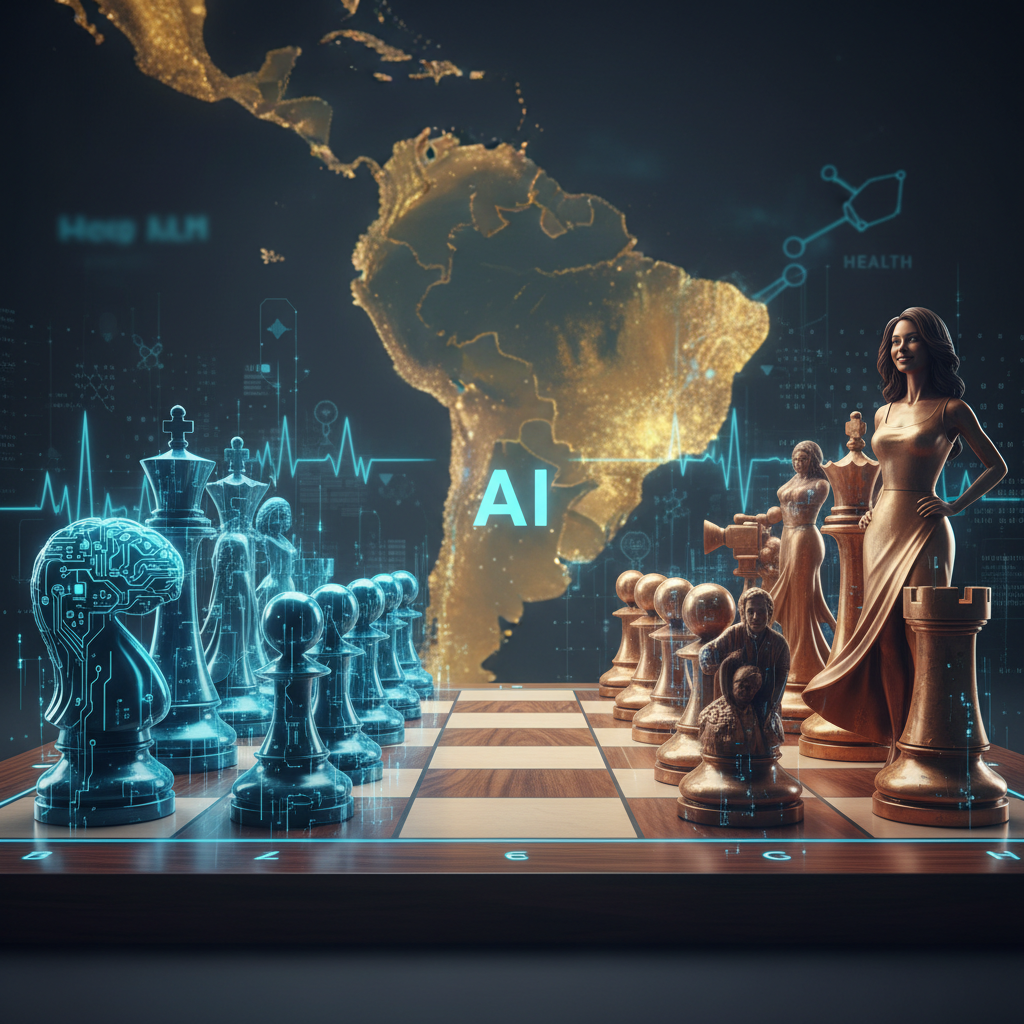

The investment trail leads to a curious intersection of Silicon Valley ambition and Brazilian cultural heritage. Netflix, the streaming behemoth, is not merely dabbling in artificial intelligence for content recommendations or production efficiencies. My investigation reveals a more audacious, and perhaps perilous, strategy: the systematic integration of generative AI into the very fabric of content creation, specifically targeting the lucrative Latin American market, with Brazil as its undeniable epicenter.
This strategic move, though not yet fully articulated in public statements, is evidenced by a surge in patent applications related to AI-driven script generation, character animation, and even voice synthesis for various languages, coupled with a quiet but significant increase in AI talent acquisition in regions outside of traditional tech hubs. While Hollywood grapples with the existential threat and opportunities presented by tools like OpenAI's Sora and Google's Imagen, Netflix appears to be positioning itself not just as a consumer of these technologies, but as a pioneer in their application to narrative storytelling, particularly in genres like the telenovela, which holds immense cultural sway from Rio Grande do Sul to Mexico City.
Context and Motivation: The Quest for Infinite Content
Netflix's motivation is clear: the insatiable demand for fresh content. The streaming wars have intensified, with competitors like Amazon Prime Video, Disney+, and HBO Max vying for subscriber attention. Traditional production cycles are slow, expensive, and subject to the vagaries of human creativity, labor disputes, and logistical challenges. Generative AI offers a tantalizing solution: the potential to produce high-quality, culturally tailored content at unprecedented speed and scale, theoretically reducing costs and increasing output. For a market as diverse and prolific as Brazil, where telenovelas are not just entertainment but a cultural institution, the appeal of an AI capable of churning out endless dramatic narratives is obvious to a corporate bottom line.
Consider the sheer volume of content produced by Brazil's Globo, for example, a network that has historically dominated the national airwaves with its meticulously crafted serials. Netflix, by leveraging AI, aims to replicate this output, perhaps even surpass it, with algorithms designed to understand narrative structures, character archetypes, and plot twists that resonate deeply with local audiences. "The ability to rapidly prototype stories and even generate full episodes based on audience data could revolutionize how we approach global markets," a former Netflix content executive, who requested anonymity due to ongoing non-disclosure agreements, confided to me. "Imagine a telenovela that adapts its plotlines in real-time based on viewer engagement, a truly interactive experience."
Competitive Analysis: A Race for Creative Supremacy
While other studios and streaming services are exploring generative AI, Netflix's approach appears to be more vertically integrated and geographically focused. Disney, for instance, is experimenting with AI for animation and visual effects, but its core strategy remains rooted in established intellectual property and traditional production pipelines. Amazon's investments in AI for its Prime Video platform often lean towards personalization and recommendation engines, not necessarily the wholesale creation of narrative content.
The true competitive edge, Netflix believes, lies not just in having AI tools, but in owning the entire AI-powered content creation stack. This includes proprietary models trained on vast datasets of existing successful shows, local cultural narratives, and audience preferences. This strategy is reminiscent of NVIDIA's dominance in GPU hardware, where owning the foundational technology provides an insurmountable lead. "Netflix is trying to become the NVIDIA of storytelling," remarked Dr. Ana Paula Dantas, a leading researcher in AI ethics at the Universidade de São Paulo. "They want to control the means of production, from the algorithm to the final pixel, and that has profound implications for creative labor and cultural expression." Her insights, shared during a recent academic conference, underscore the gravity of this shift.
Strengths and Weaknesses: The Algorithm's Embrace and Its Cold Shoulder
Netflix's strategy boasts several strengths. The most evident is efficiency. AI can dramatically cut down on pre-production time, scriptwriting, and even post-production tasks. This could lead to a higher volume of content, potentially increasing subscriber retention and attracting new audiences in price-sensitive markets. Furthermore, AI's ability to analyze vast amounts of viewer data could allow for hyper-personalized content, theoretically delivering exactly what an individual subscriber wants to watch, when they want to watch it.
Another strength is the potential for rapid iteration and experimentation. An AI-generated series could be tested with small audiences, adjusted based on feedback, and then scaled up, a process far more agile than traditional filmmaking. This iterative approach could lead to new forms of storytelling, perhaps even interactive narratives that respond to viewer choices in real-time, blurring the lines between audience and creator.
However, the weaknesses are equally profound. The primary concern, especially here in Brazil, is the question of authenticity and cultural nuance. Can an algorithm, however sophisticated, truly capture the soul of a novela das oito, the subtle humor of a Brazilian comedy, or the profound emotional depth of a drama rooted in our complex social realities? Critics argue that AI, by its nature, is a synthesizer of existing data, not a true creator of original thought or feeling. "Art is not just data, it is human experience, emotion, and often, rebellion," stated acclaimed Brazilian filmmaker Fernando Meirelles in a recent interview with Reuters. "To delegate that to a machine is to risk losing the very essence of what makes a story resonate."
There is also the significant issue of intellectual property and labor. As AI generates more content, what happens to the screenwriters, directors, actors, and crew members who form the backbone of the creative industry? The Writers Guild of America and Sag-aftra strikes in Hollywood last year provided a stark preview of these battles. Here in Brazil, where many artists already struggle for fair compensation and recognition, the threat of algorithmic displacement is a very real and pressing concern. The investment trail leads to a future where human creativity might be commoditized, reduced to mere data points for an AI to learn from.
Verdict and Predictions: A Telenovela of Unforeseen Consequences
Netflix's aggressive push into AI-generated content for Latin America is a high-stakes gamble. If successful, it could solidify its market dominance, creating an unprecedented content engine that outpaces all competitors. The allure of endless, tailored entertainment is powerful, particularly in a region with a burgeoning middle class and a deep love for serialized drama. Brazil's AI funding landscape hides surprises, and Netflix's quiet investment in this area is one of the most significant.
However, the risks are substantial. A misstep in cultural representation, a poorly executed narrative, or a perceived devaluation of local talent could trigger a significant backlash. Brazilian audiences are sophisticated and deeply connected to their cultural products. An AI-generated telenovela, no matter how technically perfect, might be rejected if it lacks the human touch, the jeitinho brasileiro, the genuine spark of creativity that defines our storytelling.
My prediction is that Netflix will indeed launch several AI-assisted or even fully AI-generated series in the coming years, particularly in genres like short-form comedy or experimental dramas. The initial reception will be mixed, with some praising the novelty and efficiency, while others will decry the loss of human artistry. The true test will be whether these productions can achieve the deep emotional connection and cultural resonance that traditional Brazilian productions have mastered for decades. The battle for the future of entertainment is not just about technology; it is about the soul of storytelling itself. And in Brazil, the soul is a formidable force. The future, like a good telenovela, remains unwritten, but the plot twists are certainly coming. Wired has also been tracking the broader implications of AI in creative industries, highlighting the global nature of this unfolding drama.