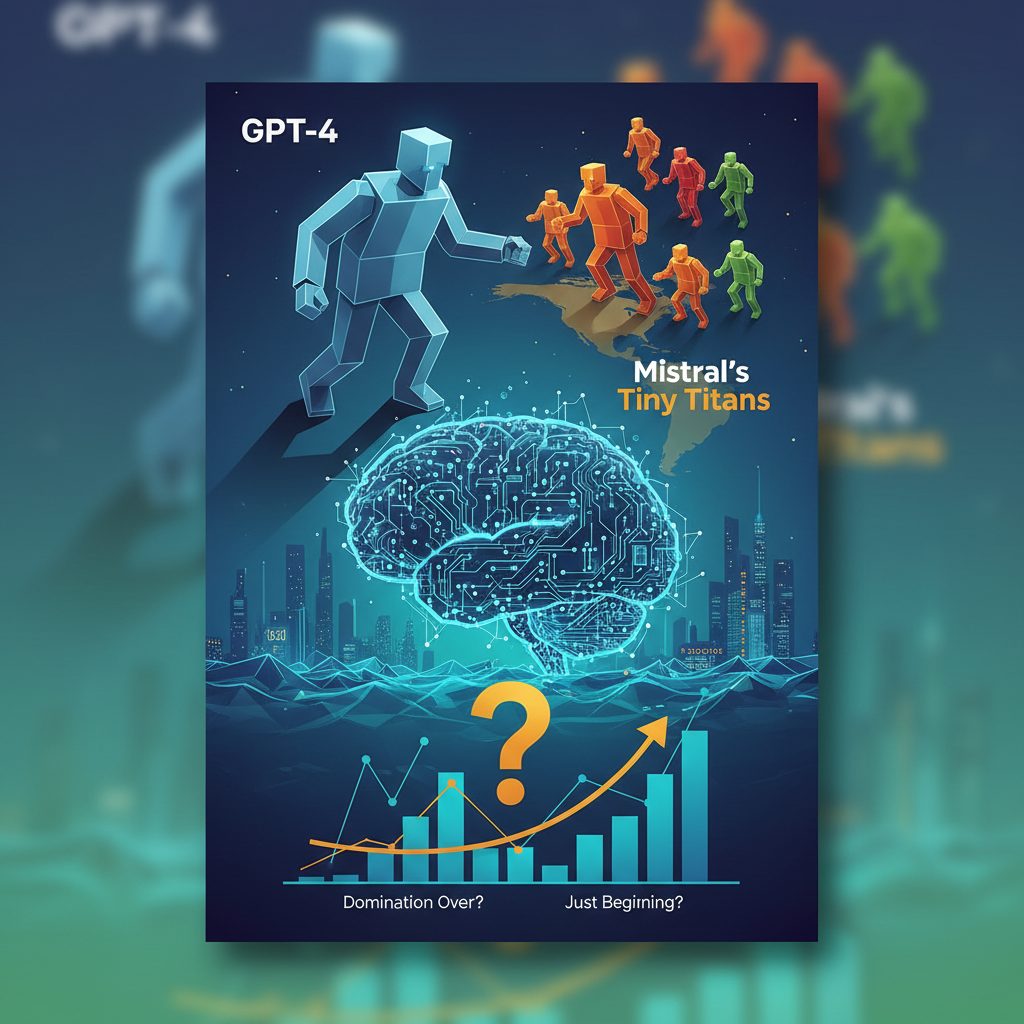

Is the era of monolithic, resource-hungry AI models like OpenAI's GPT-4 truly over, or are we just witnessing a clever illusion, a technological mirage shimmering on the horizon? This is the burning question echoing through the tech corridors, from Silicon Valley to the burgeoning AI hubs of Guadalajara and Monterrey. The buzz around small language models, or SLMs, achieving performance levels that rival their gargantuan predecessors, but at a fraction of the cost and computational burden, is not just industry chatter, it is a potential revolution. For us in Latin America, this trend is not merely interesting, it is absolutely vital. It promises to democratize access to powerful AI, moving it from the exclusive domain of well-funded giants to the hands of innovators everywhere. La tecnología es para todos, and this development could finally make that a reality.
For too long, the narrative of AI progress has been dominated by a relentless pursuit of scale. Bigger models, more parameters, larger datasets, and astronomical training costs. This approach, championed by titans like OpenAI with their GPT series and Google with Gemini, has certainly yielded impressive results. We have seen AI capable of generating human-like text, translating languages with uncanny accuracy, and even writing code. But this power came at a steep price: billions of dollars in investment, massive energy consumption, and an infrastructure accessible to only a select few. The barrier to entry was immense, effectively creating a technological chasm between the global north and south. How could a Mexican startup, no matter how brilliant, compete with the computational might of a Microsoft or an Amazon?
Then came the shift. Companies like Mistral AI, a French startup that has quickly become a darling of the open-source community, began demonstrating that intelligence does not always require gigantism. Their models, like Mistral 7B and Mixtral 8x7B, proved that with clever architectural design, optimized training techniques, and a focus on efficiency, smaller models could punch far above their weight. These SLMs, often with billions rather than trillions of parameters, started showing benchmarks that made the industry sit up and take notice. Imagine an AI model that performs at 90 percent of GPT-4's capability but costs 1 percent to run. This is not science fiction, it is the reality we are now confronting. Recent reports suggest that some of these optimized SLMs can run efficiently on consumer-grade hardware, even on a high-end smartphone or a modest cloud instance, a stark contrast to the data centers filled with NVIDIA H100 GPUs required for the larger models.
This shift is not just about cost, it is about sovereignty and control. For countries like Mexico, relying entirely on APIs from foreign tech giants for core AI capabilities presents a strategic vulnerability. What if access is restricted, prices surge, or the models are not culturally attuned to our unique needs? This affects every family in Latin America, from the small business owner trying to automate customer service to the farmer seeking better crop yield predictions. The ability to fine-tune and deploy models locally, with data that reflects our languages, our slang, our history, and our values, is invaluable. It means an AI assistant can understand the nuances of Mexican Spanish, not just a generic, standardized version. It means an AI medical diagnostic tool can be trained on local health data, addressing specific regional health challenges.
I spoke with Dr. Elena Ramirez, head of AI research at Tecnológico de Monterrey, about this very topic. "For years, we've been trying to fit our problems into the molds provided by Silicon Valley's large models," she told me. "Now, with SLMs, we can build solutions that are truly bespoke. We can train models on specific Mexican legal texts, on indigenous languages, or on the unique challenges of our agricultural sector. This is not just about efficiency, it's about cultural relevance and empowering local innovation." Her team recently deployed a Mixtral-based model for a local government initiative, helping citizens navigate complex bureaucratic processes in several regional dialects, something a generic GPT-4 model struggled with.
The financial implications are equally profound. Small businesses, startups, and even government agencies in Mexico often operate on tighter budgets than their counterparts in wealthier nations. The prohibitive cost of accessing and running large, proprietary models has been a significant barrier to AI adoption. "We've seen a 70 percent reduction in our operational costs for AI inference since switching to optimized SLMs," stated Ricardo Morales, CEO of 'Nube Inteligente,' a burgeoning AI startup based in Mexico City. "This allows us to offer our services at a price point that is accessible to small and medium-sized enterprises, something that was impossible just a year ago. It has leveled the playing field significantly." His company focuses on providing AI-powered analytics for local agricultural cooperatives, helping them optimize irrigation and planting schedules.
Of course, there are skeptics. Some argue that while SLMs are impressive, they still have limitations, particularly in complex reasoning tasks or when dealing with highly abstract concepts. "While the progress is undeniable, we must be careful not to overstate the current capabilities," cautioned Dr. Julian Vargas, a senior AI scientist at a major financial institution in Mexico City. "GPT-4 still holds an edge in certain areas, especially those requiring deep, nuanced understanding and extensive world knowledge. The question is whether that marginal performance difference justifies the exponential cost." He believes that a hybrid approach, where SLMs handle routine tasks and larger models are reserved for critical, high-stakes decisions, might be the most pragmatic path forward.
However, the trajectory of improvement for SLMs is incredibly steep. Companies like Google, with their lightweight Gemma models, and Meta, with the open-source Llama series, are also investing heavily in this space, recognizing the immense market potential. The competition is driving innovation at a furious pace. Just last month, a new benchmark showed an experimental 13-billion-parameter model from a lesser-known research lab achieving a 92 percent score on a common reasoning task, compared to GPT-4's 95 percent, all while being able to run on a single mid-range GPU. This kind of progress is simply astounding. You can follow these developments closely on TechCrunch's AI section or The Verge's AI news.
My verdict is clear: this is no fad. The rise of efficient, powerful small language models is the new normal, and it is a profoundly positive development for equity and access in AI. It is creating an environment where innovation is no longer solely dictated by who has the deepest pockets. For Mexico, this means a chance to leapfrog some of the traditional barriers to technological advancement. We can build our own AI solutions, tailored to our specific needs, fostering local talent and creating economic opportunities that were previously out of reach. Mexico's AI story is not being told, until now, and these SLMs are writing a powerful new chapter.
This shift empowers our universities, our startups, and our communities to participate meaningfully in the global AI revolution. It allows us to develop AI that speaks our languages, understands our cultures, and solves our problems, rather than simply importing solutions designed for different contexts. The future of AI, I believe, will be distributed, diverse, and deeply rooted in local realities, thanks in no small part to these nimble, powerful small models. It is a future where the power of AI is truly for everyone.