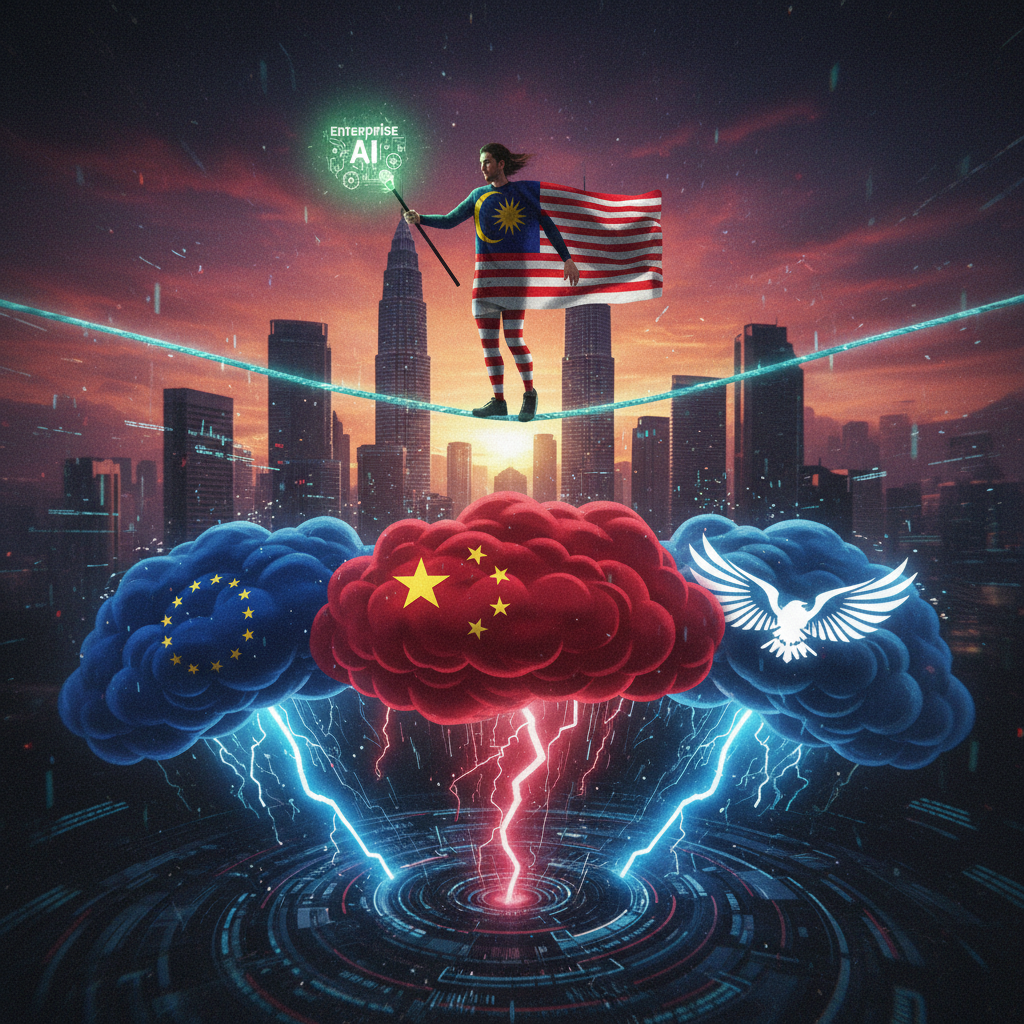

Kuala Lumpur, Malaysia, The air in Putrajaya feels particularly charged this week, not with the usual monsoon humidity, but with the palpable tension of a global AI regulation showdown. It is a complex dance, a geopolitical ballet where the European Union, the United States, and China are all performing their own intricate steps, each with a different rhythm and philosophy. And here in Southeast Asia, particularly in Malaysia, we are left to wonder if we can join the dance or if we will be caught in the crossfire.
Just days ago, the EU AI Act officially became law, marking a monumental shift in how artificial intelligence will be developed and deployed globally. This landmark legislation, the first comprehensive AI law in the world, categorizes AI systems by risk level, imposing strict requirements on high-risk applications like those used in critical infrastructure, law enforcement, and employment. Think of it like a meticulous chef in a Michelin-starred restaurant, carefully inspecting every ingredient and process to ensure safety and quality before a dish ever reaches the table. Their approach is prescriptive, detailed, and legally binding, creating a precedent that reverberates far beyond Brussels.
Across the Pacific, the United States has opted for a more agile, executive-order driven approach. President Biden’s comprehensive executive order on AI, issued late last year, emphasizes safety, security, and trust, pushing for voluntary commitments from tech giants and directing federal agencies to set standards. It is less about a heavy legislative hand and more about guiding the industry, much like a seasoned coach giving strategic advice to a football team, expecting them to implement best practices without dictating every single play. This flexibility aims to foster innovation while still addressing risks, a delicate balance indeed.
Meanwhile, China has been steadily rolling out its own set of AI regulations, focusing heavily on content generation, algorithmic recommendations, and data security. Their approach is characterized by a blend of state control and rapid technological advancement, often prioritizing national security and social stability. Imagine a master weaver, meticulously controlling every thread and pattern to ensure the final tapestry reflects a specific vision. These regulations are not just about safety; they are about alignment with national objectives and maintaining societal order, a distinct difference from the Western models.
The divergence is stark, and for a nation like Malaysia, deeply integrated into global supply chains and digital economies, this regulatory fragmentation presents both challenges and opportunities. Our local tech companies, from burgeoning startups in Cyberjaya to established players in Penang, are now faced with a bewildering array of compliance requirements depending on where their products are sold or their data is processed. It is like trying to drive on a highway where different lanes have different speed limits and traffic rules, all at the same time.
The Architecture is Fascinating: A Closer Look at the Regulatory Pillars
The EU AI Act, with its tiered risk framework, means that an AI system used for, say, credit scoring, would face far more scrutiny than a simple chatbot. Developers must conduct conformity assessments, implement robust risk management systems, and ensure human oversight. “The EU AI Act is a game-changer, setting a global benchmark for ethical and trustworthy AI,” stated Věra Jourová, Vice President of the European Commission, in a recent press conference. “It ensures that AI systems respect our fundamental rights and values.” This approach is already influencing companies like Google and Microsoft, who are adapting their internal development processes to meet these stringent standards, even for products deployed outside the EU.
In contrast, the US executive order, while powerful, relies heavily on agency directives and voluntary industry participation. It mandates that developers of powerful AI models share safety test results with the government and establishes new standards for AI security. “We are committed to fostering responsible AI innovation while protecting American citizens,” said Arati Prabhakar, Director of the White House Office of Science and Technology Policy, during a recent briefing. “Our approach is nimble, allowing us to adapt as the technology evolves.” This strategy aims to avoid stifling the very innovation that has made US tech giants global leaders.
China’s regulatory landscape, exemplified by its regulations on generative AI and algorithmic recommendations, is arguably the most comprehensive and rapidly evolving. It places significant responsibility on providers to ensure content aligns with socialist values, prevents discrimination, and protects user data. Companies like Baidu and ByteDance have already integrated these requirements into their AI product development, often leading to unique domestic versions of globally available services. The emphasis is on control and alignment, ensuring AI serves state and societal interests.
Malaysia's Balancing Act: Why This Matters for Southeast Asia
Malaysia, with its ambition to become a regional digital hub, cannot afford to ignore these global currents. Our government has been proactive, launching initiatives like the Malaysia Digital Economy Blueprint (MyDIGITAL) and investing in AI research through institutions like Mimos Berhad. But the question remains: how do we harmonize these disparate regulatory philosophies into a coherent national strategy?
“For Malaysia, the challenge is to craft a regulatory framework that is both globally compatible and locally relevant,” explains Dr. Mazlan Abbas, CEO of Favelle Favco Berhad and a prominent figure in Malaysia’s tech scene. “We need to protect our citizens and foster trust in AI, while simultaneously attracting foreign investment and enabling our local innovators to compete on a global stage. It is a delicate balance, like preparing a perfect Nasi Lemak, where every ingredient must be just right.”
The implications for data governance are particularly acute. If a Malaysian company develops an AI solution using local data, but intends to deploy it in Europe, it must comply with the EU AI Act and GDPR. If it targets the US market, it navigates a different set of expectations, often influenced by sector-specific regulations. And if it seeks to enter China, it faces a highly centralized and often opaque regulatory environment. This multi-jurisdictional compliance burden can be a significant barrier for smaller businesses and startups.
What Happens Next: A Call for Asean Unity?
There is a growing consensus among regional experts that Asean, as a bloc, might need to develop a more unified stance on AI regulation. A fragmented approach within Southeast Asia would only exacerbate the challenges posed by global regulatory divergence. Imagine the strength in numbers if all ten Asean nations could present a common front, influencing global standards rather than merely reacting to them.
“A harmonized Asean AI framework, perhaps drawing inspiration from the best practices of all three major blocs, could provide clarity and reduce compliance costs for businesses operating across the region,” suggests Professor Dr. Shahrin Sahib, a leading expert in AI ethics at Universiti Teknologi Malaysia. “It would also bolster our collective bargaining power on the international stage, ensuring our unique cultural and economic contexts are considered.” This is where Malaysia is positioning itself perfectly, advocating for regional collaboration and knowledge sharing.
Indeed, the recent Asean Digital Ministers’ Meeting saw robust discussions on cross-border data flows and AI governance, indicating a growing awareness of the need for regional coherence. The goal is not to copy any single model wholesale, but to craft a framework that is pragmatic, promotes innovation, and safeguards public interest, much like our diverse Malaysian society finds unity in its differences.
Why You Should Care: The Future of Our Digital Lives
Ultimately, this regulatory showdown is not just about legal texts and geopolitical maneuvering; it is about the future of our digital lives. It determines who controls the algorithms that shape our news feeds, who gets access to our data, and who is held accountable when AI systems make mistakes. For us in Malaysia, as consumers, as innovators, and as citizens, understanding these global shifts is paramount.
Will we see a future where AI systems are developed with a universal set of ethical guidelines, or will we live in a digital world Balkanized by conflicting regulations? The answer will profoundly impact everything from the cost of AI services to the types of innovations that flourish, and crucially, the trust we place in these powerful technologies. The path forward is complex, but one thing is clear: the global conversation on AI regulation has only just begun, and Malaysia, along with its Asean neighbors, has a vital role to play in shaping its trajectory. The stakes are incredibly high, and the world is watching. For more insights into how AI is reshaping global industries, you can explore reports on AI business news or delve into AI research and analysis. You can also keep up with the latest in AI product news.
While the EU AI Act's impact on accountability is significant, it is worth remembering that the question of 'who pays for AI's mistakes' is a global one, extending beyond Brussels. For a deeper dive into this, you might find this related article insightful: When the Algorithmic Oracle Fails: Who Pays for AI's Mistakes, From Delphi to Brussels' AI Act? [blocked].