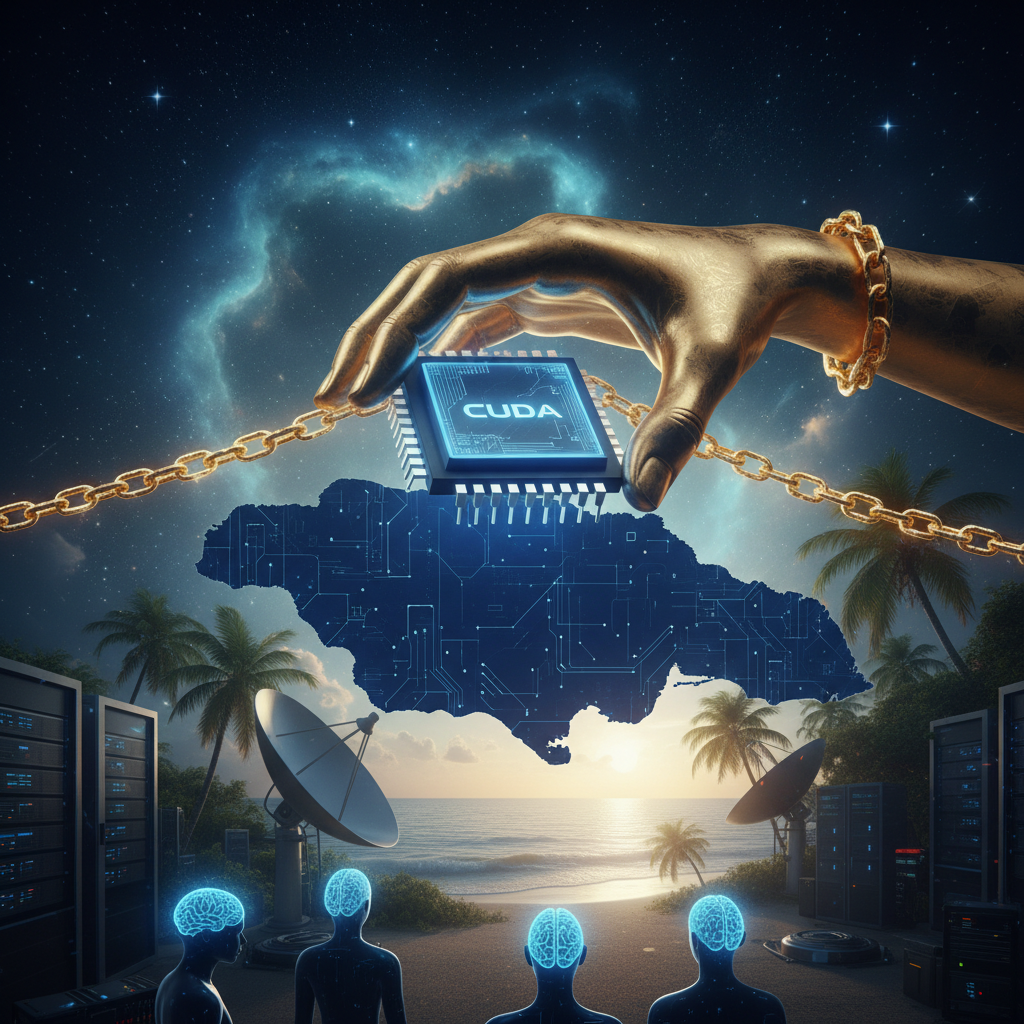

Alright, let's talk about the elephant in the digital room, or perhaps, the very well-fed dragon guarding its hoard of gold. I'm talking about NVIDIA, of course, and their iron grip on the AI world, particularly through their Cuda software stack. Everyone, from the biggest tech giants to the smallest startups in Kingston, wants a piece of that AI pie, but it seems Jensen Huang has decided he's the only one with the recipe book, and he's not sharing the ingredients freely.
For those of you who haven't been living under a rock, or perhaps just enjoying the beach too much, NVIDIA’s Graphics Processing Units, or GPUs, are the undisputed workhorses of modern artificial intelligence. They're what make large language models like OpenAI's GPT-4 or Google's Gemini actually think. But it's not just the hardware, oh no. It's the software that runs on it, specifically Cuda, NVIDIA's parallel computing platform, and TensorRT, their optimization library. These aren't just tools, my friends, they are the very language of AI development for most serious players. And that, right there, is where the plot thickens for us, especially here in Jamaica.
Now, Jamaica's tech scene is like reggae, it'll surprise you. We might be a small island, but we have big ideas, and our developers are sharp. We're seeing a growing interest in AI, from optimizing logistics for our agricultural exports to creating personalized tourism experiences. Imagine AI-powered chatbots speaking patois to tourists, or machine learning models predicting crop yields with unprecedented accuracy. The potential is immense. But every time one of our bright young minds starts diving into deep learning, they inevitably hit the NVIDIA wall.
“It’s like learning to drive, but only one car manufacturer makes the steering wheel, the engine, and the tires, and they all only work with each other,” explained Dr. Aliyah Campbell, head of the AI Research Lab at the University of the West Indies, Mona. “Our students spend countless hours mastering Cuda and NVIDIA’s ecosystem because that’s where the jobs are, that’s where the cutting-edge research happens. It’s a necessary evil, but it’s still an evil.” She’s not wrong. The barrier to entry, both in terms of hardware cost and the specialized knowledge required for Cuda, is significant. It creates a dependency that can stifle innovation and limit our options down the line.
Globally, this isn't a new conversation. For years, tech pundits have been wringing their hands about NVIDIA's dominance. A report from Wired last month highlighted how over 90% of AI researchers and developers rely on NVIDIA GPUs and Cuda. That's not just market share, that's a monopoly. And while Jensen Huang, NVIDIA's CEO, might argue it's simply a testament to their superior engineering, others see it as a looming threat to the open and democratic development of AI. When one company controls the foundational infrastructure, they effectively control the pace, direction, and even the accessibility of an entire technological revolution.
What happens if NVIDIA decides to change its licensing terms? What if they prioritize certain regions or industries over others? What if a geopolitical spat suddenly makes their hardware or software inaccessible? For a small nation like Jamaica, which is already navigating complex global supply chains and economic vulnerabilities, this kind of dependency is a major concern. We're trying to build a resilient, innovative economy, not one beholden to the whims of a single Silicon Valley giant.
“We’ve seen this movie before, haven’t we?” quipped Marcus “The Code Whisperer” Garvey, a veteran Jamaican software engineer now consulting for several local startups. “Remember Microsoft and Windows, or even Apple and its ecosystem? They build something so good, so ubiquitous, that everyone has to use it. Then, they control the narrative, the pricing, and the innovation roadmap. NVIDIA is doing the same thing, but with AI, which is arguably even more critical for the future.” He’s got a point. History is littered with examples of technological dominance leading to lock-in and stifled competition.
There are alternatives, of course, but they are still playing catch-up. AMD, NVIDIA's perennial rival, has its ROCm platform, which is open source and aims to provide a viable alternative to Cuda. Intel is also making strides with its oneAPI initiative. Even tech giants like Google and Amazon are developing their own custom AI chips, like Google's TPUs and Amazon's Inferentia, to reduce their reliance on NVIDIA. But these efforts are fragmented, and none have achieved the widespread adoption and developer support that Cuda enjoys. It’s a classic chicken-and-egg problem: developers go where the tools are best, and the tools are best where the most developers are.
For our local developers, the choice is often pragmatic. “I’d love to experiment with ROCm, but the community support isn’t as strong, and frankly, the performance isn’t always there yet for the complex models we’re building,” admitted Shanice Davis, a data scientist working on an AI solution for traffic management in Kingston. “When you’re on a tight deadline and budget, you go with what works, and right now, that’s NVIDIA. It’s a shame, but it’s reality.” This sentiment is echoed across the globe, not just here. According to a recent article in MIT Technology Review, the cost of switching from Cuda to an alternative platform can be astronomical, involving re-writing significant portions of code and retraining engineers.
The Caribbean has entered the chat, and we're not just here for the sunshine and beaches anymore. We're building, innovating, and trying to secure our place in the global digital economy. But this NVIDIA lock-in situation forces us to ask some uncomfortable questions. Are we truly fostering independent innovation if our foundational AI infrastructure is controlled by a single foreign entity? Are we setting ourselves up for future dependencies that could hinder our growth or even compromise our digital sovereignty?
Perhaps the answer lies in fostering greater collaboration within the open-source AI community, or perhaps in regional initiatives to pool resources and invest in alternative hardware and software stacks. Maybe it’s about lobbying for more open standards in AI development, pushing for interoperability that transcends proprietary ecosystems. One thing is clear: we cannot afford to be passive observers. Our digital future, and the economic opportunities that come with it, are too important to leave to chance, or to the sole discretion of Jensen Huang and NVIDIA. We need to ensure that the tools of tomorrow are accessible, flexible, and truly serve the interests of all nations, not just the ones with the deepest pockets or the most established tech giants. We need to be proactive, to think strategically, and to remember that true independence, even in the digital realm, is always worth fighting for.
It’s a complex problem, with no easy answers. But acknowledging the problem is the first step. And here in Jamaica, we’re not afraid to call out the absurdities when we see them. This isn't just about microchips and code; it's about control, access, and the very fabric of our digital future. And that, my friends, is a conversation worth having, loudly and clearly. From Kingston to Silicon Valley, everyone should be listening. From Papeete to the Cloud: How Microsoft Azure AI is Charting a New Course for Enterprise in Our Islands [blocked] also touches on island nations navigating tech dependencies.