
The digital frontier is redrawing geopolitical maps, and at its heart is the relentless march of artificial intelligence. For years, the United States has largely held the reins of technological innovation, a position underpinned by its Silicon Valley giants. Yet, a quiet but potent shift is underway, spearheaded by NVIDIA and its charismatic CEO, Jensen Huang. This shift, characterized by NVIDIA's burgeoning partnerships with sovereign AI initiatives across the globe, is creating a complex tapestry of technological interdependence that demands scrutiny from Washington.
My investigation reveals that these partnerships, often framed as benign efforts to democratize AI, carry significant implications for U.S. national security, economic competitiveness, and the very fabric of global power dynamics. While NVIDIA positions itself as an enabler of national progress, the underlying reality is a strategic distribution of critical AI infrastructure that could dilute America's long-held technological edge.
The Risk Scenario: A Distributed AI Power Grid
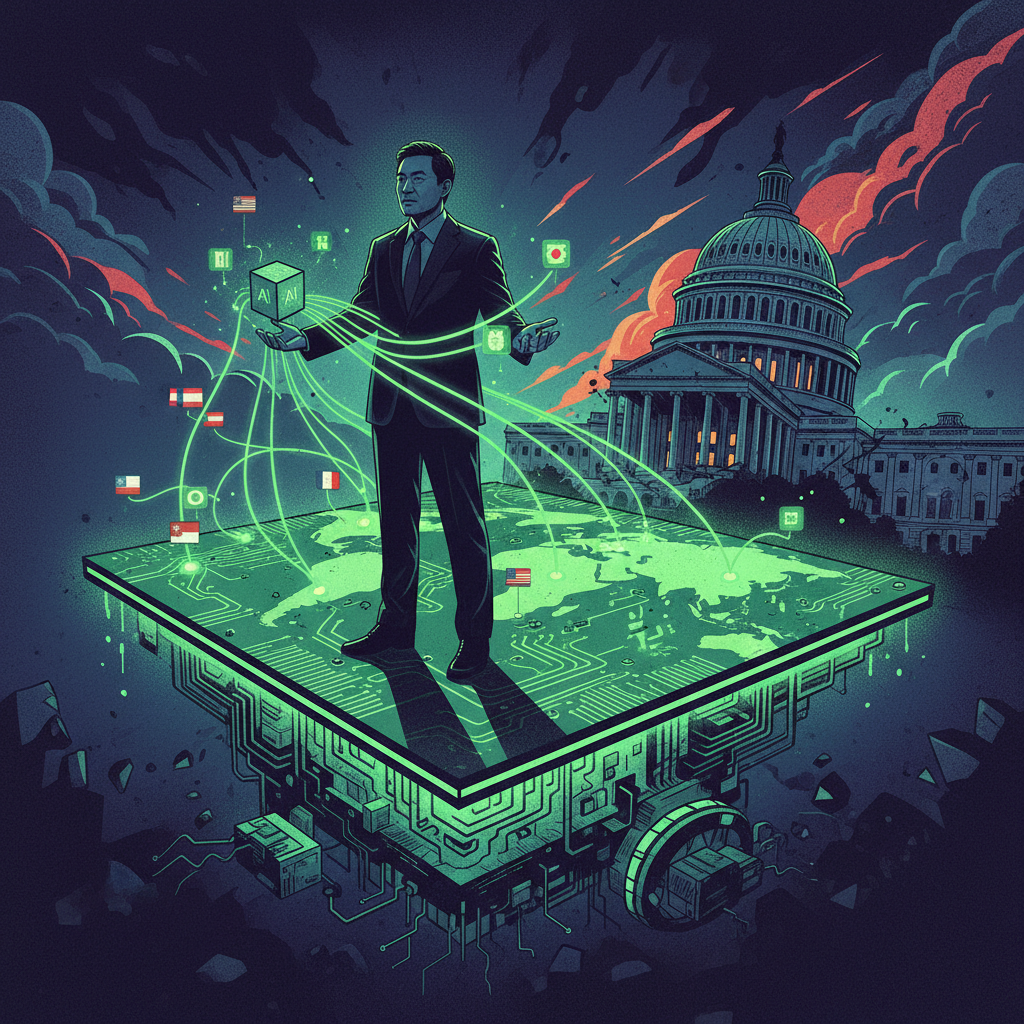
Imagine a world where advanced AI capabilities, once concentrated in a few tech hubs, are now dispersed across dozens of nations, each with its own agenda, regulatory framework, and geopolitical allegiances. This is the future NVIDIA is actively constructing. From Saudi Arabia to Japan, from India to France, nations are pouring billions into building their own AI supercomputing centers, often with NVIDIA's H100 and upcoming B200 GPUs as the foundational hardware. These sovereign AI clouds are designed to process sensitive national data, develop bespoke AI models for defense, intelligence, and critical infrastructure, and foster local AI ecosystems.
The immediate risk for the USA is twofold: first, the potential for technology leakage and dual-use concerns, and second, the erosion of American influence over global AI norms and standards. As these nations gain advanced AI capabilities, the U.S. may find itself in a more precarious position, facing a multipolar AI landscape where its technological leadership is challenged by a diverse array of state actors, some of whom may not share American values or strategic interests.
Technical Explanation: The GPU as a Geopolitical Lever
At the core of this phenomenon is the Graphics Processing Unit, or GPU, a piece of hardware that has become the indispensable engine of modern AI. NVIDIA, through decades of innovation, has established a near-monopoly on the high-end AI GPU market. Its Cuda software platform further locks in developers, making it exceedingly difficult for competitors to gain traction. This technological dominance grants NVIDIA an unparalleled position as the gatekeeper to advanced AI capabilities.
When a nation embarks on a