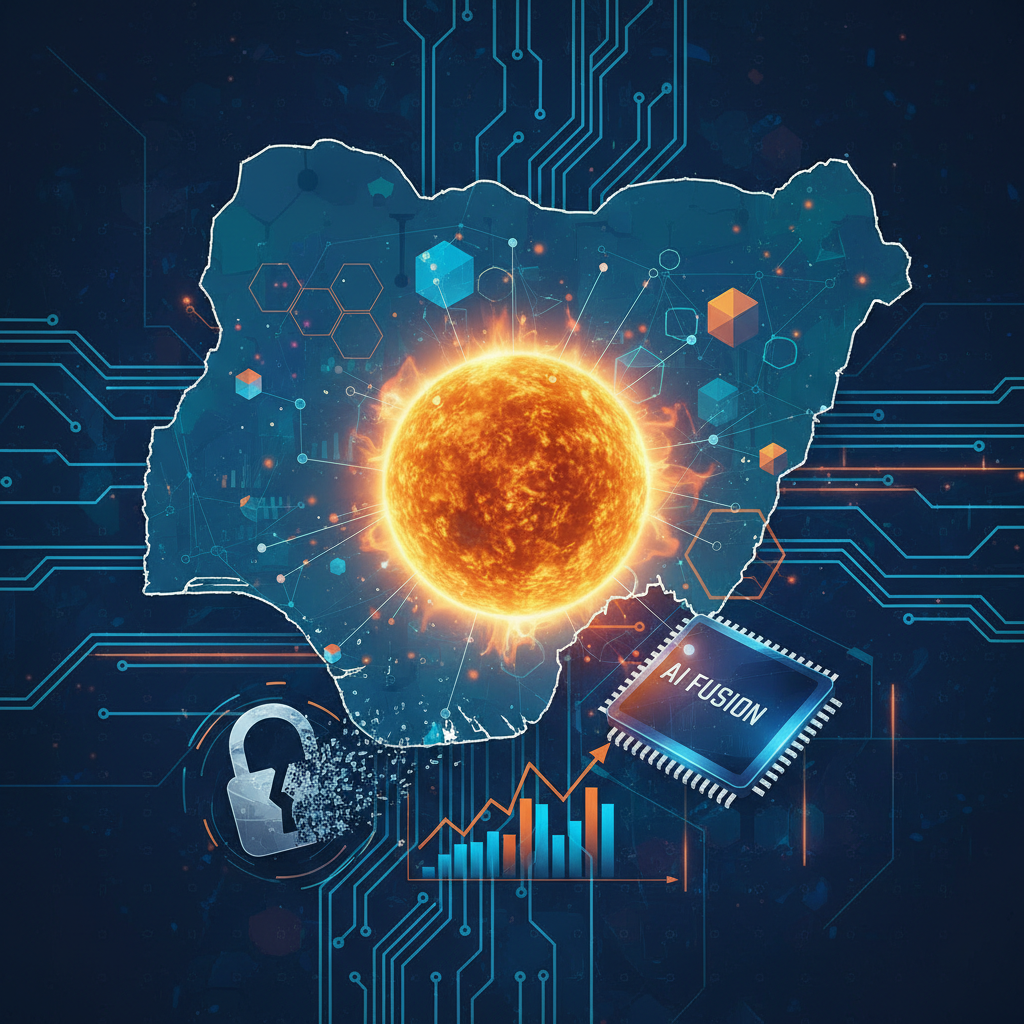

The chatter is deafening, isn't it? From Davos to Silicon Valley, the air crackles with promises of a new dawn, powered by nuclear fusion and perfected by artificial intelligence. Google DeepMind, with its AlphaFold fame, is now flexing its algorithmic muscles in the realm of plasma physics, promising to tame the sun in a bottle. Laboratories across the globe, from the venerable Iter project in France to startups like Commonwealth Fusion Systems, are all singing the same tune: AI is the secret sauce, the missing link, the deus ex machina that will finally deliver abundant, clean energy. But here in Lagos, as I watch our generators sputter and our communities grapple with persistent power deficits, I must ask: is this a revolution, or just another expensive, distant dream for the rest of us?
Unpopular opinion, perhaps, but I see a pattern. Whenever a grand technological promise emerges from the West, especially one with such profound implications, my antennae go up. It reminds me of the early days of the internet, hailed as a great equalizer, yet it deepened existing divides before we even understood its true cost. Now, AI in fusion research is being presented as humanity's salvation, a clean energy utopia. The narrative is powerful: AI models are optimizing magnetic confinement, predicting plasma instabilities, and designing more efficient reactor components. Companies like Google DeepMind are deploying sophisticated reinforcement learning algorithms to control plasma in experimental tokamaks, achieving unprecedented stability and duration. They claim these AI systems can learn optimal control strategies far beyond human intuition, accelerating the path to commercially viable fusion.
Historically, nuclear fusion has been the energy source of tomorrow, and always will be. For decades, the challenge has been monumental: how do you contain matter hotter than the sun, prevent instabilities that quench the reaction, and do it economically? The physics are brutal, the engineering complex. We have seen countless breakthroughs, each followed by another decade of research. The Joint European Torus, or JET, achieved a record 59 megajoules of sustained fusion energy in 2021, a significant milestone, but still far from net energy gain. The argument now is that AI changes everything. It is not just about crunching numbers faster; it is about discovering entirely new control regimes and design principles that human scientists might never conceive. This is the promise that has investors pouring billions into fusion startups, and governments recommitting to major research initiatives.
Consider the data. A recent report from the Fusion Industry Association indicated that private investment in fusion energy surged to over $6 billion by early 2026, with a significant portion earmarked for AI and machine learning applications. TechCrunch reports that NVIDIA’s advanced GPUs are becoming as critical to fusion labs as the magnets themselves, processing petabytes of diagnostic data in real time. Dr. Anya Sharma, a lead plasma physicist at MIT's Plasma Science and Fusion Center, recently stated, “AI is not just an accelerator; it is a paradigm shift. Our AI models, trained on decades of experimental data and high-fidelity simulations, can predict plasma disruptions milliseconds before they occur, allowing for preventative action. This was unthinkable five years ago.” Her optimism is shared by many, painting a picture of AI as the ultimate problem solver.
But let's talk about what nobody wants to discuss. Who truly benefits from this AI-driven fusion future? The narratives always focus on global energy needs, but the reality of technological advancement often means concentrated power and access. If fusion reactors become a reality, who will own the intellectual property, the operational expertise, and the energy output? Will it be open source, or will it be locked behind proprietary algorithms and corporate firewalls, accessible only to those with the deepest pockets and the most advanced infrastructure? I fear a scenario where the energy crisis in places like Nigeria continues, while nations with the resources to invest in this high-stakes game reap all the rewards.
“The promise of limitless energy is seductive, but we must interrogate the pathways to its realization,” warns Professor Chidi Okoro, an energy policy expert at the University of Ibadan. “If the AI models that underpin fusion control are developed and owned by a handful of Western tech giants, what does that mean for energy sovereignty in Africa? Will we be perpetual consumers, dependent on their benevolence, or will we have a seat at the table, contributing to and benefiting from this technology?” His concerns echo mine. We have seen this play out before, where technology, initially hailed as universal, becomes another tool for geopolitical leverage.
Furthermore, the cybersecurity implications are staggering. We are talking about controlling miniature stars on Earth. If AI is the brain of these reactors, optimizing plasma containment and preventing catastrophic meltdowns, then the security of that AI becomes paramount. Imagine a sophisticated cyberattack targeting a fusion plant's AI control system. The consequences could be devastating, far beyond anything we have seen with conventional power grids. This is an area where the cybersecurity community, often an afterthought in these grand scientific endeavors, needs to be at the forefront. As Mr. Ken Nduka, head of cybersecurity for the Nigerian National Petroleum Company, often reminds us, “The more complex and critical a system becomes, the more attractive a target it is for malicious actors. AI in fusion is not just a scientific challenge; it is a national security imperative.”
My verdict? The advancements in AI for nuclear fusion are undeniably impressive, a testament to human ingenuity and algorithmic power. The ability of systems like those from Google DeepMind to manipulate plasma in real time, learning from complex, chaotic systems, is a scientific marvel. However, we must temper our enthusiasm with a healthy dose of skepticism and critical inquiry. This is not just about physics and algorithms; it is about power, access, and equity.
We need to ask not just if AI can ignite the sun on Earth, but who will control that sun, and how its light will be distributed. Will it truly be for all humanity, or will it further entrench existing technological and economic disparities? Until these questions are addressed with transparency and genuine commitment to global equity, the AI-driven fusion dream, however brilliant, remains for many of us, just another distant flicker on the horizon. The world needs clean energy, yes, but it needs it equitably and securely. Anything less is just another Silicon Valley fantasy, beautifully packaged but ultimately inaccessible to those who need it most. For more on the broader implications of AI, you might find this piece on AI ethics insightful.