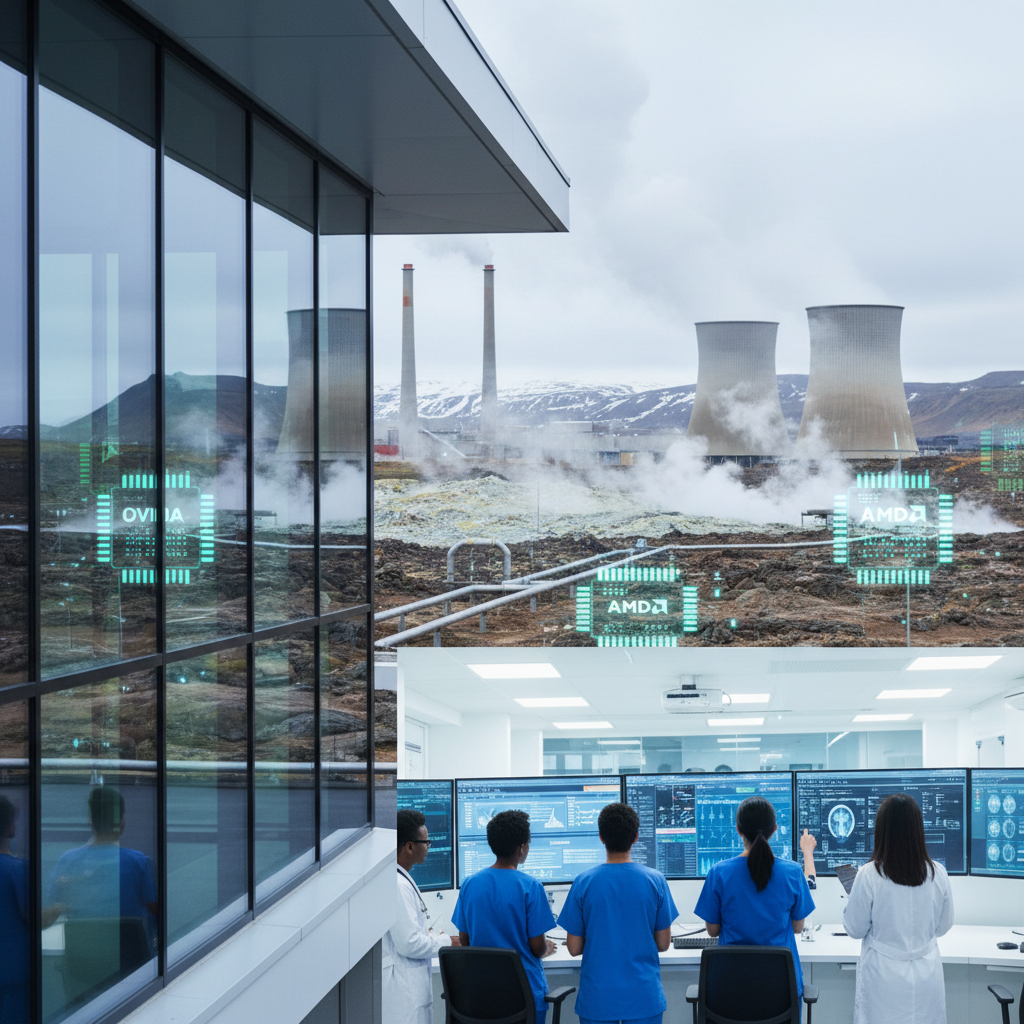

You hear a lot of noise these days about AI, about the big players, the billions being thrown around. It is enough to make a practical person, like myself, wonder what is real and what is just another passing fad. But when you look closely, past the headlines and the venture capital hype, you find the real story: the silicon powering it all. The battle for AI chip supremacy between NVIDIA, AMD, and Intel is not just a corporate skirmish; it is a fundamental contest that will shape the future of every industry, including healthcare, and even influence how small nations like Iceland can compete.
Here in Iceland, we think differently about this. We do not have vast manufacturing plants or a deep pool of semiconductor engineers. What we do have is an abundance of clean, renewable energy, primarily geothermal and hydro. This is not just a nice environmental talking point; it is a strategic asset, especially when you consider the energy demands of modern AI. Training a large language model, for instance, can consume as much electricity as a small town over its lifetime. When you are running AI models for critical applications, like those in healthcare, that energy cost becomes a significant factor.
NVIDIA, with its Cuda platform and dominant H100 and upcoming B200 Blackwell GPUs, has been the undisputed king of AI for years. Their chips are the workhorses behind most of the major AI breakthroughs, from OpenAI's GPT models to Google DeepMind's AlphaFold. Jensen Huang, NVIDIA's CEO, has built an empire on this. Analysts estimate NVIDIA controls over 80 percent of the market for AI accelerators. This dominance gives them immense leverage, but it also creates a bottleneck. Everyone wants NVIDIA, and the supply simply cannot keep up with demand.
This is where AMD and Intel see their opening. AMD, led by Lisa Su, has been aggressively pushing its MI300X accelerators, directly challenging NVIDIA's performance claims. They are making a strong case for open software standards, aiming to break NVIDIA's Cuda lock-in. Microsoft, for example, has reportedly been a significant customer for AMD's AI chips, deploying them in their Azure cloud infrastructure. Intel, with its Gaudi line of AI accelerators, is also in the fray, emphasizing cost-effectiveness and scalability for enterprise AI. Pat Gelsinger, Intel's CEO, has repeatedly stressed the importance of a diverse and open ecosystem for AI hardware.
For healthcare AI, this competition is a double-edged sword. On one hand, more competition means innovation, lower prices, and greater accessibility to powerful computing. This is crucial for Icelandic hospitals and research institutions. Imagine an AI system that can analyze medical images with greater speed and accuracy, helping doctors detect diseases earlier. Or a drug discovery platform that can simulate molecular interactions at an unprecedented scale, speeding up the development of new treatments. These applications demand immense computational power.
Dr. Helga Þórisdóttir, a lead researcher at Landspítali, Iceland's National University Hospital, emphasized this point recently. She said, "Our ability to leverage AI in diagnostics and personalized medicine is directly tied to the availability and affordability of high-performance computing. We need solutions that are not only powerful but also energy-efficient and accessible to smaller research groups." Her words resonate deeply here. We cannot afford to be left behind because the hardware is too expensive or too scarce.
Our data centers, often powered by the geothermal approach to computing, are already attracting attention. Companies looking to run energy-intensive AI workloads are starting to look beyond the traditional tech hubs. The consistent, low-cost, and green energy available in Iceland makes it an attractive location. This is not just about keeping the lights on; it is about keeping the carbon footprint low, which is a growing concern for many global corporations and a point of pride for us.
Consider the practical implications for healthcare. Training a sophisticated AI model to identify subtle patterns in MRI scans for early cancer detection requires processing petabytes of data. Doing this efficiently and sustainably is paramount. If AMD or Intel can offer competitive performance at a better price point or with a more open software stack, it could significantly impact the adoption of advanced AI in smaller, publicly funded healthcare systems like ours. It could mean the difference between a cutting-edge diagnostic tool being widely available or remaining a luxury for a few.
The global AI chip market is projected to reach hundreds of billions of dollars in the coming years. NVIDIA's revenue from its data center segment, largely driven by AI, has soared, reaching record highs in recent quarters. This growth fuels their research and development, but it also incentivizes their competitors to innovate faster. The race is on to deliver not just raw power, but also efficiency, ease of use, and a robust software ecosystem.
From Iceland's perspective, this competition is vital. Small nations have big advantages in AI when they can leverage their unique resources. Our clean energy, combined with a highly educated workforce and a willingness to embrace new technologies, positions us well to be a hub for sustainable AI computing. We may not build the chips, but we can certainly provide the ideal environment for them to run, especially for critical applications like healthcare where reliability and sustainability are non-negotiable.
The future of healthcare AI, whether it is powered by NVIDIA, AMD, or Intel, will depend on more than just raw teraflops. It will depend on the entire ecosystem: the software, the data, the talent, and crucially, the energy that fuels it. And in that regard, Iceland has a hand to play. The chip war is heating up, and its ripples are felt even in the quiet, geothermal-powered corners of the world, influencing the very health of our people. The next few years will show us which company, and which approach, truly delivers on the promise of AI for all, not just the biggest players. For more on the tech industry's latest moves, you can always check out TechCrunch's AI section or follow developments on Reuters Technology. The landscape is always shifting, and keeping an eye on the hardware beneath the hype is always a good idea.