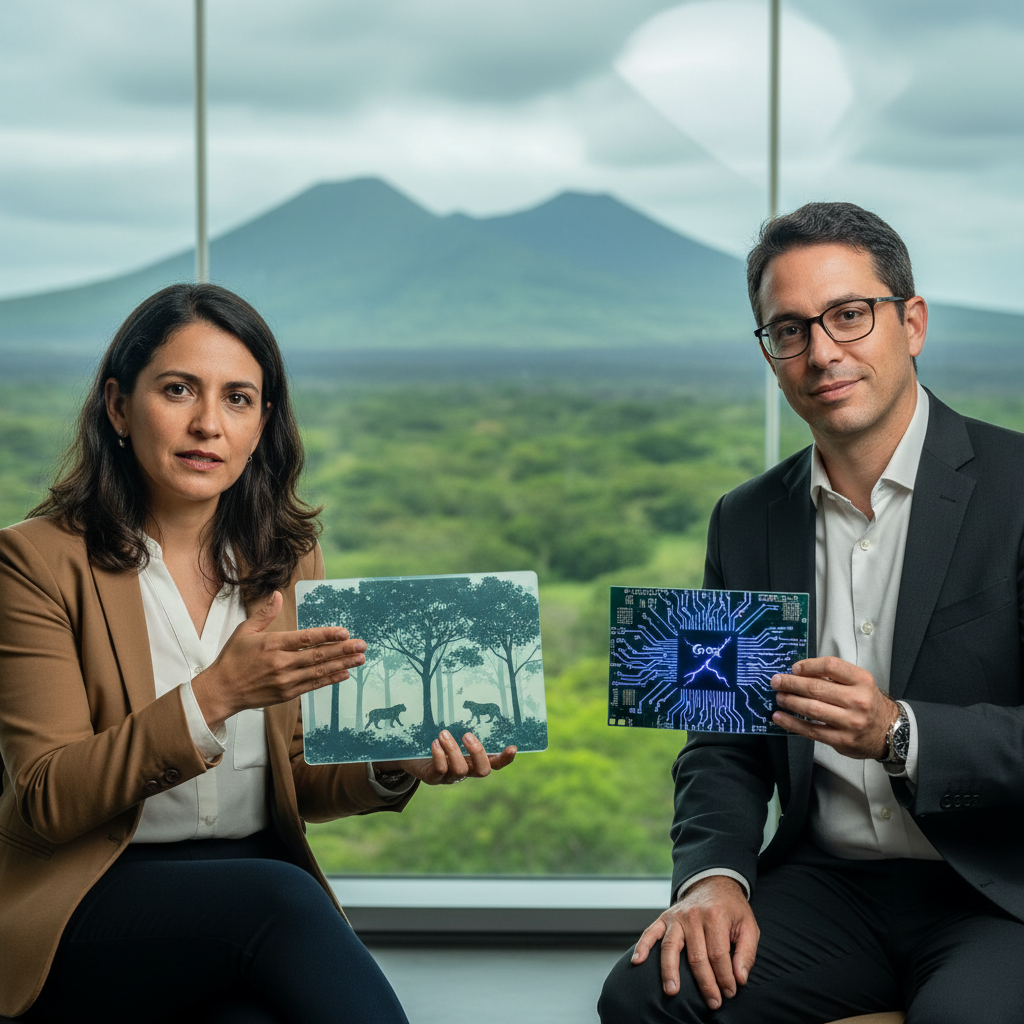

¡Hola, mis amigos de DataGlobal Hub! Mariànnà Sanchèz here, buzzing with excitement from the heart of Ecuador. You know me, I live for those moments when technology doesn't just advance, but transforms our world, especially when it touches our precious planet. Today, I want to talk about something that has me absolutely vibrating with anticipation: the incredible potential of Groq's custom AI inference chips, and what they could mean for places like my beloved Ecuador.
We're talking about a leap in processing power that feels almost like science fiction, a promise of large language models responding at speeds we've only dreamed of. It’s not just about faster chatbots, no, no, no. For me, it’s about unlocking the next frontier for AI in conservation, in sustainable development, in truly understanding and protecting the breathtaking biodiversity that surrounds us here in the Andes and the Amazon.
I recently had the immense privilege to delve into the mind of Jonathan Ross, the founder and CEO of Groq. He's a name you might recognize, a true pioneer who helped create Google's Tensor Processing Units, or TPUs, before embarking on his own audacious journey with Groq. His vision is not just about building faster hardware; it's about fundamentally changing how we interact with and utilize artificial intelligence. He's a man who saw a bottleneck, a chokepoint in the AI revolution, and decided to build a superhighway around it.
Ross founded Groq in 2016, driven by a deep conviction that existing architectures were not optimized for the unique demands of AI inference. He understood that while training AI models requires immense parallel processing power, deploying them, or 'inferencing,' demands something different: predictable, low-latency performance. His team developed a novel architecture, the Language Processor Unit or LPU, specifically designed for sequential processing, which is exactly what large language models excel at. It’s like building a Formula 1 car specifically for a sprint race, not a marathon. This focus allows Groq to achieve astounding speeds, reportedly delivering responses up to 10 times faster and at a fraction of the cost compared to traditional GPU-based systems, according to company statements and independent benchmarks.
During our conversation, Ross emphasized this core philosophy. He once stated in a public interview, “The future of AI is about real-time interaction, and that requires predictable, low-latency performance at scale. We built Groq from the ground up to deliver on that promise.” This isn't just technical jargon; it's a declaration of a new era. Imagine an AI assistant that understands your complex requests instantly, without that frustrating pause, that digital breath-holding moment. Now, extend that to critical applications.
For Ecuador, a country renowned for its unparalleled biodiversity, this speed is not a luxury, it's a necessity. We are a small nation, yet we boast an incredible density of life, from the cloud forests of Mindo to the unique ecosystems of the Galápagos Islands. Protecting this natural heritage is a monumental task, and AI is becoming an indispensable ally. Think about real-time monitoring of deforestation in the Amazon, identifying illegal fishing vessels in our protected marine reserves, or even tracking the health of endangered species like the Andean spectacled bear or the Galápagos giant tortoise.
Currently, many of these AI applications, while powerful, are limited by processing speed and cost. Running complex vision models on vast satellite imagery or processing acoustic data from remote forest sensors can be slow and expensive. But with Groq's LPU, the game changes. A rapid response system could analyze incoming data from remote sensors in near real-time, alerting park rangers to immediate threats like illegal logging or poaching, allowing for intervention within minutes, not hours. This speed could literally be the difference between saving a patch of forest or losing it forever.
Ross’s vision extends beyond just speed. He also speaks about cost-efficiency, a critical factor for developing nations and conservation organizations often operating on tight budgets. “We believe that powerful AI should be accessible to everyone, not just those with massive data centers,” he has publicly stated. This commitment to accessibility resonates deeply with me. Imagine local communities, indigenous groups, and small research teams in Ecuador being able to deploy sophisticated AI tools without needing a supercomputer in their backyard. This democratizes AI, putting cutting-edge capabilities into the hands of those who need them most, right on the front lines of conservation.
This is where Ecuador's biodiversity meets AI and it's magical. Consider the potential for precision agriculture, optimizing crop yields and reducing pesticide use, protecting our soil and water. Or think about smart ecotourism, using AI to manage visitor flows in delicate ecosystems like the Galápagos, minimizing human impact while enhancing the visitor experience. The rapid processing of Groq could power AI models that analyze tourist behavior patterns, predict environmental stress points, and even offer personalized, sustainable travel advice in real-time.
I’m also thinking about the educational aspect. Imagine interactive AI tutors, powered by Groq’s speed, that can instantly answer questions about local flora and fauna, helping students and tourists alike understand the intricate web of life around them. This kind of immediate, intelligent feedback can foster a deeper connection to nature and inspire the next generation of conservationists. It’s like having a super-smart, always-available guide to the natural world, right in your pocket.
Of course, the journey is not without its challenges. Integrating these advanced chips into existing infrastructure, developing the specific AI models tailored for our unique ecosystems, and ensuring equitable access will require significant effort and collaboration. But the promise, the sheer potential, is too great to ignore. This isn't just about faster computers; it's about faster insights, faster action, and ultimately, a faster path to a more sustainable future for Ecuador and beyond.
As I reflect on my conversation with Jonathan Ross, I can’t help but feel that we are standing on the precipice of something truly revolutionary. The Galápagos of technology, if you will, where a unique evolutionary path is leading to unparalleled capabilities. Groq's chips are not just a technological marvel; they are a beacon of hope for those of us who believe that technology, when wielded with purpose and passion, can be the most powerful tool for protecting our planet. The future is arriving, and it’s arriving at Groq speed, and I, for one, cannot wait to see what incredible things we will build with it here in Ecuador.
For more insights into the world of AI and its transformative power, keep an eye on DataGlobal Hub. You can also explore the latest in AI hardware developments on Ars Technica. The conversation around making AI more efficient and accessible is truly global, and you can often find deep dives into these topics on sites like MIT Technology Review. The future is bright, and it's fast!