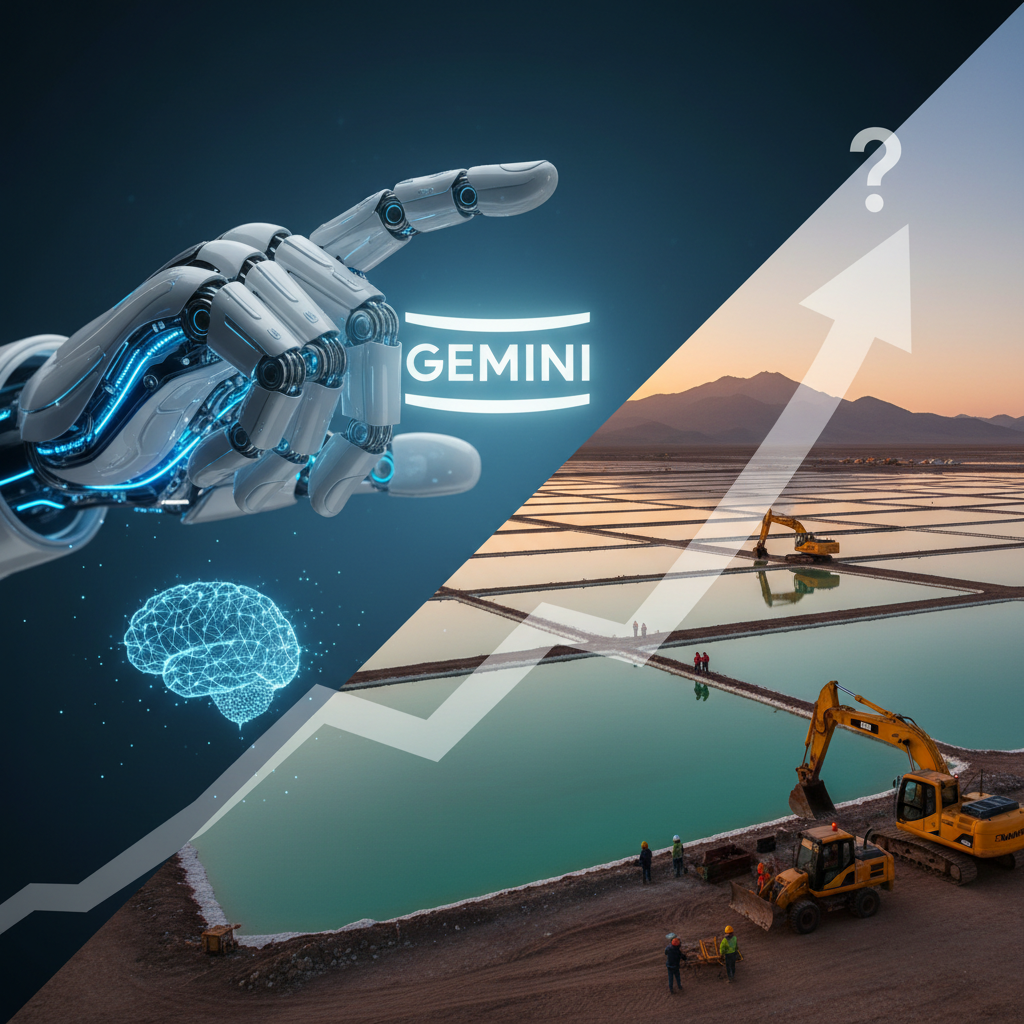
The digital world, much like the high-altitude mining operations I observe daily in Bolivia, runs on a complex, often unseen, infrastructure. While Silicon Valley debates the nuances of large language models, here, we consider the tangible impact, the resources consumed, and the practical applications. The current fervor around Google Gemini's multimodal capabilities, and its ongoing contest with OpenAI's GPT series, is no exception. It is a technological arms race, certainly, but one with very real implications for nations like ours.
Google's latest iterations of Gemini have indeed demonstrated impressive multimodal reasoning, integrating text, images, audio, and video inputs with a fluidity that was once confined to science fiction. This capability, where an AI can not only understand a complex query but also interpret visual cues or spoken commands simultaneously, marks a significant leap. Sundar Pichai, CEO of Google and Alphabet, has consistently emphasized the company's long-term vision for AI, stating, “We are building a future where AI is a helpful assistant for everyone, everywhere. Multimodality is a crucial step towards that vision.” This sentiment, while aspirational, must be grounded in the reality of resource allocation and global equity.
OpenAI, with its GPT models, has undeniably set a formidable benchmark, particularly in natural language processing. The continuous refinement of GPT-4 and its successors has pushed the boundaries of what AI can generate and comprehend, from intricate code to nuanced creative writing. However, the multimodal frontier is where the current battle is most fiercely waged. While GPT models have integrated image and voice capabilities, Gemini's architecture, developed by Google DeepMind, appears designed from the ground up for this integrated understanding. This architectural difference is not trivial; it speaks to varying philosophies in AI development and potentially different pathways to achieving artificial general intelligence, or AGI.
The real question for us, looking from 4,000 meters above sea level, is not just what these models can do, but what they demand. These advanced AI systems require immense computational power, which translates directly into energy consumption and, critically, into a demand for the rare earth minerals and metals that power the necessary hardware. Bolivia, as the nation with one of the world's largest lithium reserves, finds itself at the epicenter of this global technological expansion. The batteries that power the data centers, the GPUs, and the devices accessing these AI models all rely on materials extracted from our soil. This is not a distant concern; it is our daily reality.
Consider the data. Training a single large AI model can consume energy equivalent to what several homes use in a year. As these models become more complex and multimodal, their energy footprint only grows. This is a topic of increasing discussion in the tech world. According to a report highlighted by MIT Technology Review, the carbon footprint of training some large language models can be substantial, comparable to the lifetime emissions of multiple cars. This data is sobering, particularly when we consider the environmental impact of lithium extraction, even with improved methods. Bolivia's challenges require Bolivian solutions, and part of that is ensuring that our resources contribute to a sustainable future, not merely an accelerated consumption cycle.
The practical applications of multimodal AI in a country like Bolivia are compelling, yet often overlooked in the global narrative. Imagine a multimodal AI assistant that can interpret a farmer's spoken query about crop disease, analyze an image of the affected plant, and then provide guidance in Quechua or Aymara, referencing local agricultural practices and climate data. Or an AI that can assist medical professionals in remote areas by analyzing medical images and patient descriptions, overcoming language barriers and limited access to specialized expertise. These are not utopian fantasies; these are practical needs that could genuinely benefit from advanced AI, provided the technology is accessible, affordable, and culturally relevant.
Dr. Ricardo Flores, a lead researcher at the Bolivian Institute of AI Applications in La Paz, recently commented, “The promise of multimodal AI for development is immense, but we must ensure these technologies are designed with global accessibility and local context in mind. It is not enough to create powerful models; they must be adaptable to diverse linguistic and cultural realities, and their underlying infrastructure must be sustainable.” His perspective underscores the need for a pragmatic approach, one that looks beyond the immediate hype.
The competition between Google and OpenAI, and indeed other players like Anthropic and Meta, is driving rapid innovation. Each announcement of a new model or capability pushes the boundaries further. OpenAI's strategic partnerships and its focus on developer accessibility have created a vast ecosystem around GPT. Google, with its deep research capabilities and integration across its vast product suite, is leveraging its scale. The outcome of this race will shape the future of AI interfaces and applications globally. However, the true measure of success will not be who achieves the most impressive benchmark, but whose technology delivers the most meaningful and equitable impact.
Let's talk about what actually works at 4,000 meters. Here, connectivity can be intermittent, electricity supplies can be unstable, and specialized technical expertise is scarce. For AI to truly be transformative, it needs to function robustly in these challenging environments. This means efficient models, capable of running on less powerful hardware, and interfaces that are intuitive for users with varying levels of digital literacy. Edge AI, where processing happens closer to the data source rather than in distant cloud data centers, becomes particularly relevant. Qualcomm's advancements in on-device AI, for example, offer a glimpse into how powerful models might one day operate more independently, reducing reliance on constant cloud connectivity.
The altitude of innovation, for us, is not just about technical breakthroughs, but about resilience, adaptability, and resourcefulness. As Google and OpenAI continue their high-stakes competition, the world watches. But here in Bolivia, we are not just spectators. We are foundational to this technological future, providing the very elements that make it possible. Our focus remains on ensuring that this progress translates into tangible benefits for our people, rather than simply fueling another cycle of extractive demand. The conversation must shift from mere capability to equitable access, sustainable development, and genuine local empowerment. Without this shift, the most advanced AI models, no matter how multimodal or intelligent, will remain a distant echo for much of the world. The future of AI, like our mountains, must have solid foundations. For more insights into how AI is impacting global economies, consider reading about Ghana's AI Boom and its challenges.