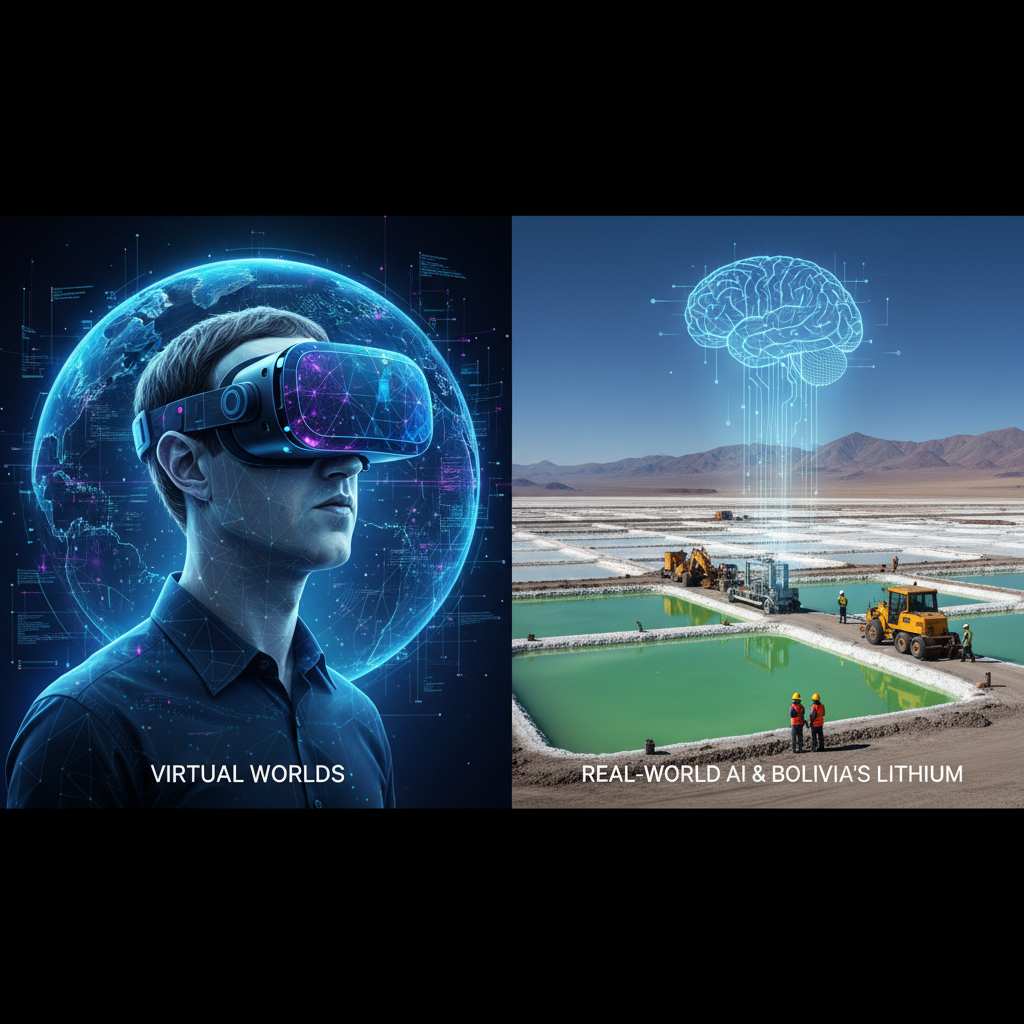
The digital landscape, much like the high-altitude plains of the Altiplano, is prone to sudden shifts in weather. For years, the tech world, led by Meta Platforms, chased the mirage of the metaverse, a sprawling digital realm promising immersive experiences. Yet, as with many grand visions, the practicalities often lag behind the hype. Mark Zuckerberg, Meta's CEO, has now unequivocally signaled a pivot: the future, he asserts, is AI. This is not merely a change in marketing rhetoric; it represents a fundamental re-engineering of Meta's core technological infrastructure and a strategic recalibration of its ambitions. For us in Bolivia, a nation poised at the nexus of the global lithium economy, understanding these shifts is not an academic exercise, it is a pragmatic necessity.
The technical challenge Meta faces is immense: to transition from a social media and virtual reality company to a leading AI powerhouse, capable of competing with OpenAI, Google, and Microsoft. This involves not just developing cutting-edge models but also integrating them across a vast ecosystem of applications, from Instagram to WhatsApp, and potentially, into new hardware initiatives. The problem Meta is solving is multifaceted: enhancing user engagement through personalized AI, creating new content generation tools, and, crucially, making its AI infrastructure scalable and efficient. This last point is particularly salient, given the insatiable computational demands of modern large language models (LLMs) and multimodal AI.
Architecture Overview: A Unified AI Stack
Meta's AI strategy centers on a unified AI stack, designed to support a diverse range of models and applications. At its core are massive data centers housing tens of thousands of NVIDIA GPUs, interconnected by high-bandwidth fabrics like InfiniBand or Meta's custom optical interconnections. This infrastructure is purpose-built for distributed training of gargantuan models. The architecture typically involves a hierarchical structure:
- Data Ingestion and Preprocessing: Petabytes of diverse data, including text, images, audio, and video, are collected from Meta's platforms. Robust data pipelines, often leveraging Apache Spark or Flink, are employed for cleaning, normalization, and tokenization. This stage is critical for mitigating biases and ensuring data quality.
- Model Training Clusters: These are the computational workhorses. Large-scale distributed training frameworks, such as PyTorch Distributed and Meta's own TorchElastic, orchestrate the training process across thousands of GPUs. Techniques like data parallelism and model parallelism are extensively used to handle models with trillions of parameters.
- Model Serving Infrastructure: Once trained, models need to be deployed efficiently for inference. Meta utilizes specialized serving systems like TorchServe and custom inference engines optimized for low latency and high throughput. These often involve quantization, pruning, and compilation to specialized hardware accelerators.
- Feedback Loops and Reinforcement Learning: Continuous learning is paramount. User interactions, model outputs, and explicit feedback are fed back into the training pipeline, often through reinforcement learning from human feedback (rlhf) mechanisms, to refine model behavior and alignment.
Key Algorithms and Approaches
Meta's pivot is heavily reliant on transformer architectures, particularly for its Llama series of LLMs. The core innovation lies in scaling these models and making them more efficient. For instance, the Llama 3 architecture, while still a decoder-only transformer, incorporates advancements such as Grouped-Query Attention (GQA) to reduce memory footprint and increase inference speed. This is crucial for deploying models at Meta's scale.
Consider a simplified conceptual example of GQA:
# Conceptual GQA for a single attention head
def grouped_query_attention(queries, keys, values, num_query_groups):
 # queries: (batch_size, seq_len, head_dim)
 # keys, values: (batch_size, seq_len, head_dim * num_query_groups)

# Reshape keys and values to have separate groups
 keys_grouped = keys.view(batch_size, seq_len, num_query_groups, head_dim)
 values_grouped = values.view(batch_size, seq_len, num_query_groups, head_dim)

outputs = []
 for i in range(num_query_groups):
 # For each query group, attend to its corresponding keys/values
 group_keys = keys_grouped[:, :, i, :]
 group_values = values_grouped[:, :, i, :]

 # Standard dot-product attention for this group
 attention_scores = torch.matmul(queries, group_keys.transpose(-2, -1)) / sqrt(head_dim)
 attention_weights = F.softmax(attention_scores, dim=-1)
 output = torch.matmul(attention_weights, group_values)
 outputs.append(output)

 # Concatenate outputs or average them depending on specific GQA variant
 return torch.cat(outputs, dim=-1) # Or some other aggregation
# Conceptual GQA for a single attention head
def grouped_query_attention(queries, keys, values, num_query_groups):
 # queries: (batch_size, seq_len, head_dim)
 # keys, values: (batch_size, seq_len, head_dim * num_query_groups)

# Reshape keys and values to have separate groups
 keys_grouped = keys.view(batch_size, seq_len, num_query_groups, head_dim)
 values_grouped = values.view(batch_size, seq_len, num_query_groups, head_dim)

outputs = []
 for i in range(num_query_groups):
 # For each query group, attend to its corresponding keys/values
 group_keys = keys_grouped[:, :, i, :]
 group_values = values_grouped[:, :, i, :]

 # Standard dot-product attention for this group
 attention_scores = torch.matmul(queries, group_keys.transpose(-2, -1)) / sqrt(head_dim)
 attention_weights = F.softmax(attention_scores, dim=-1)
 output = torch.matmul(attention_weights, group_values)
 outputs.append(output)

 # Concatenate outputs or average them depending on specific GQA variant
 return torch.cat(outputs, dim=-1) # Or some other aggregation
This conceptual pseudocode illustrates how multiple query heads can share a smaller set of key and value heads, significantly reducing the computational burden during inference without a drastic drop in performance. Meta has also invested heavily in multimodal AI, integrating vision and audio capabilities into its models, moving beyond text-only generation. This involves fusing embeddings from different modalities early in the transformer stack, allowing for a richer, more contextual understanding of input data.
Implementation Considerations and Trade-offs
The practical implementation of such a strategy involves navigating significant trade-offs. Performance versus cost is a constant battle. Training Llama 3, for instance, reportedly required tens of thousands of GPUs running for months, incurring costs that run into the hundreds of millions of dollars. Optimizing GPU utilization, managing memory, and ensuring fault tolerance in such massive distributed systems are non-trivial engineering challenges. Furthermore, ethical considerations, including bias detection and mitigation, remain paramount, especially when deploying models that influence billions of users. "The altitude of innovation often reveals the thin air of ethical oversight," as one might say, emphasizing the need for robust governance.
Benchmarks and Comparisons
Meta's Llama series has consistently aimed to compete with proprietary models from OpenAI and Google. Llama 3, for example, has shown competitive performance on various benchmarks, including Mmlu (Massive Multitask Language Understanding) and HumanEval (code generation). While not always surpassing GPT-4 or Gemini Ultra, its open-source nature provides a distinct advantage, fostering a vibrant ecosystem of developers and researchers. This open approach, championed by Meta AI, stands in contrast to the more closed development cycles of some competitors, accelerating innovation and allowing for broader scrutiny. "Building With Mark Zuckerberg's pivot from metaverse to AI: Lessons From Production Deployments in Bolivia" might sound like a distant dream, but the open-source nature of Llama models makes local experimentation more feasible.
Code-Level Insights
For developers, Meta's commitment to PyTorch is a key takeaway. The PyTorch ecosystem, with libraries like torch.distributed, torch.compile, and fsdp (Fully Sharded Data Parallel), provides the foundational tools for building and scaling these models. Meta's fairseq library, though perhaps less prominent now, has also been influential in transformer research. For multimodal applications, frameworks like transformers from Hugging Face, often integrated with PyTorch, are essential for handling diverse data types and pre-trained models. Utilizing bitsandbytes for quantization and FlashAttention for optimized attention mechanisms are practical tips for improving efficiency on consumer-grade or smaller enterprise GPUs.
Real-World Use Cases
- Content Generation and Moderation: Meta's AI is deployed to generate creative content for ads and user posts, and critically, to moderate harmful content across its platforms. This involves sophisticated image, video, and text analysis. For example, AI identifies hate speech or misinformation at scale, a task impossible for human moderators alone.
- Personalized Recommendations: AI drives the recommendation engines across Facebook, Instagram, and Reels, tailoring content feeds, advertisements, and friend suggestions to individual users, significantly boosting engagement.
- Customer Support and Virtual Assistants: AI-powered chatbots and virtual assistants are increasingly handling customer service inquiries on WhatsApp Business and other Meta platforms, providing instant responses and escalating complex issues to human agents.
- Augmented Reality (AR) Experiences: While the metaverse vision has shifted, AR remains a focus. AI enhances AR filters, object recognition, and spatial computing, laying groundwork for future smart glasses and immersive experiences. This is where the lines between the physical and digital begin to blur, even if the grand metaverse is still a distant horizon.
Gotchas and Pitfalls
The journey is not without its challenges. Data privacy remains a perennial concern, especially given Meta's vast data holdings. Model bias, stemming from unrepresentative training data, can lead to discriminatory outcomes. The sheer energy consumption of training and running these models is also a significant environmental consideration. Furthermore, the rapid pace of AI development means that yesterday's state-of-the-art model can quickly become obsolete, requiring continuous investment in research and infrastructure. For a country like Bolivia, where infrastructure development is always a consideration, these energy demands present a unique challenge. "Let's talk about what actually works at 4,000 meters," is a sentiment that applies not just to physical infrastructure but also to the resource intensity of advanced AI.
Resources for Going Deeper
For those looking to delve further into Meta's AI advancements, the Meta AI blog is an invaluable resource, often publishing detailed technical posts on their latest models and research. Academic papers, particularly those presented at NeurIPS, Icml, and Iclr, frequently feature Meta researchers and their contributions. The arXiv pre-print server is another excellent source for cutting-edge research. For practical implementation, the PyTorch documentation and the Hugging Face transformers library documentation provide comprehensive guides and examples.
Mark Zuckerberg's pivot is not a retreat but a strategic repositioning, acknowledging the immediate, tangible value AI brings. For Bolivia, a nation rich in the very lithium that powers these computational behemoths, this shift underscores a critical reality: the global technological race increasingly hinges on raw materials. Our role is not just to supply the world with these resources but to understand the technologies they enable, to ensure that "Bolivia's challenges require Bolivian solutions" in this new AI-driven era. The future of AI, whether open or proprietary, will undoubtedly shape our world, and it is imperative that we, from our unique vantage point, are not merely observers but active participants in its evolution.