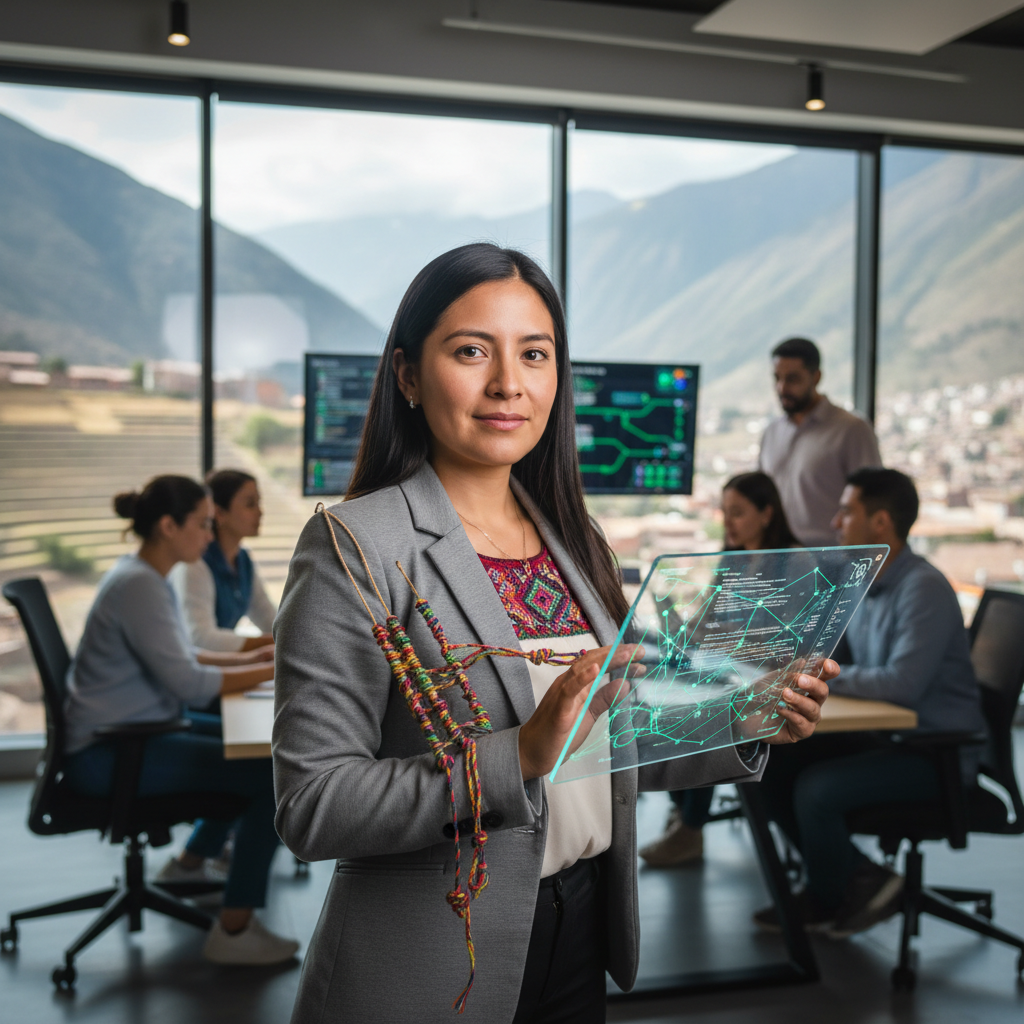

The air in Cusco, even now in April, carries a crispness that awakens the senses, a subtle reminder of the mountains that cradle this ancient city. It is a place where the past breathes alongside the present, where the stones of Incan walls tell stories to the modern world. It was here, amidst this powerful blend of history and innovation, that I first encountered the work of Khipu AI, a startup that is not just building technology, but weaving a narrative as rich and complex as the textiles of the Sacred Valley.
At the heart of Khipu AI is its founder, Dr. Elena Quispe, a woman whose eyes hold the wisdom of generations and the sharp intellect of a Stanford-trained AI researcher. I met her in a bustling café near the Plaza de Armas, the aroma of strong Peruvian coffee filling the air. She showed me something that changed my understanding of how ancient wisdom can truly meet modern AI. Elena grew up in a small community in the Urubamba Valley, learning from her grandmother the intricate art of weaving and the profound meaning behind the khipus, the knotted cords the Incas used to record information and stories. "My grandmother always said that every knot, every color, every twist had a purpose, a piece of knowledge," Elena told me, her voice soft but firm. "It was a system of immense complexity, yet beautifully ordered. When I started studying computer science and then artificial intelligence, I saw parallels. Our digital world, too, is full of complex information, but often without the inherent order or the deep understanding of context that the khipus embodied."
Elena's 'aha moment' came during her doctoral research on anomaly detection in large datasets. She was grappling with how to make AI systems not just identify threats, but understand their context within a larger, evolving system. Traditional cybersecurity often felt like a game of whack-a-mole, reacting to known threats. Elena envisioned something more proactive, more intuitive, something that could 'read' the digital landscape with the depth of a khipu master interpreting ancient records. "OpenAI's enterprise push, particularly with ChatGPT Enterprise, was a game changer for us," she explained. "It offered the foundational large language model capabilities we needed, but with the security and customization that businesses demand. We realized we could build a layer on top, a truly intelligent 'khipu' that could interpret the subtle 'knots' in network traffic, user behavior, and data flow to predict and neutralize threats before they escalate."
The problem Khipu AI is solving is profound, especially for businesses in Latin America. Cyberattacks are not just growing in volume, but in sophistication. Phishing scams, ransomware, and state-sponsored espionage are costing companies billions annually. In Peru alone, the Ministry of Transport and Communications reported a 300% increase in cyber incidents targeting critical infrastructure in the last two years. Small and medium enterprises, often lacking dedicated cybersecurity teams, are particularly vulnerable. Existing solutions are often generic, expensive, and fail to account for the unique linguistic, cultural, and operational nuances of the region.
Khipu AI's technology, which they call 'KhipuGuard,' integrates directly with a company's existing infrastructure, leveraging the robust, secure environment of ChatGPT Enterprise. Instead of simply flagging suspicious keywords or IP addresses, KhipuGuard uses advanced natural language processing and behavioral analytics to build a contextual understanding of a company's digital ecosystem. It learns the normal patterns of communication, data access, and workflow, much like a khipu master understands the normal rhythm of their community's records. When an anomaly occurs, it is not just detected; its potential impact and origin are analyzed within this rich context. For instance, an email written in a specific regional dialect, attempting to solicit sensitive information, would be flagged not just for its content, but for its deviation from the sender's usual communication style and the recipient's typical interactions, all while respecting data privacy and localization needs. "We train our models on diverse datasets, including regional linguistic patterns and common business practices here in Latin America," Elena emphasized. "This makes KhipuGuard far more accurate and less prone to false positives than systems trained primarily on North American or European data."
The market opportunity for Khipu AI is immense. The global cybersecurity market is projected to reach over $300 billion by 2027, with Latin America being one of the fastest-growing segments. A recent report by Reuters highlighted the increasing investment in AI-driven cybersecurity solutions. Elena estimates the addressable market for Khipu AI in Latin America alone to be around $15 billion, focusing initially on financial services, government agencies, and critical infrastructure. "Our initial pilot programs have shown remarkable results," she stated, showing me a slide detailing a 92% reduction in successful phishing attacks and a 75% faster threat response time for their early clients. "This translates directly into saved revenue and protected reputations."
In terms of funding, Khipu AI has already secured a seed round of $5 million from regional venture capital firms, including Lima Ventures and Andean Tech Fund, and is currently in talks for a Series A round, aiming for $20 million. Their valuation is projected to hit $80 million by the end of this year, a testament to their innovative approach and the urgent market need.
The competitive landscape is crowded, with giants like Palo Alto Networks, CrowdStrike, and Microsoft offering enterprise cybersecurity solutions. However, Elena believes Khipu AI's unique value proposition lies in its deep contextual understanding and regional focus. "Many large players offer powerful tools, but they often lack the nuanced understanding of the local threat landscape and the cultural context that is so vital here," she explained. "Our integration with OpenAI's enterprise offerings gives us the raw power of a world-class LLM, but our 'khipu' layer provides the intelligence that truly resonates with our clients. We are not just selling a product; we are offering a tailored shield, built with an understanding of our unique digital tapestry."
I asked her about the ethical implications, a topic often discussed in the AI community. "We are very conscious of bias and privacy," Elena replied. "Our system is designed with transparency and explainability in mind. We are also working closely with regulatory bodies like Peru's National Authority for Personal Data Protection to ensure compliance and build trust." She believes that by embedding cultural understanding and ethical considerations from the ground up, Khipu AI can set a new standard for responsible AI deployment in sensitive areas like defense.
What is next for Khipu AI? Elena envisions expanding their reach across Latin America, adapting KhipuGuard to the specific needs of different countries and industries. They are also exploring partnerships with local universities, like the Universidad Nacional Mayor de San Marcos, to foster a new generation of AI talent deeply rooted in the region's unique heritage. "This is a story about ancient wisdom meeting modern AI, not just for profit, but for protection and progress," she concluded, a determined glint in her eye. "We are building a digital guardian, inspired by the ingenuity of our ancestors, to safeguard the future of our businesses and our communities."
As I left the café, the ancient stones of Cusco seemed to hum with a new energy. Khipu AI is more than just a startup; it is a powerful example of how innovation can draw strength from tradition, proving that the future of enterprise defense might just be found by looking back at the wisdom of the past, interpreted through the lens of cutting-edge artificial intelligence. Their work reminds us that the most effective solutions often emerge when technology is deeply connected to the human experience and local context, building bridges between the digital and the deeply human. You can learn more about the broader trends in AI startups and enterprise solutions on TechCrunch.