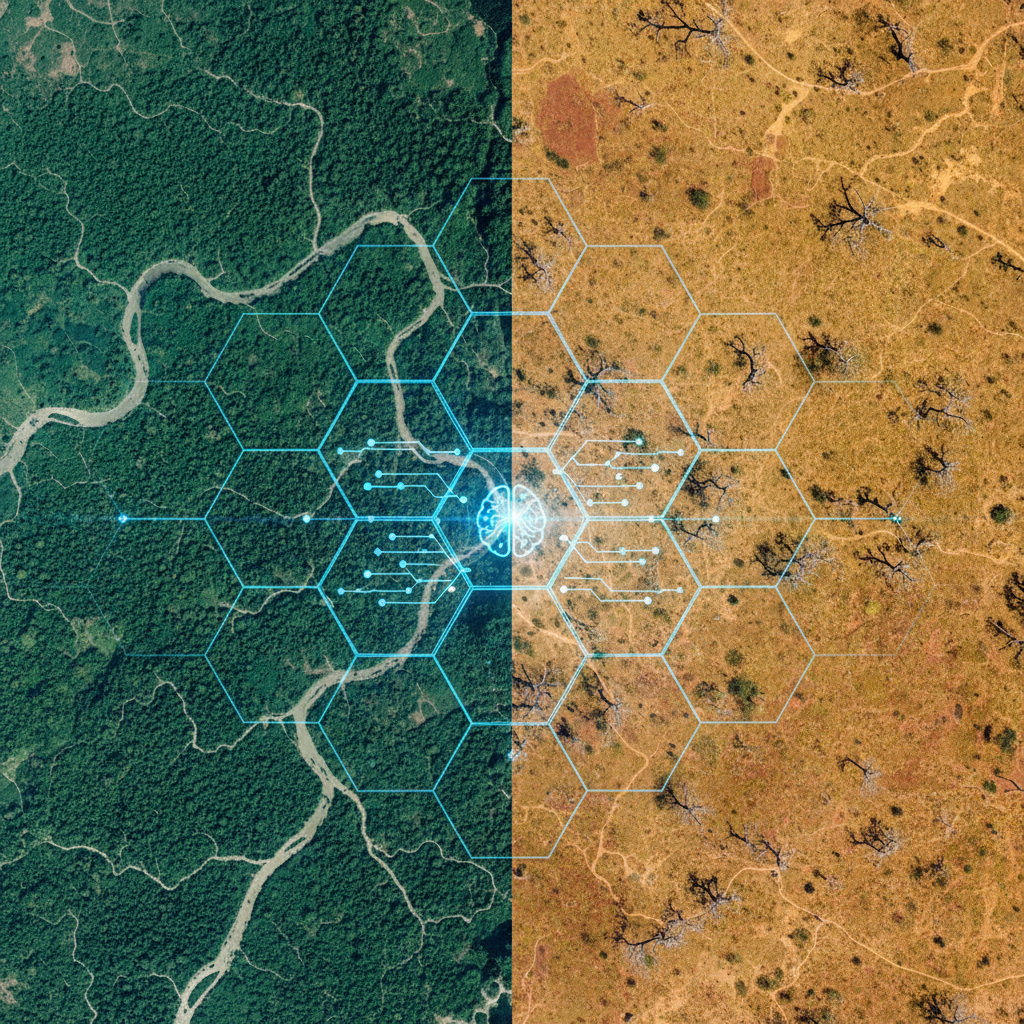

The world talks about climate change, but here in Brazil, we live it. From the scorching droughts in the Northeast to the relentless floods in the South, the changes are not abstract, they are our daily reality. For too long, the narrative has been one of despair, of a planet in peril. But I see something different, something vibrant and full of potential. I see Brazil, the sleeping giant of AI, waking up, not just for economic gain, but to tackle the biggest challenge humanity has ever faced: saving our home.
And how are we doing it? By getting smarter, much smarter, about how we understand our environment. No more guesswork, no more relying on outdated models. We are leveraging the power of artificial intelligence, specifically advanced systems like Google DeepMind's 'TerraPredict', to give us a real-time, granular view of our ecosystems. This isn't just about pretty maps; this is about survival, about making informed decisions that will shape the next hundred years, not just the next fiscal quarter.
The Big Picture: What Does TerraPredict Do for Brazil?
Imagine having a crystal ball, but instead of vague prophecies, it gives you precise data on deforestation, water stress, crop yields, and even the health of our biodiversity, all across a continent-sized nation. That's essentially what TerraPredict aims to be for Brazil. It's an AI-driven platform designed to monitor, predict, and analyze environmental changes at an unprecedented scale and speed. Its primary goal is to provide actionable intelligence to governments, farmers, conservationists, and even indigenous communities, helping them adapt to and mitigate the impacts of climate change.
Think about the Amazon, our lungs of the world. Understanding its complex dynamics, from illegal logging to shifting rainfall patterns, is a monumental task. TerraPredict takes in vast amounts of satellite imagery, weather data, soil composition, and even local sensor readings, then uses sophisticated machine learning models to identify patterns and predict future scenarios. It's like having millions of highly trained environmental scientists working 24/7, without ever needing a coffee break.
The Building Blocks: Key Components Explained Simply
TerraPredict isn't a single, monolithic AI. It's a symphony of interconnected systems, each playing a crucial role:
-
Data Ingestion Layer: This is the hungry mouth of the system. It continuously pulls in petabytes of data from various sources: NASA's Landsat and Sentinel satellites, Brazil's own Inpe (National Institute for Space Research) satellites, ground-based weather stations, river sensors, and even drone footage from specific regions. It's all about raw, unfiltered environmental information.
-
Feature Extraction Modules: Once the data is in, specialized neural networks get to work. For satellite images, convolutional neural networks (CNNs) are employed to identify specific features: tree cover, bare soil, water bodies, agricultural fields, urban sprawl. For numerical data like temperature or humidity, other models extract trends and anomalies. This is where the raw pixels become meaningful environmental indicators.
-
Predictive Modeling Engine: This is the brain, where the magic truly happens. Using a combination of recurrent neural networks (RNNs) for time-series analysis and transformer models for spatial context, this engine builds predictive models. It learns from historical data to forecast future trends. For example, it can predict the likelihood of a drought in the Cerrado based on current rainfall, soil moisture, and El Niño patterns, with an accuracy rate often exceeding 90 percent for short-term forecasts.
-
Anomaly Detection System: This component is the alarm bell. It constantly compares current data and predictions against established baselines. If it detects a sudden surge in deforestation in a protected area, or an unexpected drop in river levels, it flags it immediately. This is critical for rapid response and intervention.
-
Visualization and Decision Support Interface: What good is all this complex AI if nobody can understand it? This is the user-friendly face of TerraPredict. It translates complex data and predictions into intuitive maps, dashboards, and reports. It allows users, from a state governor to a local farmer, to query the system and get clear, actionable insights.
Step by Step: How It Works from Input to Output
Let's walk through a typical scenario, say, monitoring deforestation in a critical part of the Amazon:
-
Satellite Scan: Every few days, or even daily, satellites pass over the Amazon, capturing high-resolution images. These images, along with meteorological data, are streamed to Google's cloud infrastructure.
-
Pre-processing and Feature Extraction: TerraPredict's data ingestion layer receives these images. Its CNNs immediately begin analyzing them, pixel by pixel. They identify specific spectral signatures that indicate healthy forest, degraded forest, newly cleared land, or agricultural conversion. This process can classify millions of hectares in minutes.
-
Change Detection: The anomaly detection system compares the new classifications with previous observations. If a patch of healthy forest suddenly appears as bare soil, it's flagged as a potential deforestation event. The system can even differentiate between natural forest loss (like a storm) and human-induced clearing with high confidence.
-
Prediction and Risk Assessment: Based on historical trends, current weather, and economic indicators, the predictive modeling engine might then forecast the likelihood of further deforestation in that region over the next few weeks or months. It might also identify adjacent areas at high risk.
-
Alert and Action: An alert is sent to the relevant authorities, perhaps the Brazilian Institute of Environment and Renewable Natural Resources (ibama) or a local environmental agency. The visualization interface provides a detailed map of the affected area, showing the extent of the damage, the rate of change, and the predicted trajectory. This allows for targeted enforcement actions, like deploying patrols or drones.