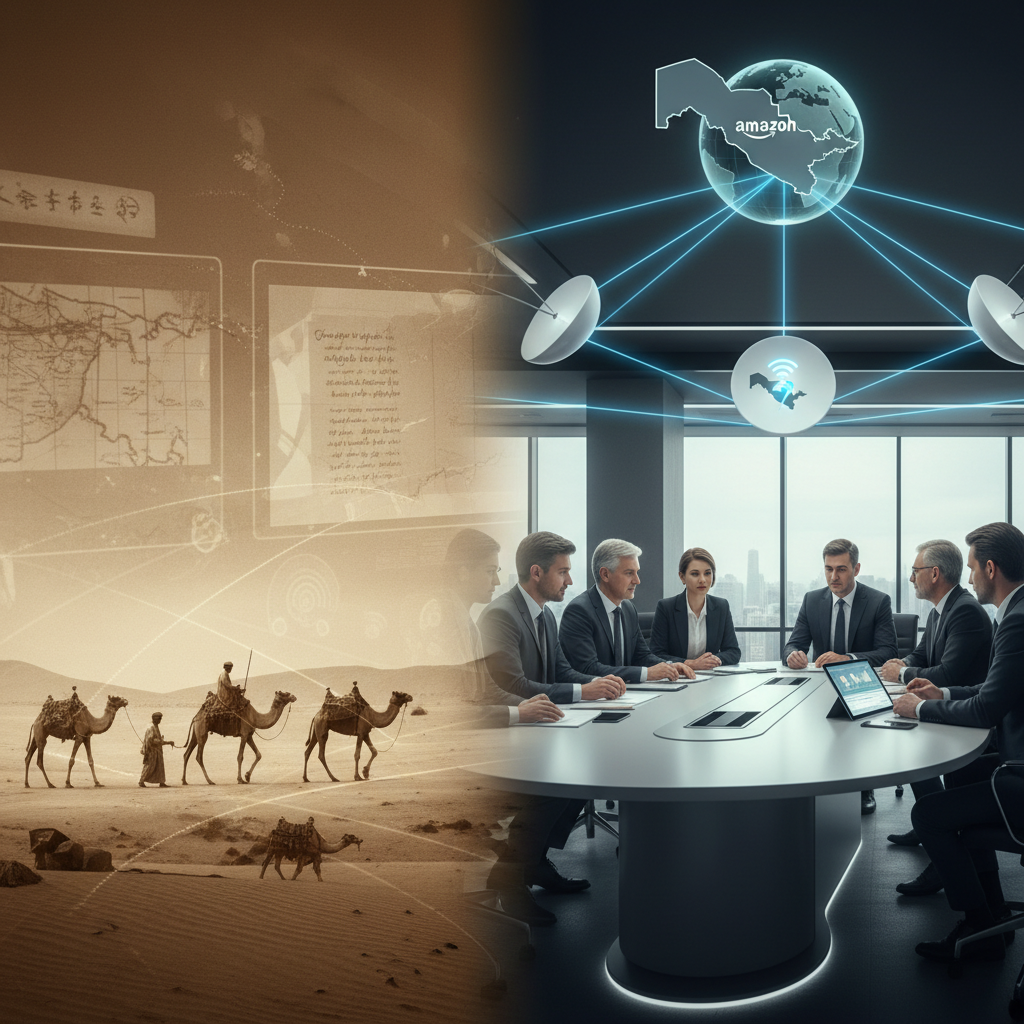

The scent of spices and freshly baked non still hangs heavy in the air of the Chorsu Bazaar in Tashkent, a place where history whispers from every archway. Yet, just a few kilometers away, in a small office in Tashkent, a different kind of revolution is unfolding. It is not about ancient trade routes, but about invisible highways of data, stretching from the sky to the very heart of Uzbekistan's burgeoning economy. This is the story of how Amazon's Project Kuiper, with its constellation of low Earth orbit satellites, is not just bringing internet to remote corners, but is fundamentally reshaping the enterprise landscape, powered by the quiet hum of artificial intelligence.
For too long, businesses in Central Asia faced a digital chasm. Reliable, high-speed internet was a luxury, often expensive and inconsistent, particularly outside major urban centers. This limited everything from e-commerce potential to access to global markets and advanced cloud services. Then came Project Kuiper. While its global rollout is ambitious, its impact here, in a region yearning for connectivity, feels particularly profound. Amazon's strategy to integrate Kuiper's high-bandwidth, low-latency internet with its robust AWS cloud services, including a suite of AI tools, has created a powerful synergy.
I recently spoke with Dilshod Karim, the CEO of 'Oltin Qo'l' (Golden Hand), a cooperative that connects artisans from across Uzbekistan with international buyers. Their challenge was always connectivity. "Before Kuiper, our artisans in places like Khiva or Bukhara struggled to upload high-resolution images of their intricate ceramics or silk carpets," Dilshod explained, his eyes bright with enthusiasm. "Video calls with international clients were a dream, often pixelated and dropping. Now, with Kuiper terminals, they can showcase their work live, use AI-powered translation tools for negotiations, and even manage inventory through cloud platforms. Our sales have increased by 30 percent in the last six months, and we are reaching markets we never thought possible." This is not just about faster internet; it is about empowering livelihoods and preserving cultural heritage through digital means.
The data supports Dilshod's anecdotal evidence. A recent report from the Ministry of Digital Technologies indicated a 25 percent increase in digital service adoption among small and medium-sized enterprises (SMEs) in rural and semi-urban areas since the initial Kuiper deployments began in late 2025. This surge is largely attributed to the availability of reliable internet and the subsequent uptake of cloud-based business tools. Furthermore, a study by IDC, a global market intelligence firm, projected that Central Asian countries, including Uzbekistan, could see an additional 0.5 percent to 1 percent growth in GDP directly linked to enhanced digital infrastructure and AI adoption by 2030. This is a significant figure for a developing economy.
However, it is not a uniform story of success. The initial investment in Kuiper terminals and the subscription costs, while becoming more accessible, still pose a barrier for the smallest micro-enterprises. "We have seen a clear divide," noted Professor Gulnora Saidova, an economist at the Tashkent State University of Economics. "Larger enterprises, particularly in logistics, mining, and education, have been quick to adopt Kuiper and leverage AI for operational efficiency. For instance, mining companies are using AI for predictive maintenance on heavy machinery in remote locations, reducing downtime by an estimated 15 percent. Educational institutions are deploying AI-powered learning platforms across distant schools. But for the small family-run businesses, the leap is still substantial. We need more localized support and training programs to ensure this digital transformation is inclusive." Her insights highlight the crucial role of government and local initiatives in bridging this gap.
Indeed, the winners in this new landscape are those with the foresight and capital to invest. Logistics firms, for example, are using Kuiper's reliable connection to power real-time tracking and AI-optimized route planning across vast, often challenging terrains. Agricultural enterprises are deploying IoT sensors in fields, transmitting data via satellite for AI-driven insights on irrigation and crop health, leading to more efficient resource use. These are sectors where the return on investment for high-quality connectivity and AI tools is immediate and tangible.
But what about the workers? The human element remains at the core of this transformation. I spoke with Zulfiya Sharipova, a young software developer in Tashkent who recently joined a local tech startup focused on AI solutions for agriculture. "Before, if we needed to access a large language model or a specialized AI library, the download times alone could be hours, sometimes days, with our old connection," she told me, gesturing animatedly. "Now, with Kuiper's speed, we can iterate faster, collaborate seamlessly with global partners, and access vast computational resources on AWS. It feels like we have been given wings." She showed me something remarkable: an AI model trained on local Uzbek crop data, predicting pest outbreaks with startling accuracy. This kind of innovation, once hampered by infrastructure, is now flourishing.
Of course, there are concerns. The rapid introduction of AI, even with the best intentions, raises questions about job displacement, particularly in administrative and repetitive tasks. "We must proactively address the skills gap," urged Dr. Alisher Makhmudov, head of the Uzbekistan Academy of Sciences' AI department. "Our education system needs to adapt quickly, focusing on digital literacy, critical thinking, and specialized AI skills. The goal is not to replace human workers, but to augment their capabilities, freeing them for more creative and strategic roles." This perspective underscores the need for a thoughtful approach to workforce development.
Looking ahead, the next phase of Kuiper's integration with AI in Uzbekistan promises even more profound changes. Amazon's continued investment in its AWS infrastructure globally, including new AI services, will only amplify the capabilities available here. The development of localized AI models, trained on Uzbek language and cultural data, will further tailor these technologies to the specific needs of the region. This could lead to breakthroughs in areas like personalized education, healthcare diagnostics, and even the digital preservation of Uzbekistan's rich historical archives. The potential for Central Asia's best-kept secret, its vibrant culture and ingenuity, to connect with the global digital economy is immense.
The journey from ancient caravan routes to satellite internet is a testament to human ambition. As Amazon's Kuiper continues to weave its digital threads across the Uzbek landscape, connecting people and businesses, it reminds us that true progress is not just about technology, but about the opportunities it unlocks for every individual. The digital future is not just arriving; it is being built, piece by digital piece, right here. For more insights into how AI is reshaping global industries, you can explore reports on TechCrunch or MIT Technology Review. The story of digital transformation in emerging markets is just beginning. You can also find more global tech news on BBC News Technology.