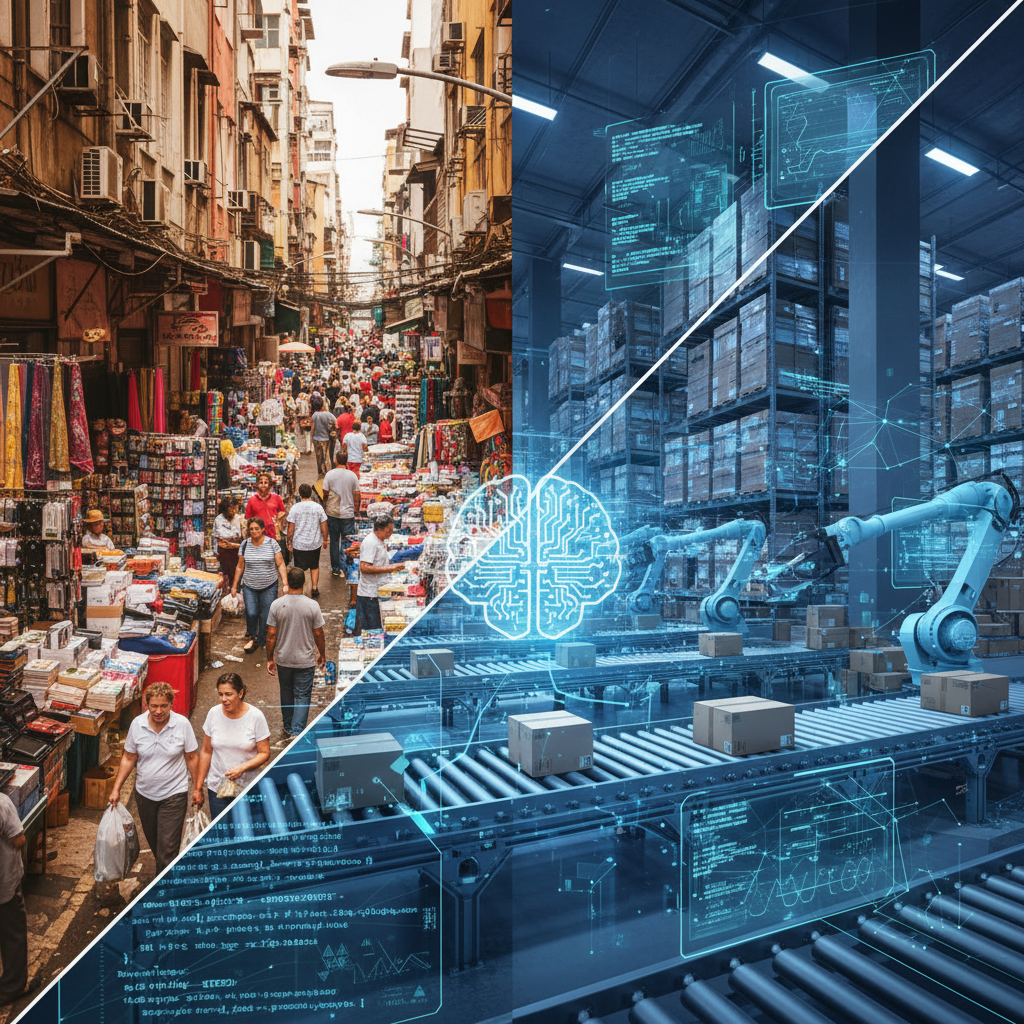

Walk through any major city in Brazil, from São Paulo to Rio, and you will feel the pulse of commerce. From the vibrant street vendors of Rua 25 de Março to the gleaming malls, retail is the lifeblood of our economy. But beneath the surface, a profound shift is underway, powered by artificial intelligence. This isn't just about chatbots or fancy recommendation engines, my friends. This is about the very nervous system of retail: demand forecasting, inventory optimization, and personalized shopping. And for developers and data scientists in Brazil and across Latin America, understanding the technical architecture behind this transformation is not just an advantage, it is a necessity.
The traditional methods, often relying on historical averages or simple time series models, are like trying to navigate the Amazon River with a canoe when you need a satellite. The sheer volatility of consumer behavior, influenced by everything from economic shifts to cultural events like Carnival or the World Cup, makes accurate prediction a Herculean task. Retailers face a constant dilemma: too much stock means capital tied up and potential waste, too little means lost sales and unhappy customers. Then there is the challenge of making each customer feel seen, understood, and valued, not just another number in a spreadsheet. This is where AI steps in, offering a level of precision and adaptability that was once unimaginable.
Let me explain the architecture: The Retail AI Brain
At its core, a robust AI-driven retail system is a complex symphony of data pipelines, machine learning models, and real-time decision engines. Think of it like a highly sophisticated logistical operation, but instead of moving physical goods, it's moving data and insights. The architecture typically begins with a robust data ingestion layer, pulling information from diverse sources: point-of-sale (POS) systems, e-commerce platforms, customer relationship management (CRM) databases, supply chain logs, social media feeds, weather data, and even macroeconomic indicators. This raw data, often messy and disparate, is then cleaned, transformed, and stored in a data lake or data warehouse, perhaps using solutions like Google Cloud's BigQuery or AWS Redshift.
From there, the system branches into specialized modules, each powered by distinct AI models:
-
Demand Forecasting Module: This is the predictive powerhouse. It consumes cleaned historical sales data, promotional calendars, external factors, and even competitor pricing. Models here often include advanced time series techniques like arima (Autoregressive Integrated Moving Average), Prophet (from Meta), or more sophisticated deep learning approaches such as Recurrent Neural Networks (RNNs), specifically LSTMs (Long Short-Term Memory), or even Transformer networks for handling long-range dependencies in sequential data. The output is a probabilistic forecast for each SKU (Stock Keeping Unit) at various granularities, from daily to monthly, and at different store or regional levels. For instance, predicting the demand for pão de queijo in a specific bakery in Belo Horizonte during a holiday week requires a model sensitive to local nuances.
-
Inventory Optimization Module: This module takes the demand forecasts and marries them with supply chain constraints and costs. It considers lead times, supplier reliability, storage costs, obsolescence risks, and desired service levels. Optimization algorithms, often based on reinforcement learning or stochastic programming, determine optimal reorder points and quantities. The goal is to minimize holding costs and stockouts simultaneously. Imagine a Brazilian supermarket chain like Carrefour Brasil, managing thousands of SKUs across hundreds of stores. The complexity is staggering, and the code tells the real story of how these systems manage to keep shelves stocked without excess.
-
Personalized Shopping Module: This is where the customer experience truly shines. It leverages customer profiles, browsing history, purchase patterns, and real-time interactions. Common techniques include collaborative filtering (user-user or item-item similarity), matrix factorization (like Singular Value Decomposition), and increasingly, deep learning-based recommender systems that can capture complex, non-linear relationships. Think of a system suggesting cachaça brands to a customer who frequently buys caipirinha ingredients, or recommending a new samba album based on their streaming history. These systems often employ A/B testing frameworks to continuously evaluate and improve recommendation efficacy.
Key Algorithms and Approaches
For demand forecasting, a simplified conceptual example of an Lstm might look like this:
# Conceptual Lstm for time series forecasting
import tensorflow as tf
from tensorflow.keras.models import Sequential
from tensorflow.keras.layers import Lstm, Dense

# Assume 'X_train' is sequences of historical sales data, 'y_train' is future sales
model = Sequential([
 LSTM(units=50, activation='relu', input_shape=(timesteps, features)),
 Dense(units=1)
])
model.compile(optimizer='adam', loss='mse')
model.fit(X_train, y_train, epochs=100, batch_size=32)
# Conceptual Lstm for time series forecasting
import tensorflow as tf
from tensorflow.keras.models import Sequential
from tensorflow.keras.layers import Lstm, Dense

# Assume 'X_train' is sequences of historical sales data, 'y_train' is future sales
model = Sequential([
 LSTM(units=50, activation='relu', input_shape=(timesteps, features)),
 Dense(units=1)
])
model.compile(optimizer='adam', loss='mse')
model.fit(X_train, y_train, epochs=100, batch_size=32)
This is a highly simplified representation, of course. In reality, feature engineering is critical, incorporating external variables like holidays, promotions, price changes, and even local weather patterns. For inventory, a common approach involves dynamic programming or simulation to find optimal policies given probabilistic demand. For personalization, embedding techniques (like Word2Vec for items or users) combined with neural networks are powerful.
Implementation Considerations and Benchmarks
Implementing these systems is not for the faint of heart. Data quality is paramount; garbage in, garbage out, as we say. Scalability is another huge factor. Processing billions of transactions daily requires distributed computing frameworks like Apache Spark or Flink. Model interpretability, especially in regulated industries, is gaining importance. Explainable AI (XAI) techniques, such as Shap or Lime, help us understand why a model made a particular prediction, which is crucial for trust and debugging. Performance is measured not just by model accuracy (e.g., Rmse for forecasting) but by business metrics: reduction in stockouts, decrease in inventory holding costs, and uplift in average order value or conversion rates. According to a recent report by Reuters, retailers adopting AI for supply chain optimization have seen inventory reductions of up to 30% and service level improvements of 5-10%.
Real-World Use Cases
- Magazine Luiza (Magalu): This Brazilian retail giant has been a pioneer in leveraging AI. They use sophisticated models for demand forecasting across their vast product catalog, optimizing inventory in their physical stores and distribution centers. Their personalized recommendation engine is a key driver of their e-commerce success, suggesting everything from electronics to fashion based on user behavior and preferences. They have also invested heavily in logistics, using AI to optimize delivery routes.
- Mercado Livre (MercadoLibre): While an Argentine company, its massive presence in Brazil means its AI innovations directly impact our market. Their platform uses AI extensively for search ranking, fraud detection, and, crucially, for personalizing the buyer and seller experience. Their fulfillment centers, similar to Amazon's, rely on AI for optimal storage and picking strategies.
- Grupo Pão de Açúcar (GPA): One of Brazil's largest food retailers, GPA employs AI for fresh produce demand forecasting, a notoriously difficult problem due to perishability. This reduces waste and ensures product availability, directly impacting profitability and customer satisfaction.
Gotchas and Pitfalls
Deploying AI in retail is not without its challenges. Data silos are a common problem, preventing a holistic view of the customer or supply chain. Overfitting models to historical data can lead to poor performance during unexpected events, like a sudden economic downturn or a global pandemic. Ethical considerations around data privacy and algorithmic bias in personalization are also critical. For example, ensuring that recommendation engines do not inadvertently create filter bubbles or discriminate against certain customer segments is a continuous effort. Furthermore, the initial investment in infrastructure and talent can be substantial. Brazil's developer community is massive and talented, but the specialized skills needed for advanced AI implementation are still in high demand.
Resources for Going Deeper
For those looking to dive deeper, I recommend exploring academic papers on time series forecasting, particularly those involving deep learning. The arXiv repository is an excellent resource for cutting-edge research. For practical implementations, explore libraries like TensorFlow, PyTorch, Scikit-learn, and specialized time series libraries like statsmodels or pmdarima in Python. Courses on platforms like Coursera or edX focusing on machine learning engineering and MLOps are also invaluable. Understanding how to deploy and monitor these models in production is just as important as building them.
Ultimately, the integration of AI into retail is not a fad, it is a fundamental shift. It is about moving from reactive decision-making to proactive, intelligent operations. For Brazil, a country with immense retail potential and a dynamic consumer base, embracing these technologies is key to unlocking new levels of efficiency, customer satisfaction, and economic growth. The future of commerce is already here, and it speaks the language of algorithms.