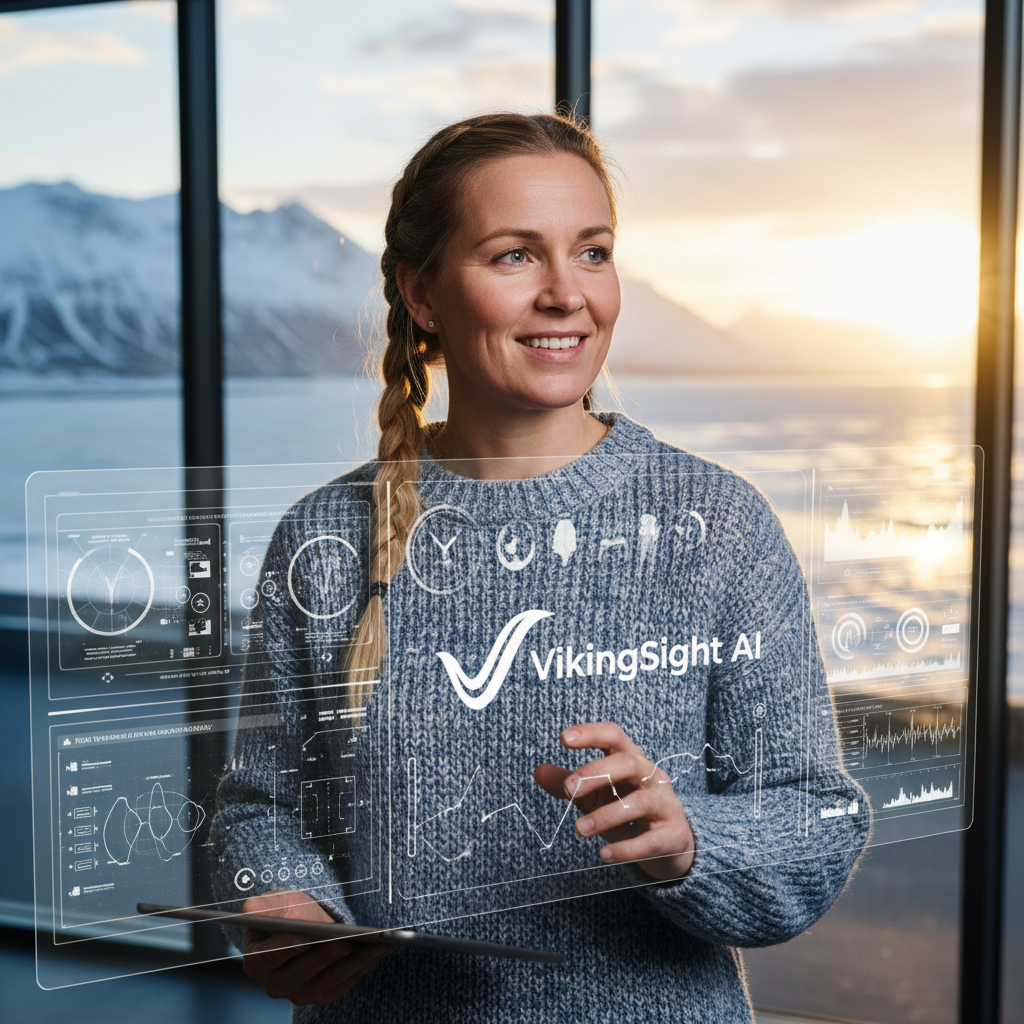
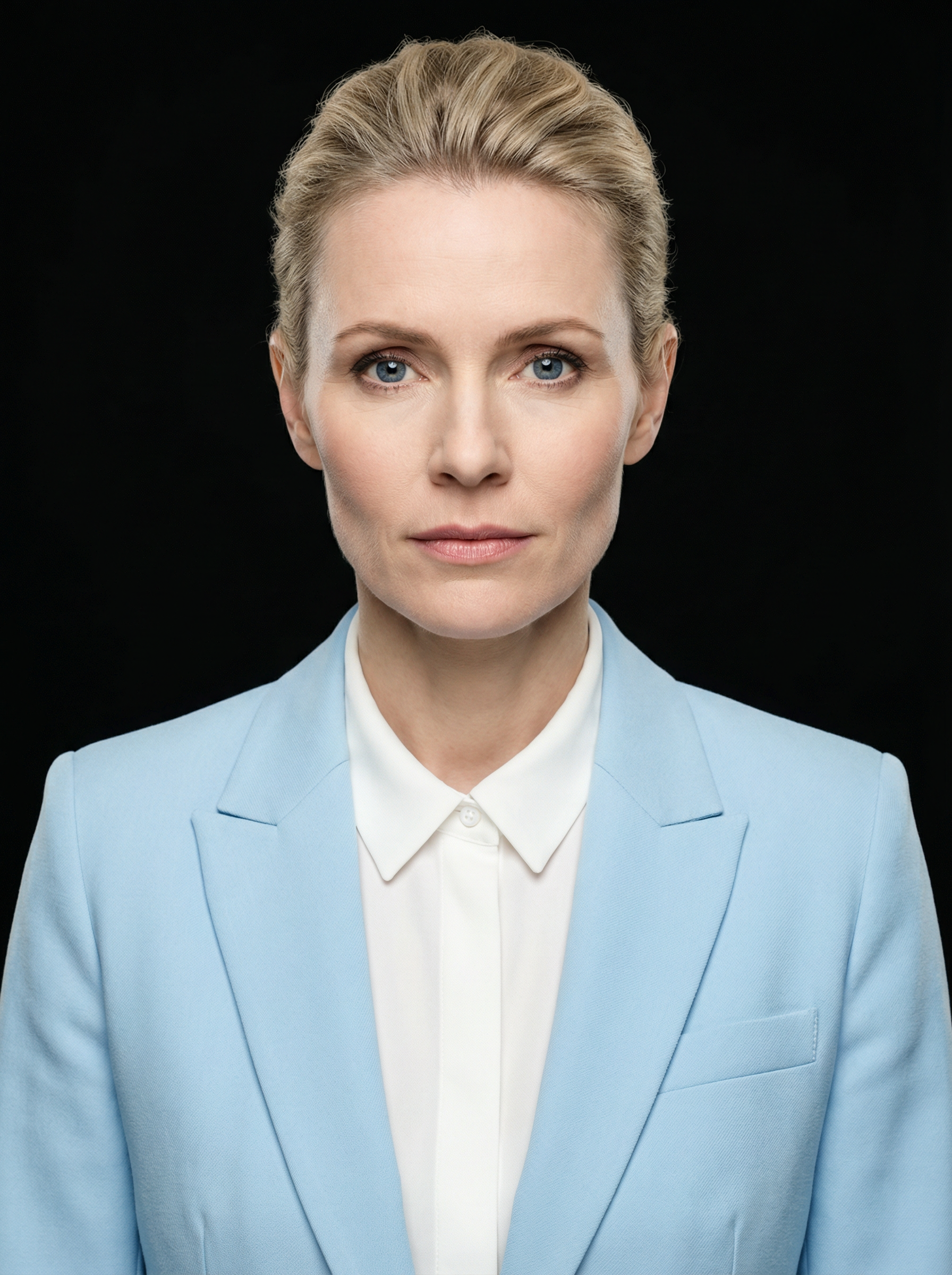
The wind whipped around us, carrying the scent of salt and the distant murmur of the Atlantic. Elín Magnúsdóttir, dressed in a practical, warm jacket, gestured towards the football pitch below, where a youth team was training despite the biting April chill. "You see them," she said, her voice clear above the wind, "every single one dreams of greatness. My job, our company's job, is to help them get there, and to keep them healthy along the way." This was not a Silicon Valley boardroom, but a small, unassuming office building in Reykjavík, overlooking the very fields where Elín herself once played. It felt perfectly fitting for the founder of VikingSight AI, a company now valued at $300 million after a recent $30 million Series A round led by Altos Ventures, that is changing how the world understands athlete performance and injury prevention.
Elín, now 28, has always been driven by a quiet intensity. Growing up in a small town on Iceland's south coast, she was a promising football player herself, until a devastating knee injury at 17 ended her professional dreams. "It was heartbreaking," she recalled, her gaze distant for a moment. "But it also opened my eyes. We had so little data, so little understanding of why these things happened, or how to prevent them. It felt like a roll of the dice." This personal tragedy became the unlikely seed for her entrepreneurial journey. She enrolled at the University of Iceland, initially studying sports science, but quickly found herself drawn to computer science, seeing it as the tool to solve the problems that plagued her own athletic career. She devoured everything she could about machine learning and data analytics, often staying up late in the university's quiet labs, the only sound the hum of servers and the occasional gust of wind against the windows.
Her early days were far from glamorous. After graduating with a dual degree in Computer Science and Sports Physiology, Elín spent a year working as a data analyst for a local sports federation, feeling the frustration of outdated systems and limited resources. The idea for VikingSight AI began to crystallize during this time. She envisioned a platform that could ingest vast amounts of biometric data, training logs, video analysis, and even environmental factors, then use advanced AI to predict injury risk and optimize training regimens. "I wanted to build something that could have saved my knee, and countless others," she explained. "It wasn't just about winning, it was about longevity, about human potential." She showed me her research in a lab overlooking a glacier, a stark reminder of the powerful environment that shaped her vision.
Her co-founder, Dr. Björn Helgason, a brilliant but notoriously introverted biomechanics expert, was a chance encounter at a small tech conference in Akureyri. Elín, then 24, had cornered him after his presentation on gait analysis using nascent AI models. "He looked terrified," she laughed, recalling the moment. "But I just started talking, explaining my vision, and I could see his eyes light up. We spent the next three hours sketching ideas on napkins." Björn, 45, brought the deep scientific rigor and a network within the academic sports world that Elín lacked. Their partnership was a classic blend of visionary ambition and meticulous scientific execution.
Their first attempt, a clunky desktop application focused solely on football, was, by Elín's own admission, a "glorious failure." It was too complex, too slow, and lacked the intuitive interface needed for busy coaches. "We poured everything into it, our savings, our weekends, our sanity," she admitted, a wry smile playing on her lips. "When it flopped, it was a punch to the gut. We almost gave up." But the feedback, though harsh, was invaluable. They realized they needed to simplify, to focus on actionable insights, and to broaden their scope beyond a single sport. This was their pivot, their turning point. They spent six months in a self-imposed exile, holed up in a rented cottage in the Westfjords, refining their algorithms, interviewing coaches, and redesigning the user experience from the ground up. "It was like a coding boot camp meets a philosophical retreat," Björn later told me, a rare chuckle escaping him. "The isolation forced clarity."
Their breakthrough came with the integration of multimodal AI models, capable of processing not just numerical data but also video feeds and even natural language from coach reports. Using techniques similar to those employed by Google's Gemini and OpenAI's GPT, VikingSight AI developed a proprietary predictive engine that could identify subtle patterns indicating fatigue, stress, and impending injury with an accuracy rate of 87%, significantly higher than traditional methods. They also built modules for optimizing player development and even enhancing fan engagement through personalized data insights delivered via team apps. "In the land of fire and ice, AI takes a different form," Elín mused. "It's about resilience, about adapting to harsh realities, and finding beauty in precision."
Building the company from the ground up in Iceland presented its own unique challenges and advantages. The small talent pool meant fierce competition for skilled engineers, but also fostered a tight-knit, collaborative culture. "Everyone here is passionate, everyone is invested," Elín said. "We're a family, really." They attracted early funding from local angel investors who believed in Elín's vision and Iceland's burgeoning tech scene. Their big break came after a successful demo at a major sports tech conference in London, catching the eye of Altos Ventures. The $30 million Series A round, announced in late 2025, valued VikingSight AI at $300 million, a testament to their groundbreaking technology and rapid adoption. "It was surreal," Elín recalled, "to go from struggling to pay the server bills to having that kind of backing. It validated everything."
Today, VikingSight AI works with over 50 professional sports teams across Europe and North America, from football clubs to basketball franchises. Their annual recurring revenue (ARR) is projected to hit $25 million this year, with plans to reach $100 million within the next three years. They recently launched a new fan engagement module, allowing teams to offer personalized player stats and predictive insights directly to their supporters, creating a deeper connection between athletes and their audience. "We're seeing a 15% increase in fan app engagement for teams using our platform," said Dr. Katrín Ólafsdóttir, VikingSight AI's Head of Product. "It's about making the game more immersive, more intelligent, for everyone."
What drives Elín now, beyond the impressive numbers, is the human impact. She regularly visits youth academies, seeing the next generation of athletes, knowing her technology is helping them avoid the fate she experienced. "It's not just about algorithms and data points," she insisted. "It's about dreams, about careers, about people's lives. Iceland's story is unique, and we want to bring that spirit of innovation and care to the global stage." She believes AI can be a powerful force for good in sports, making it safer, fairer, and more engaging for everyone involved. Her ultimate goal is to make advanced sports analytics accessible to amateur leagues and youth programs worldwide, democratizing the benefits currently enjoyed by elite teams. "Every athlete, regardless of their level, deserves the best chance to perform and stay healthy," she stated firmly.
Looking ahead, VikingSight AI is exploring partnerships with wearable tech companies and expanding into personalized rehabilitation programs powered by AI. Elín also hinted at a future where their models could even help identify and nurture talent from underserved communities, using objective data to spot potential often overlooked by traditional scouting methods. The journey from a personal setback on an Icelandic football pitch to leading a global AI sports analytics company has been extraordinary. Elín Magnúsdóttir embodies the spirit of innovation that thrives even in the most remote corners of the world, proving that sometimes, the most profound insights come from the most personal experiences. You can read more about the broader trends in AI and sports analytics on TechCrunch or explore the ethical considerations of AI in sports on Wired. Her story reminds us that at the heart of every technological leap, there is often a deeply human desire to solve a problem, to heal a wound, or to simply make things better. It's a powerful lesson, one that resonates deeply in our island nation.