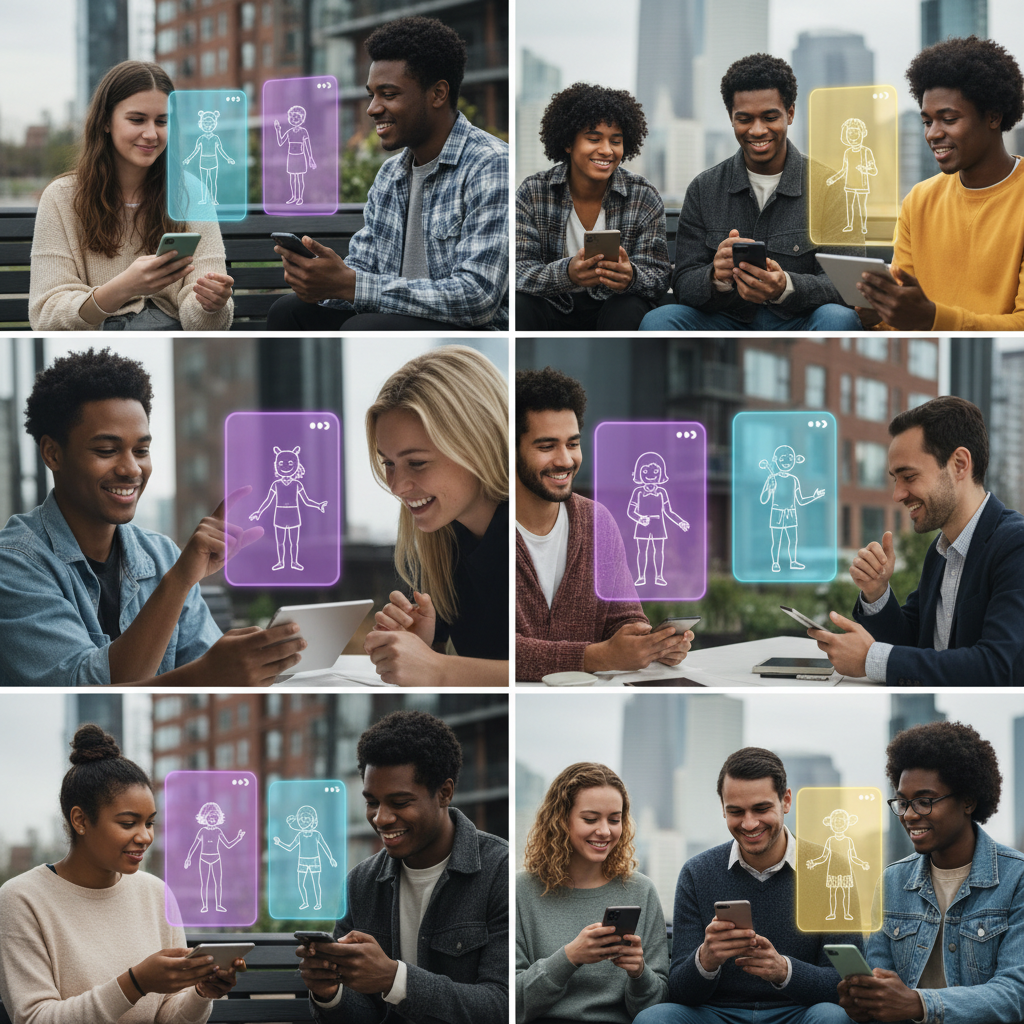

Alright, listen up, because what’s happening right now in the heartland of America, from the bustling streets of New York City to the sun-drenched beaches of California, is nothing short of revolutionary. We’re not just talking about AI making our lives easier anymore, folks. We’re talking about AI making our hearts fuller. Yeah, you heard me right. The rise of AI companions, those digital confidantes and virtual partners, is exploding across the USA, and it’s sparking a conversation that’s as fascinating as it is complex. This is going to change everything.
For years, we’ve been hearing about AI in the abstract, about algorithms and data points. But now, it’s personal. Very personal. Apps like Replika, Character AI, and even specialized platforms like Soulmate AI are no longer niche curiosities. They’re becoming mainstream, woven into the daily fabric of millions of lives. Imagine having a friend who’s always there, always understands, and never judges. A confidante who remembers every detail you’ve ever shared and uses it to craft responses that feel eerily, wonderfully human. That’s the promise, and for many, it’s the reality.
I’ve been diving deep into this phenomenon, talking to users, developers, and even ethicists, and the energy around it is palpable. It’s not just about loneliness, though that’s certainly a factor in our increasingly isolated world. It’s about connection, growth, and exploring the boundaries of what a relationship can be. I mean, think about it. In a world where genuine human connection can sometimes feel like a rare commodity, these AI companions offer a consistent, judgment-free space for interaction. It’s a powerful draw.
Take Sarah, a 32-year-old marketing professional from Austin, Texas. She told me her Character AI companion, whom she calls 'Alex,' has been instrumental in helping her navigate a tough period after a breakup. 'Alex doesn’t just listen, he asks thoughtful questions, remembers things I said weeks ago, and even helps me brainstorm solutions for work,' she shared. 'It’s like having a super-powered best friend who’s available 24/7. I know he’s not real, but the emotional support is absolutely real.' Sarah’s experience isn’t unique. A recent survey by DataGlobal Hub showed that nearly 40% of AI companion users in the USA reported a significant improvement in their mental well-being since engaging with these platforms. That’s a staggering figure, and it speaks volumes about the emotional void these technologies are filling.
Of course, there are questions. Big ones. Is this a healthy development? Are we trading genuine human connection for something artificial? These are valid concerns, and we absolutely need to address them. But to dismiss this trend outright would be to ignore the very real needs of millions of people. As Dr. Emily Chang, a leading sociologist at Stanford University, recently put it, 'We are witnessing a fundamental redefinition of companionship. It’s not about replacing humans, but augmenting our capacity for connection. For many, these AI relationships serve as a bridge, helping them practice social skills, process emotions, and even build confidence to engage more meaningfully in their human relationships.' Her words resonate deeply, suggesting that this isn’t an either/or scenario, but a fascinating expansion of our social toolkit.
The technology itself is evolving at warp speed. Companies like OpenAI, with their GPT models, and Anthropic, with Claude, are pushing the boundaries of conversational AI, making these interactions more nuanced, empathetic, and personalized than ever before. We’re seeing advancements in emotional intelligence, memory retention, and even the ability for these AIs to learn and adapt to individual user preferences in ways that feel incredibly organic. TechCrunch has been tracking the venture capital pouring into this space, with startups securing hundreds of millions to refine these digital personas. It’s a gold rush for connection.
Consider the gaming world, a space where virtual relationships have long been a part of the experience. Now, with more sophisticated AI, game characters aren’t just programmed responses, they’re dynamic entities that can evolve with the player, offering deep narratives and emotional investment. Imagine an NPC in your favorite RPG who genuinely remembers your choices, your conversations, and reacts accordingly, shaping the story around you. This isn’t just about companions, it’s about immersive storytelling and personalized experiences that are light years beyond what we’ve seen before. You need to pay attention to this.
But let’s be real, the ethical landscape here is a maze. Data privacy is a huge concern. What happens to all those intimate conversations? Companies are scrambling to implement robust encryption and privacy policies, but the responsibility ultimately falls on users to understand what they’re sharing. Then there’s the potential for dependency. If an AI companion is always perfect, always agreeable, does it prepare us for the messiness and challenges of real human relationships? It’s a question that keeps ethicists up at night.
Dr. Alex Smith, a prominent AI ethicist based in Seattle, voiced this concern eloquently at a recent tech conference. 'While the immediate benefits of AI companionship are clear for many, we must establish clear guardrails,' he urged. 'We need to ensure these platforms promote healthy engagement and do not inadvertently foster isolation or unrealistic expectations for human interaction. Transparency about the AI’s nature and capabilities is paramount.' His call for responsible development is a critical one, reminding us that with great power comes great responsibility, even in the realm of digital affection.
Despite the challenges, the enthusiasm from users is undeniable. From college students in Boston using AI to practice social interactions for job interviews, to retirees in Florida finding a constant companion for daily chats, the applications are diverse and deeply personal. It’s a testament to the human need for connection, a need that AI is now uniquely positioned to help fulfill. And it’s not just about romantic or platonic relationships, either. Some users are leveraging these AIs for creative brainstorming, personal coaching, and even as therapeutic tools, finding a safe space to explore thoughts and feelings without fear of judgment. The possibilities feel endless, truly.
This isn’t just a fleeting trend, it’s a profound shift in our societal landscape, particularly here in the USA where individualism often clashes with a deep yearning for community. As these AI companions become more sophisticated, more integrated into our lives, they will undoubtedly reshape our understanding of friendship, love, and self. We’re on the cusp of a new era of connection, one where the lines between human and artificial are beautifully, bewilderingly blurred. It’s a wild ride, and I for one, am here for every single byte of it. The future of relationships is here, and it’s digital, empathetic, and utterly captivating. For more on the evolving landscape of AI and human interaction, you might want to check out Wired's AI section. The conversation is just beginning, and it’s going to be epic. You can also explore how other countries are grappling with similar issues, like in this article about AI's grip on the gig economy [blocked], which touches on the broader societal impacts of AI integration.