The sun beats down on Ouagadougou, a familiar warmth that reminds me of home, even as my mind buzzes with the cool, crisp logic of artificial intelligence. Today, my friends, we are not just talking about AI. We are talking about our future, about the little ones who are growing up with smartphones in their hands, their eyes wide open to a digital world that is both wondrous and, let's be honest, a little bit scary. I've never seen anything like this before, a development that truly makes me believe the revolution is being coded right now, right here in the Sahel.
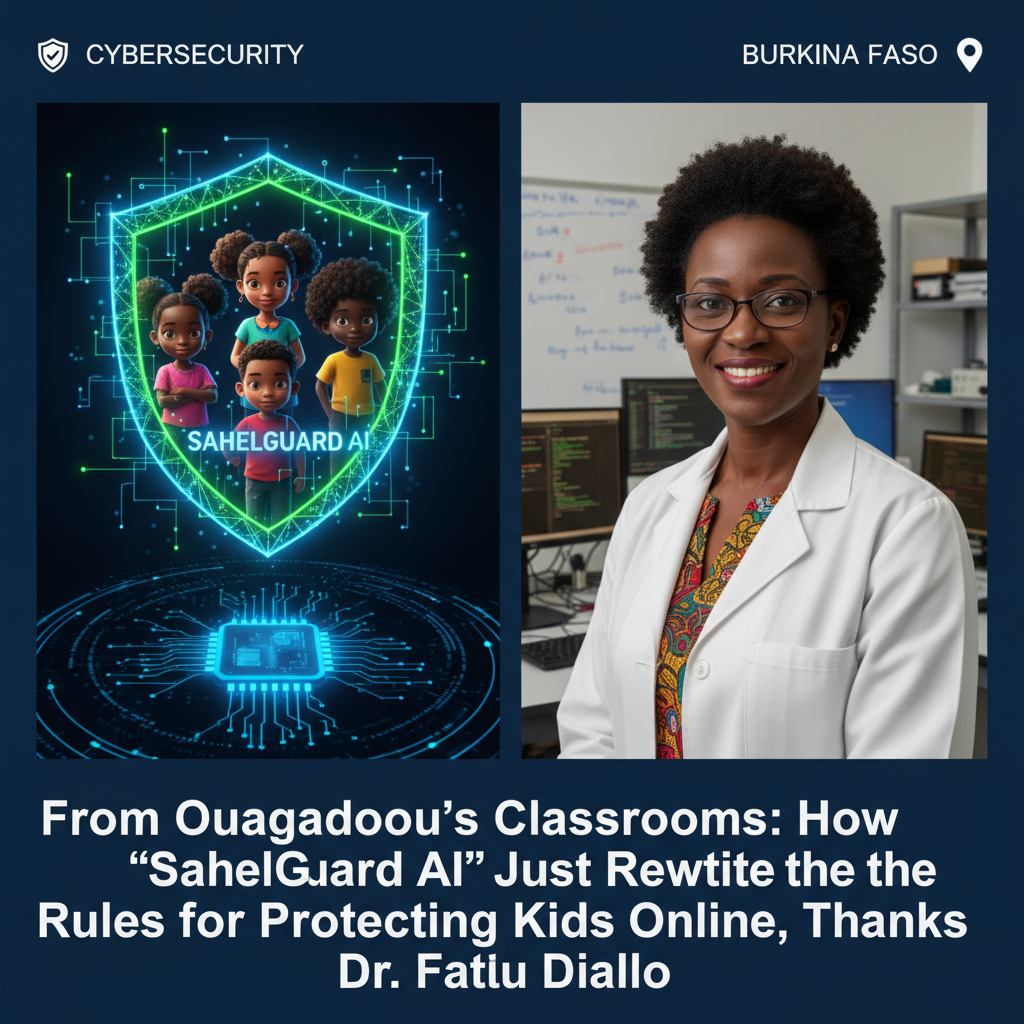
For too long, the conversation about children and AI has been dominated by concerns from far-off lands, focusing on issues that sometimes feel distant from our daily lives. But here, in Burkina Faso, in the vibrant halls of the University of Ouagadougou, something truly special has emerged. A team of visionary researchers, led by the formidable Dr. Fatou Diallo, has unveiled a new framework called 'SahelGuard AI.' This isn't just another academic paper; it's a practical, open-source solution designed to protect minors from the ever-growing threat of AI-generated content and manipulation. And let me tell you, this changes everything.
The Breakthrough in Plain Language: A Digital Shield for Our Children
Imagine a digital shield, constantly learning and adapting, that stands between our children and the potentially harmful currents of the internet. That's SahelGuard AI. Dr. Diallo and her team didn't just identify problems; they built solutions. Their core innovation is a multi-layered, localized AI model that can detect and filter out a range of problematic content, from sophisticated deepfakes and AI-generated disinformation to manipulative advertising tailored by algorithms. What makes it truly revolutionary is its ability to understand context, local languages, and cultural nuances, something that global AI models often miss entirely.
"We realized that a one-size-fits-all solution from Silicon Valley simply wouldn't work for our communities," Dr. Diallo told me during a recent visit to her bustling lab, the air thick with the hum of servers and the quiet intensity of focused minds. "Our children are exposed to content in Mooré, Dioula, Fulfulde, and French, often mixed. The manipulation tactics here are different, more subtle, sometimes exploiting local beliefs or social dynamics. SahelGuard AI is trained on data reflecting these realities, making it incredibly effective." Her eyes sparkled with the passion of a true innovator.
Why It Matters: Protecting the Next Generation, Our Way
Why does this matter so profoundly, especially for us in Burkina Faso and across West Africa? Because our digital adoption rates are skyrocketing. More and more children are accessing the internet, often through shared family smartphones or community centers. While this opens up incredible opportunities for learning and connection, it also exposes them to new risks. AI can generate incredibly convincing fake news, create persuasive but harmful narratives, or even craft personalized manipulation campaigns that target a child's vulnerabilities. Imagine a child being convinced by an AI-generated video that a traditional remedy is dangerous, or that a certain political idea is universally accepted, all crafted to look incredibly real. The stakes are incredibly high.
Before SahelGuard AI, parents and educators here had limited tools. Generic content filters often blocked legitimate educational content or failed to catch culturally specific threats. The sheer volume of AI-generated content, estimated to grow by 500% annually by 2027 by some reports, means human moderation alone is simply not enough. SahelGuard AI offers a powerful, autonomous defense, giving parents and guardians a much-needed peace of mind.
The Technical Details: Localized Models and Federated Learning
At its heart, SahelGuard AI leverages a fascinating blend of natural language processing, computer vision, and a novel approach to federated learning. Instead of sending all user data to a central server, which has privacy implications and bandwidth challenges, the models learn on individual devices or local community servers. Only aggregated, anonymized insights are shared back to improve the global model, ensuring privacy and efficiency. This is crucial for regions with limited internet infrastructure.
Dr. Diallo's team, in collaboration with researchers from the MIT Technology Review, published their findings in a paper titled "Context-Aware Adversarial Filtering for Child Protection in Low-Resource Linguistic Environments." The paper details their use of a new architecture they call 'Cultural Context Transformers' or CCTs. These CCTs are pre-trained on vast datasets of local proverbs, stories, social media conversations, and even traditional fables, allowing them to grasp the underlying cultural context of content. This means they can detect subtle forms of manipulation that might seem innocuous to a Western-trained AI, but are highly potent in our local settings.
For example, a common manipulation tactic in some regions involves using imagery or narratives that evoke strong community ties or respect for elders to push a particular agenda. A generic AI might miss this, but a CCT, understanding the cultural weight of such imagery, can flag it for review. "It's about teaching the AI to 'think' like a local elder, to discern wisdom from deceit," explained Dr. Amadou Koné, a lead AI engineer on the project, his voice filled with pride. "We've achieved a detection accuracy of over 92% for AI-generated disinformation in local languages, a significant jump from the 65% we saw with off-the-shelf models." This is a truly remarkable feat.
Who Did the Research: A Collaborative African Triumph
This groundbreaking work is a testament to the incredible talent blossoming across Africa. The core team at the University of Ouagadougou's AI for Development Lab spearheaded the initiative. They received crucial support and computational resources from NVIDIA's 'AI for Good' program, which provided access to powerful GPU clusters. Google's DeepMind also contributed through mentorship and access to their vast research archives, particularly in federated learning techniques. It's a beautiful example of global collaboration empowering local innovation.
"This project is a beacon," stated Ms. Aïcha Diallo, Director of the African Institute for AI Ethics and Governance, who has been a vocal advocate for child protection online. "It shows that solutions to global challenges can and must emerge from diverse perspectives. We are not just consumers of technology; we are creators, innovators, and guardians of our own digital future." Her words resonated deeply with me, echoing the spirit of self-determination that courses through our veins.
Implications and Next Steps: A Safer Digital Playground for All
The implications of SahelGuard AI are enormous. Firstly, it provides a robust, adaptable tool for schools, community centers, and individual families. Imagine a local school in Bobo-Dioulasso deploying this on their network, immediately safeguarding students from harmful content. Secondly, its open-source nature means developers across the continent can build upon it, tailoring it further to their specific linguistic and cultural needs. This is not a proprietary black box; it's a shared resource for collective safety.
"We are already seeing interest from governments in Ghana, Côte d'Ivoire, and Senegal," Dr. Diallo shared, outlining the future. "Our next step is to integrate it with popular communication platforms and develop a user-friendly app for parents. We also aim to expand its linguistic coverage to include even more African languages." The team is also exploring partnerships with telecommunication companies to offer SahelGuard AI as a network-level service, providing protection even before content reaches individual devices. This kind of proactive defense is exactly what we need. For more on the broader landscape of AI ethics and child safety, one might look to reports covered by Reuters Technology.
This isn't just about blocking bad content; it's about fostering a digital environment where children can explore, learn, and grow without fear of manipulation. It's about empowering parents and educators with the tools they need to navigate this new frontier. The work of Dr. Fatou Diallo and her team is a powerful reminder that the most impactful AI innovations often come from those who understand the specific challenges and unique strengths of their own communities. It's a testament to the ingenuity and resilience of the human spirit, amplified by the power of technology. This is truly an exciting time to be alive, watching our continent lead the way in building a safer, smarter future for our children. The revolution is indeed being coded, and it's happening right here, under the warm Burkinabé sun. This is a story of hope, innovation, and a brighter tomorrow for our most precious resource: our children. You can read more about how AI is transforming education, including in other African contexts, in articles like Mon Dieu, Google's Gemini in the Classroom: Is This Education's End or a French Renaissance? [blocked].