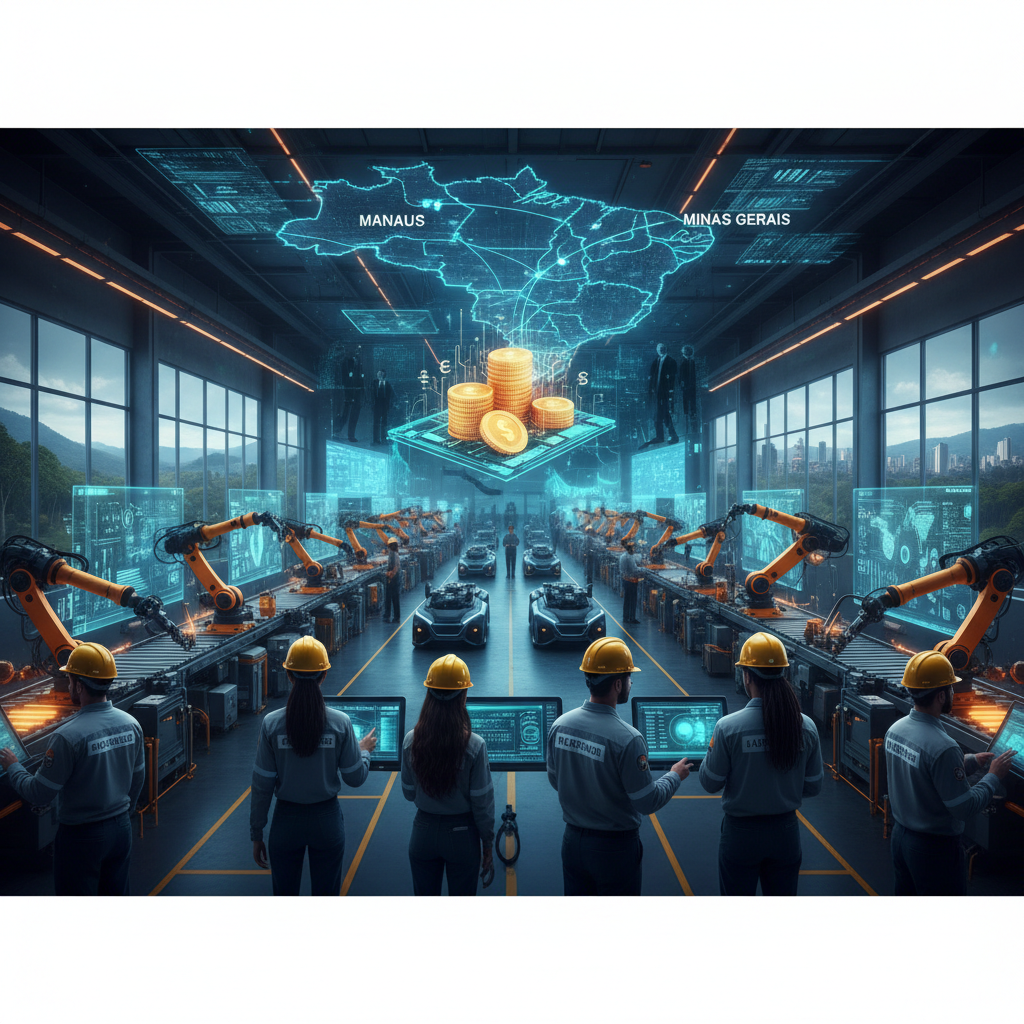

The hum of machinery in Brazil's industrial heartland, from the automotive plants of São Paulo to the burgeoning tech hubs of Santa Catarina, is increasingly orchestrated not by human hands alone, but by algorithms. This silent revolution, powered by artificial intelligence in manufacturing, promises predictive maintenance, enhanced quality control, and the elusive 'smart factory.' Yet, beneath the glossy headlines and optimistic projections, a more intricate story unfolds: one of significant investment, strategic maneuvering, and the perennial question of who truly benefits when global capital meets local ambition.
My investigation reveals that Brazil's AI funding landscape hides surprises. While the narrative often centers on Silicon Valley giants, the investment trail leads to a surprising confluence of domestic financial powerhouses and international venture funds, all vying for a slice of this rapidly expanding market. Data from the Brazilian Association of Industrial AI (abai) indicates that investments in AI for manufacturing surged by 45% in 2025, reaching an estimated R$7.8 billion, approximately 1.5 billion US dollars. This figure, impressive on its own, masks the granular details of where these billions originate and, crucially, where they are destined to return.
Consider the case of 'Indústria Inteligente Brasil' (IIB), a consortium formed in late 2024. Publicly, IIB is a collaboration between leading Brazilian industrial groups like Gerdau and Embraer, alongside the National Confederation of Industry (CNI), aimed at accelerating AI integration. However, a deeper look into their financial structures, accessible through corporate filings at the Comissão de Valores Mobiliários (CVM), reveals a significant capital injection from a Luxembourg-based private equity fund, 'GlobalTech Ventures,' which holds a 30% stake. This fund, in turn, has known ties to major US tech players, including Microsoft and NVIDIA, through their indirect investment arms.
"The push for smart factories in Brazil is not merely about technological advancement, it is fundamentally an economic play," states Dr. Eliana Costa, a senior economist at the Getúlio Vargas Foundation, during a recent interview. "Foreign capital sees the immense potential for efficiency gains and cost reductions in our vast industrial base. The question for Brazil is how to ensure this translates into sustainable local growth, not just repatriated profits." Dr. Costa's analysis underscores a critical tension: the need for advanced technology versus the imperative to maintain economic sovereignty.
One of the most compelling applications driving this investment is predictive maintenance. Companies like Petrobras, Brazil's state-owned oil giant, have been pioneers. Their implementation of AI models, often developed in partnership with local startups like 'PrediTech Soluções' and supported by Google Cloud's AI platform, has reportedly reduced unscheduled downtime by 18% in their refineries. This translates to hundreds of millions of reais saved annually. PrediTech, a promising Brazilian unicorn in the making, recently secured a Series B funding round of R$300 million, with significant participation from the Brazilian Development Bank (bndes) but also, notably, from a subsidiary of Amazon Web Services (AWS) venture arm.
Quality control is another area witnessing transformative change. In the highly competitive automotive sector, manufacturers are deploying computer vision systems, often leveraging NVIDIA's Jetson platform, to detect microscopic defects on assembly lines with unprecedented accuracy. "We've seen a dramatic reduction in warranty claims since implementing our AI-driven inspection systems," explains Ricardo Mendes, Head of Manufacturing Innovation at a major automotive plant in São José dos Campos. "The precision of these algorithms, trained on millions of data points, far surpasses human capability for repetitive tasks. It's not about replacing workers, but augmenting our ability to deliver perfection." This sentiment, while common, faces scrutiny from labor unions concerned about the long-term impact on employment, a concern that echoes globally as AI permeates industries. For more on the broader implications of AI in industry, one might consult TechCrunch's AI section.
The vision of the 'smart factory,' a fully interconnected and self-optimizing production ecosystem, is rapidly becoming a reality in pockets across Brazil. Companies like Weg, a global leader in electrical engineering and automation, are integrating AI across their operations, from supply chain optimization to energy management. Their partnership with Siemens, utilizing their MindSphere industrial IoT platform, exemplifies the global collaborations underpinning this transformation. "Our factories in Jaraguá do Sul are becoming living organisms, constantly learning and adapting," says Ana Paula Ferreira, Weg's Director of Digital Transformation. "This level of efficiency was unimaginable just five years ago. It allows us to compete on a global scale, delivering higher quality products at competitive prices."
However, the narrative is not without its complexities. The very data that fuels these AI systems, often proprietary and generated within Brazilian facilities, frequently resides on servers managed by foreign cloud providers. This raises questions about data sovereignty and the potential for technological dependence. "While the immediate benefits of AI in manufacturing are clear, we must be vigilant about the long-term implications of ceding control over our industrial data," warns Professor Carlos Eduardo Dias, a cybersecurity expert at the University of São Paulo. "The digital infrastructure underpinning these smart factories is just as critical as the physical one. We need robust national strategies to protect this new frontier."
The role of government incentives cannot be overstated. Programs like 'Rota 2030' for the automotive sector and various tax breaks for technology investments have created a fertile ground for AI adoption. Yet, critics argue that these incentives sometimes favor large, established players, both domestic and foreign, potentially stifling smaller, innovative Brazilian startups. The investment trail leads to a landscape where the lines between local innovation and global influence are increasingly blurred, demanding careful scrutiny.
As Brazil navigates this complex technological shift, the promise of increased productivity and global competitiveness is undeniable. However, the path forward requires more than just embracing new technologies; it demands a strategic vision that prioritizes local capacity building, data governance, and equitable distribution of the economic gains. Without such a vision, Brazil risks becoming merely a consumer of foreign AI solutions, rather than a true architect of its industrial future. The billions flowing into this sector are not just capital; they are a wager on Brazil's industrial soul. For further insights into how AI is reshaping global industries, MIT Technology Review offers extensive coverage.
The journey towards truly smart factories in Brazil is still in its early stages, but the velocity of change is accelerating. The challenge for policymakers, industry leaders, and indeed, for journalists like myself, is to ensure that this revolution serves the broader interests of the Brazilian people, fostering innovation and prosperity that resonates far beyond the factory floor. The investment trail leads to a future that is still being written, and its chapters will be shaped by the decisions made today. It is a story I will continue to follow with unwavering attention. You can find more of my investigative pieces on similar topics, such as the strategic implications of NVIDIA's presence in Brazil, by reading NVIDIA's AI Compute Monopoly: Is Jensen Huang Forging a Digital Iron Curtain, or Just a Very Expensive Fence for Brazil? [blocked].