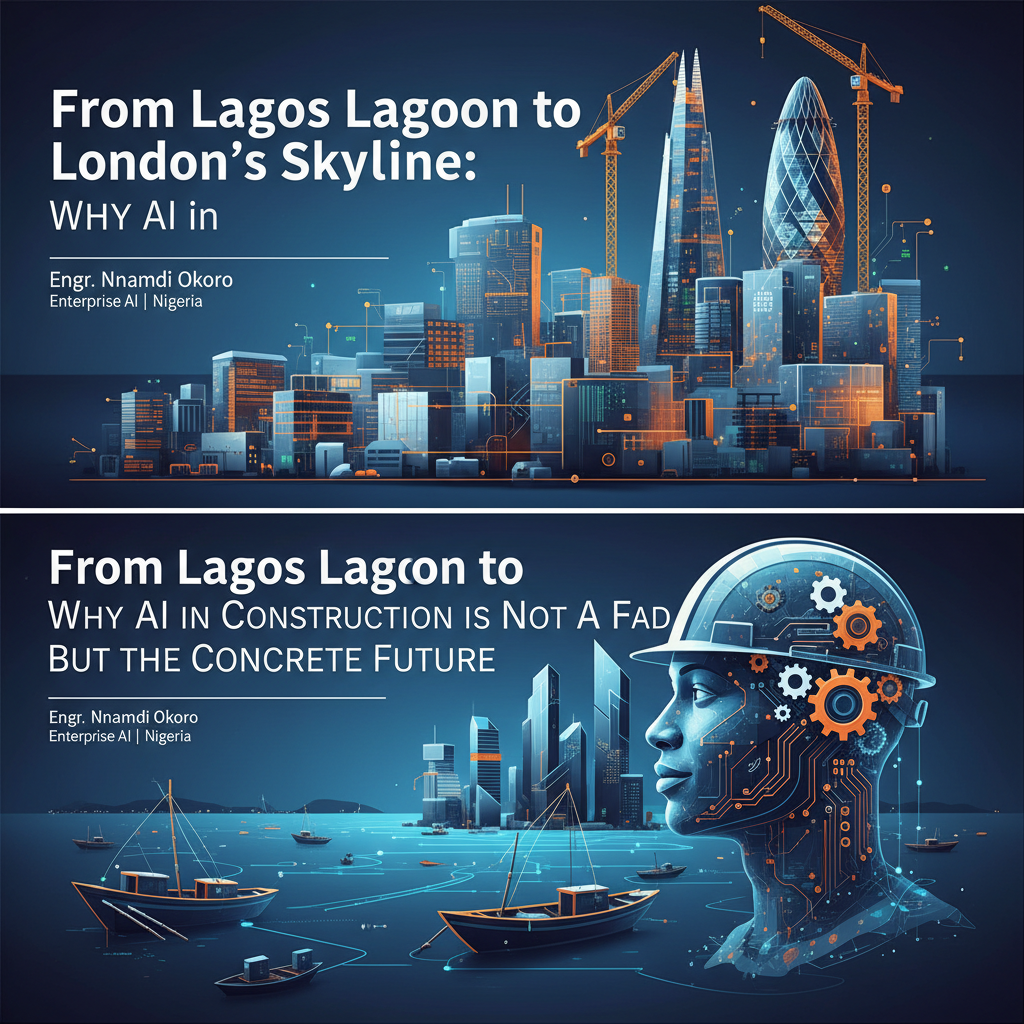

Is AI in construction just another shiny object, a digital mirage in the desert of industry innovation, or is it the very bedrock upon which our future cities will rise? As a journalist who thinks in decades, not quarters, and sees the world through the vibrant, often chaotic, lens of Lagos, I can tell you with absolute certainty: this is no passing trend. This is the new normal, and anyone who thinks otherwise is still building with mud and wattle in a world demanding steel and silicon.
For too long, the construction industry, despite its monumental output, has been seen as a laggard when it comes to technological adoption. We've had cranes, diggers, and cement mixers for generations, but the digital tools that revolutionized finance or media seemed to bypass the hard hats and high-vis vests. That era, my friends, is over. The confluence of advanced AI, ubiquitous sensors, and robust cloud computing is now fundamentally reshaping how we design, build, and manage every structure, from the smallest dwelling in a sprawling Lagos suburb to the most ambitious skyscraper in Dubai.
Consider the sheer scale of the challenge. Global construction is a multi-trillion dollar industry, yet it's plagued by inefficiencies: cost overruns, project delays, and, tragically, safety incidents. Traditional methods, relying on manual calculations, fragmented communication, and reactive problem-solving, simply cannot keep pace with the demands of a rapidly urbanizing world. This is where AI steps in, not as a replacement for human ingenuity, but as its most powerful amplifier. It's about building smarter, safer, and faster, and the numbers are beginning to speak for themselves.
Take building design optimization. Gone are the days when architects and engineers spent weeks manually iterating designs. Today, generative AI tools, powered by algorithms from giants like Google DeepMind and NVIDIA, can explore millions of design permutations in minutes, optimizing for structural integrity, energy efficiency, material usage, and even aesthetic appeal. "We're seeing a paradigm shift," explains Dr. Amina Bello, Head of Architectural Innovation at the University of Lagos. "AI allows us to push the boundaries of what's possible, creating structures that are not only beautiful but inherently sustainable and resilient. For a country like Nigeria, grappling with climate change and rapid population growth, this is not a luxury; it's a necessity." She points to a recent project in Eko Atlantic City where AI-driven design reduced material waste by an estimated 18 percent, a significant saving in both cost and environmental impact.
Then there's safety monitoring, a critical area where AI is quite literally saving lives. Construction sites are inherently dangerous environments. In Nigeria, despite regulations, accidents remain a grave concern. AI-powered vision systems, deployed on drones and static cameras, can now continuously monitor sites, identifying potential hazards in real time. They can detect if workers are not wearing proper personal protective equipment, if heavy machinery is operating too close to personnel, or if structural anomalies appear. "Before, we relied on periodic inspections and human vigilance, which, while important, has limitations," says Engr. Nnamdi Okoro, CEO of BuildAI Africa, a Lagos-based startup specializing in construction AI solutions. "Now, our systems can flag a worker without a hard hat in a high-risk zone within seconds, alerting supervisors before an incident occurs. This isn't just about compliance; it's about valuing human life. Mark my words, this technology will drastically reduce fatalities on construction sites across Africa within the next decade." Okoro's firm recently secured a significant Series A funding round, a testament to the burgeoning investor confidence in this sector. You can read more about the broader AI startup landscape on TechCrunch.
Project management, often a labyrinth of schedules, budgets, and unforeseen complications, is also being streamlined. AI algorithms can analyze vast datasets of past projects, predict potential delays, optimize resource allocation, and even manage supply chains with unprecedented precision. Microsoft's Azure AI and AWS's AI services are increasingly being integrated into project management platforms, offering predictive analytics that allow managers to proactively address issues before they escalate. "The traditional Gantt chart is evolving," states Mrs. Funke Adeyemi, a veteran project manager with Cappa & D'Alberto PLC, a leading Nigerian construction firm. "AI gives us a crystal ball, allowing us to anticipate bottlenecks, optimize material delivery, and keep projects on time and under budget. It's like having a super-intelligent assistant managing every single moving part of a complex build." She notes that projects utilizing these AI tools have seen an average reduction in delays by 15 percent and cost savings of up to 10 percent.
Some skeptics might argue that this is all just a sophisticated form of automation, a continuation of trends we've seen for decades. They might worry about job displacement, a valid concern that requires thoughtful policy and retraining initiatives. However, to dismiss AI in construction as a mere fad is to fundamentally misunderstand its transformative power. This isn't just about automating repetitive tasks; it's about cognitive augmentation, enabling humans to make better decisions, design more innovative structures, and manage projects with a level of foresight previously unimaginable. The future is already here because it's just not evenly distributed, and for those who embrace it, the rewards will be immense.
The global market for AI in construction is projected to reach over 7 billion US dollars by 2027, according to recent reports, a staggering leap from its nascent stages just a few years ago. Companies like Autodesk, Bentley Systems, and Trimble are aggressively integrating AI into their core offerings, while a vibrant ecosystem of startups, many emerging from unexpected corners of the world, are innovating at breakneck speed. This is not just a Western phenomenon; African innovators are not just consumers of this technology but active creators. From startups developing AI for local material sourcing to those building predictive maintenance models for infrastructure, Nigeria will lead this revolution.
My verdict is clear: AI in construction is not a fad. It is the architectural blueprint for the 21st century. It's the steel frame, the reinforced concrete, and the smart sensors that will define how we live, work, and thrive in our increasingly urbanized world. The challenges are real, from data privacy to ethical deployment, but the potential benefits far outweigh them. We must ensure that this revolution is inclusive, that the benefits reach every corner of the globe, and that local contexts, like those in Nigeria, are not merely footnotes but central chapters in this unfolding story. The buildings of tomorrow are being designed and constructed by algorithms today, and it's a future I, for one, am thrilled to witness and report on. For more insights into how AI is shaping industries globally, you can always check out MIT Technology Review.
This is not just about erecting buildings; it's about building a better future, one optimized, safe, and efficiently managed project at a time. And if you ask me, the foundations are already laid.