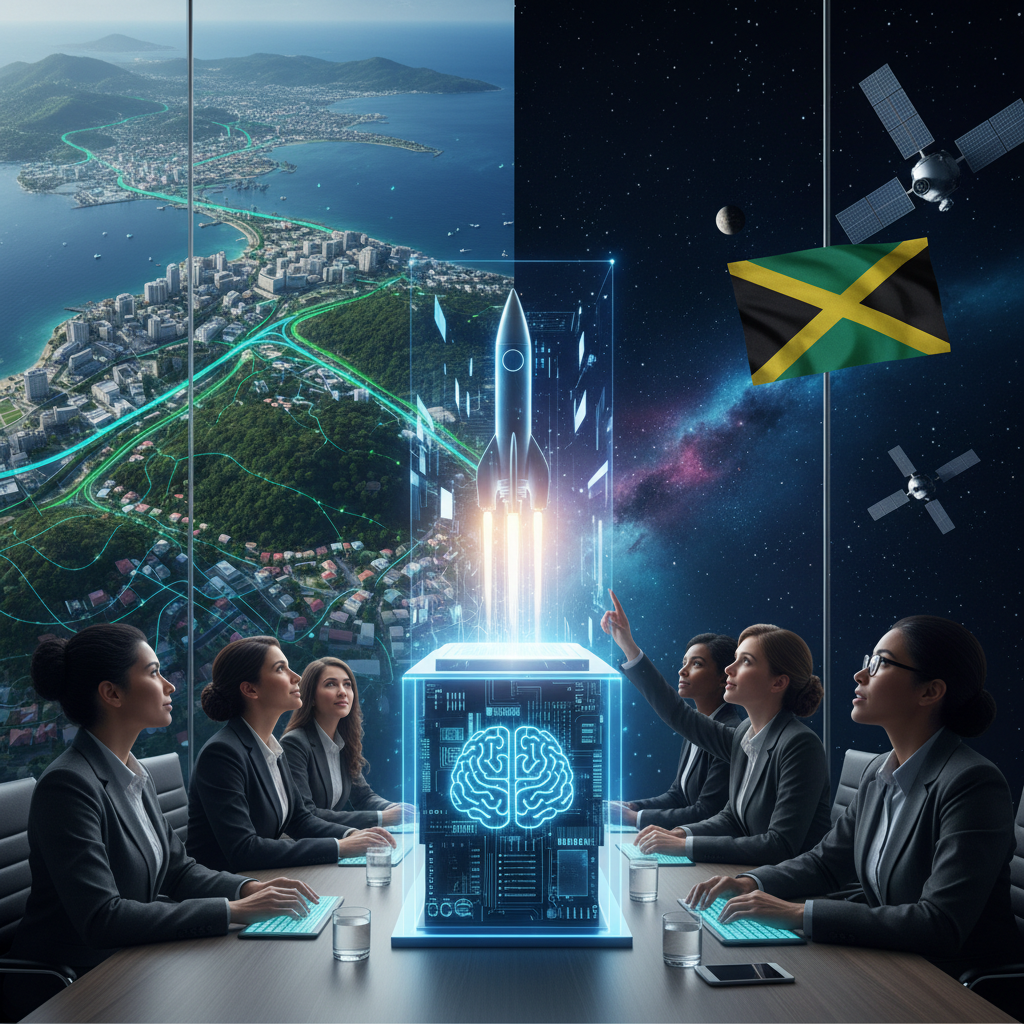

The scent of ackee and saltfish was thick in the air, the usual morning buzz of Kingston already in full swing. But inside the modest offices of ‘IslandSat Solutions’ downtown, the only thing buzzing was a server rack humming with data from, get this, space. Yes, space. While the world’s tech giants are busy dreaming of Martian colonies and asteroid mining, here in Jamaica, a small team is quietly leveraging AI and satellite data to revolutionize everything from agriculture to disaster management. It’s a classic case of small island, big ideas, and frankly, it’s a story most people miss.
For years, when folks thought of Jamaica and technology, they probably pictured a tourist posting vacation photos on Instagram, or maybe a call center agent handling queries for some overseas corporation. But the landscape is shifting, and AI, even the kind aimed at the heavens, is playing a surprisingly grounded role. The big question, as always, is whether our local businesses and workers are ready to catch this cosmic wave, or if they’ll be left watching from the shore.
Let’s talk numbers, because that’s where the rubber meets the road, or should I say, the rocket meets the launchpad. Global spending on AI in space applications, including satellite AI for Earth observation, predictive maintenance for space assets, and data analysis for deep space missions, is projected to hit over $10 billion by 2030, according to various industry reports. While Jamaica isn’t building rockets, it’s certainly becoming a consumer and innovator in the downstream applications. A recent report by the Caribbean Digital Transformation Project, backed by the World Bank, indicated a 35% increase in AI adoption among Jamaican SMEs in sectors like logistics and agriculture over the last two years, many of whom are now tapping into satellite-derived insights.
Take IslandSat Solutions, for example. Their CEO, Dr. Aliyah Campbell, a brilliant woman with a PhD in Geoinformatics from UWI Mona, told me over a cup of strong Blue Mountain coffee, “We’re not launching satellites, no. But we’re making sense of the data they send back. Our AI models analyze imagery from commercial constellations, predicting crop yields with 90% accuracy for farmers, identifying illegal deforestation, and even tracking hurricane damage in real time. This isn’t science fiction, it’s smart business, and it’s creating jobs for our data scientists.” Her company, which started with a team of five just three years ago, now employs 25 people, a significant jump for a local tech startup.
But it’s not all sunshine and satellite signals. The cost of entry, even for data analysis, remains a hurdle. Access to high-performance computing, the kind needed to train complex AI models on vast datasets, is still a challenge. Many local businesses, particularly the smaller ones, struggle with the initial investment and the steep learning curve. “It’s like trying to teach a fish to ride a bicycle,” one small farmer from St. Elizabeth lamented to me, referring to the complexity of integrating new tech. “The potential is there, yes, but the path to get there is not clear for everyone.”
Winner and loser companies are emerging, as they always do when a new tech wave hits. Companies like IslandSat Solutions, and a few others specializing in geospatial AI, are clearly winning. They’ve invested early in talent and infrastructure, positioning themselves as crucial intermediaries between global satellite providers and local industries. On the other hand, traditional consultancies and data analytics firms that haven’t pivoted to incorporate AI and satellite data are finding themselves increasingly irrelevant. Their old methods simply can’t compete with the speed and scale of AI-driven insights.
Worker perspectives are, as expected, a mixed bag. For the young, tech-savvy graduates from institutions like the University of Technology, Jamaica, AI in space exploration offers exciting new career paths. “It’s inspiring, honestly,” said Michael Thompson, a 24-year-old data analyst at IslandSat. “I never thought I’d be working with satellite data from Jamaica. It feels like we’re part of something bigger, something global.” However, for older workers, particularly those in traditional sectors now impacted by AI-driven efficiency, there’s apprehension. The fear of job displacement is real, and the need for reskilling programs is more urgent than ever. The government, through initiatives like the Heart Nsta Trust, is attempting to address this, but the pace of technological change often outstrips the pace of training.
Expert analysis confirms this dichotomy. Dr. Carla Powell, an economist specializing in technology adoption at the Caribbean Policy Research Institute (capri), highlighted the need for strategic investment. “Jamaica’s tech scene is like reggae, it’ll surprise you with its depth and global reach, but we need sustained investment in digital infrastructure and human capital,” she stated. “The private sector is showing initiative, but government policies must create an enabling environment, perhaps even through tax incentives for AI adoption and training. Otherwise, we risk widening the digital divide.” She also pointed to the critical role of international partnerships, noting that collaborations with global players like Google DeepMind or even smaller, specialized AI firms could accelerate local development.
What’s coming next? More satellites, for one. The sheer volume of data cascading down from orbit will only increase, making AI not just useful, but absolutely essential for processing and interpreting it. We’ll see more specialized AI models for specific Caribbean challenges, like predicting sargassum seaweed inundation for tourism, or optimizing shipping routes through our busy ports. The search for extraterrestrial intelligence, while seemingly distant, also has implications. The algorithms developed to sift through vast cosmic signals for patterns could find unexpected applications in other complex data analysis tasks right here on Earth. The Caribbean has entered the chat, not just as a consumer, but as a clever adapter and niche innovator in this grand cosmic game.
Ultimately, the story of AI in space exploration for Jamaica isn’t about building our own space agency, at least not yet. It’s about how we, a small island nation, can intelligently leverage global technological advancements to solve our local problems, create new industries, and carve out our own unique space in the global tech economy. The stars are aligning, but it’s up to us to make sure our feet are firmly planted while our algorithms reach for the sky. The future, as always, is what we make it. For more on how AI is shaping regional economies, you might want to check out this article on AI in Costa Rica's legal landscape [blocked].