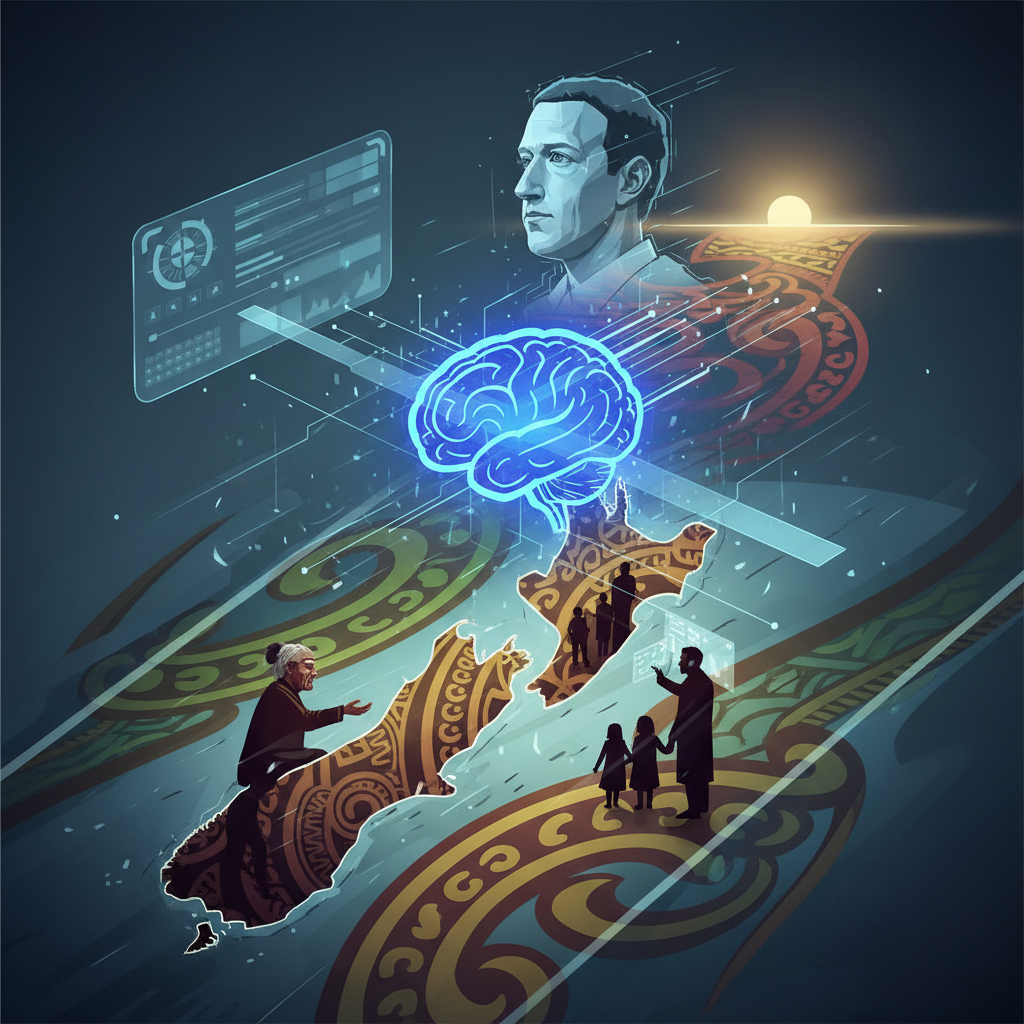
The digital winds, they shift so quickly, don't they? Just a few short years ago, the metaverse was the promised land, a boundless digital frontier where Mark Zuckerberg and Meta were planting their flag with billions of dollars. Now, in April 2026, the conversation has pivoted with a force that feels almost tectonic. The new frontier, the one demanding Meta's full might, is artificial intelligence, and its implications for our world, particularly in healthcare, are profound and immediate. For us here in Aotearoa, New Zealand, this isn't just a Silicon Valley boardroom reshuffle; it's a strategic calculus that will ripple through our communities, our hospitals, and our very understanding of wellbeing.
Imagine a tomorrow, perhaps five to ten years from now, where a young Māori woman in a remote East Coast community doesn't have to travel hours to see a specialist for a rare genetic condition. Instead, her local kaimahi hauora, her health worker, uses an AI-powered diagnostic tool, trained on diverse genomic data and culturally nuanced health indicators, to provide an initial assessment. This tool, perhaps even running on Meta's advanced Llama models, has access to a vast, anonymized dataset of global health information, but crucially, it also understands the specific health disparities and genetic predispositions common within Māori populations. It can flag potential issues with remarkable accuracy, guiding her to the right local support or connecting her via secure, real-time AI-powered telehealth to a specialist hundreds of kilometers away. Her health journey is proactive, personalized, and deeply respectful of her whakapapa, her lineage and connection to the land.
How do we get to this future from today's landscape, where healthcare access remains a significant challenge for many, particularly indigenous communities? Zuckerberg's pivot isn't just about building bigger, faster AI models; it's about integrating AI into every facet of Meta's ecosystem, from communication platforms to hardware. This means the AI tools we'll see emerging will be designed for pervasive use, often embedded in the very devices and applications we interact with daily. Meta's investment in AI research and development, reportedly in the tens of billions of dollars, is fueling a race to create foundational models that can understand, generate, and reason across various data types. This scale of investment and ambition will inevitably spill over into specialized domains like healthcare.
Key milestones on this journey will include the widespread deployment of multimodal AI assistants capable of interpreting complex medical imagery, understanding natural language in clinical notes, and even synthesizing research papers into actionable insights for clinicians. We'll see Meta's AI capabilities, perhaps through partnerships, powering diagnostic tools that can detect early signs of disease from routine scans or even wearable sensor data. Imagine an AI that can analyze speech patterns for early indicators of neurological conditions or monitor sleep data for cardiovascular risks. The integration of these tools into existing healthcare infrastructure, especially in areas with limited resources, will be critical.
However, this vision isn't without its shadows. Who wins and who loses in this AI-driven future? The potential winners are clear: patients in underserved areas, healthcare providers burdened by administrative tasks, and researchers seeking to accelerate drug discovery. The losers could be those whose data is exploited, whose cultural contexts are ignored, or who are left behind by the digital divide. If AI models are primarily trained on data from dominant populations, they risk perpetuating and even amplifying existing health inequities. This is where our vigilance, our commitment to equity, becomes paramount.
In Te Reo Māori, we have a word for this: manaakitanga, which speaks to hospitality, generosity, and care for others. It's about ensuring everyone is uplifted. When we talk about AI in healthcare, manaakitanga demands that we center the needs and values of all people, particularly those who have historically been marginalized. "The ethical development of AI is not an afterthought, it is the foundation upon which all progress must be built," stated Dr. Michelle Williams, a leading expert in AI ethics at the University of Auckland, in a recent address. "Without it, we risk creating systems that do more harm than good, especially for vulnerable populations." Her words resonate deeply with the principles of Māori data sovereignty, which insists that Māori retain control over their data, ensuring it is used in ways that benefit their communities and uphold their cultural values.
We must also consider the economic implications. Will this shift create new opportunities for our local tech sector, fostering innovation in culturally responsive AI applications? Or will it consolidate power and wealth in the hands of a few global giants, leaving smaller nations to simply consume technology rather than co-create it? New Zealand's unique position, with its strong indigenous voice and commitment to social equity, offers a chance to lead by example. Aotearoa's approach to AI is rooted in indigenous wisdom, seeking to balance technological advancement with cultural preservation and ethical considerations. We have the opportunity to influence how these powerful tools are shaped, ensuring they serve humanity in its entirety.
What should readers do now? First, demand transparency and accountability from tech giants like Meta. Understand how their AI models are trained, what data they use, and what safeguards are in place to prevent bias and protect privacy. Second, advocate for policies that prioritize data sovereignty and ethical AI development, particularly for indigenous communities. Support initiatives that empower local researchers and developers to build AI solutions tailored to their specific cultural and societal needs. Finally, engage in the conversation. The future of healthcare, profoundly shaped by AI, is not a distant concept; it is being built right now. Our collective voices, informed by diverse perspectives, are essential in guiding its trajectory. As I always say, technology must serve the people, not the other way around. Let us ensure this powerful pivot by Mark Zuckerberg and Meta leads to a future where health and wellbeing are truly accessible for all, guided by the wisdom of our ancestors and the innovation of our present. The journey is long, but the destination, a healthier, more equitable world, is worth every step.
For more insights into the broader impact of AI on global society, you can explore reports and analyses from institutions like MIT Technology Review. The rapid pace of development in AI, particularly in areas like large language models, is continuously being documented by outlets such as TechCrunch. The conversation around AI's transformative power is only just beginning.