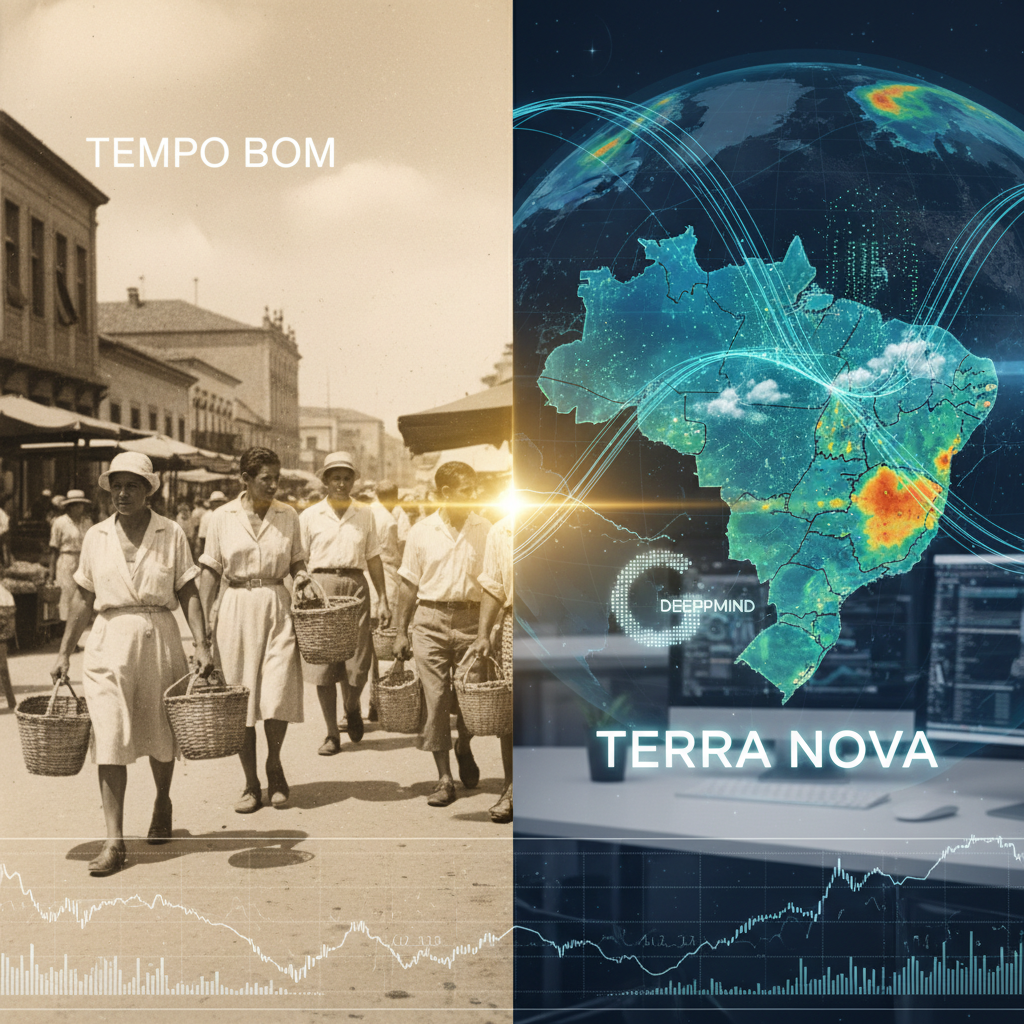

My friends, when I look up at the sky, I don't just see clouds and aluminum birds. I see data streams, algorithms, and the invisible hand of artificial intelligence guiding everything from the moment a plane pushes back from the gate at Guarulhos to its smooth landing in New York. And what I'm seeing, especially here in Brazil, is nothing short of a revolution. For too long, the narrative has been that innovation in aviation AI belongs solely to Silicon Valley or European hubs. But let me tell you, that story is changing, and it's changing fast, with a distinct Brazilian accent.
This is Brazil's decade, not just for football, but for technology, and our aviation sector is a prime example. We are not just consumers of AI, we are becoming creators, innovators, and leaders. The sheer scale of our country, the complexity of our airspace, and the ambition of our engineers are forcing us to develop solutions that are both robust and uniquely adapted to our realities. We're talking about a transformation that touches every aspect of flight, making it safer, more efficient, and yes, even more sustainable.
Let's start with flight optimization. Think about the millions of variables that go into planning a single flight route: weather patterns, air traffic congestion, fuel prices, aircraft performance, even geopolitical events. Traditionally, this has been a complex dance of human expertise and sophisticated, but often rigid, software. Now, AI is stepping in, crunching these numbers in real time, learning from past flights, and suggesting routes that shave off minutes, save tons of fuel, and reduce emissions. Embraer, our very own aerospace giant, has been quietly investing heavily in this space. They're not just building planes, they're building the intelligence that flies them. Their work with AI models to predict optimal flight paths, considering everything from wind shear to turbulence forecasts, is truly impressive. It's about getting from point A to point B not just faster, but smarter.
"The gains we're seeing from AI in flight path optimization are not marginal, they're substantial," said Dr. Ana Paula Costa, Head of AI Research at Embraer, in a recent industry conference. "We're talking about reducing fuel consumption by several percentage points across an entire fleet, which translates into massive cost savings and a significant reduction in carbon footprint. This is a game changer for the industry, and it's being driven by a global effort, with Brazil playing a crucial role." Her words echo the sentiment of many who see AI as the key to unlocking a more sustainable future for air travel, a future that is particularly important for a country like Brazil, with its vast distances and reliance on air transport.
Then there's predictive maintenance. Anyone who has ever been stuck on a tarmac because of a mechanical issue knows the frustration. It's costly for airlines, inconvenient for passengers, and can even compromise safety. But what if a plane could tell you it was about to have a problem before it actually happened? That's the promise of AI-driven predictive maintenance. Sensors on aircraft are constantly collecting data: engine temperature, vibration levels, hydraulic pressure, thousands of data points every second. AI algorithms analyze this torrent of information, looking for subtle anomalies, patterns that indicate a component is nearing failure. It's like having a doctor for every part of the plane, constantly monitoring its health.
Brazilian airlines, like Latam and GOL, are already implementing these systems, often in partnership with global tech firms but also leveraging local talent. They're moving away from scheduled maintenance, which can be inefficient, to condition-based maintenance, where parts are replaced only when they show signs of wear, not just because a calendar says so. This means less downtime, fewer unexpected delays, and ultimately, safer flights. The economic impact is huge, too. According to a report by Reuters, the global market for AI in predictive maintenance in aviation is expected to reach billions of dollars in the coming years, and our local players are ensuring they get a piece of that pie.
But perhaps the most complex, and arguably the most critical, application of AI in aviation is air traffic control. Imagine the intricate ballet of planes taking off, landing, and traversing crowded airspace, especially over major hubs like São Paulo or Rio de Janeiro. Human air traffic controllers are heroes, managing incredible complexity under immense pressure. But their capacity is finite. AI, however, can process vast amounts of real-time data from radar, flight plans, and weather forecasts, identifying potential conflicts, optimizing traffic flow, and even suggesting alternative routes to controllers. It's not about replacing humans, but augmenting their capabilities, giving them superpowers to manage an ever-increasing volume of air traffic.
NAV Brasil, our national air navigation service provider, has been exploring AI solutions to enhance their operations. They're looking at how machine learning can predict congestion hotspots, optimize runway usage, and even assist in emergency situations. The goal is to create a more resilient, efficient, and safer airspace. This is a massive undertaking, requiring robust infrastructure and cutting-edge algorithms, but the potential benefits are immense. We're talking about reducing delays, preventing incidents, and making our skies even safer. The collaboration between government agencies, universities, and private companies here is a testament to the collective vision.
Let's not forget the human element, though. While AI offers incredible potential, the transition isn't without its challenges. There are concerns about data privacy, algorithmic bias, and the need for rigorous testing and certification of these AI systems. Regulators, both here in Brazil and internationally, are grappling with how to ensure these powerful tools are deployed responsibly. The International Civil Aviation Organization (icao) is actively working on frameworks for AI in aviation, recognizing the need for global standards to ensure seamless integration and safety across borders. It's a delicate balance, pushing innovation while upholding the highest safety standards, and Brazil is actively participating in these global dialogues.
What truly excites me, however, is the unique perspective Brazil brings to this global conversation. Our diverse geography, from the Amazon rainforest to the bustling metropolises, presents unique challenges for aviation. Developing AI solutions that can handle extreme weather conditions, remote airfields, and varied infrastructure means our innovations are often more adaptable and robust than those developed in more uniform environments. São Paulo's tech scene rivals any in the world [blocked], and it's becoming a hotbed for aviation AI startups, attracting talent and investment.
We are seeing a future where AI isn't just a tool, but a fundamental pillar of aviation, transforming how we fly, maintain aircraft, and manage our skies. This isn't some distant sci-fi fantasy, my friends. This is happening now, right here, and Brazil is at the forefront, charting a bold new course for the world to follow. The future of flight is intelligent, and it's being built, in no small part, from the vibrant energy of our land. It's time the world took notice. For more insights into how AI is shaping industries globally, you can always check out what's trending on TechCrunch. The sky is no longer the limit, it's just the beginning. And I, for one, am ready for the journey.