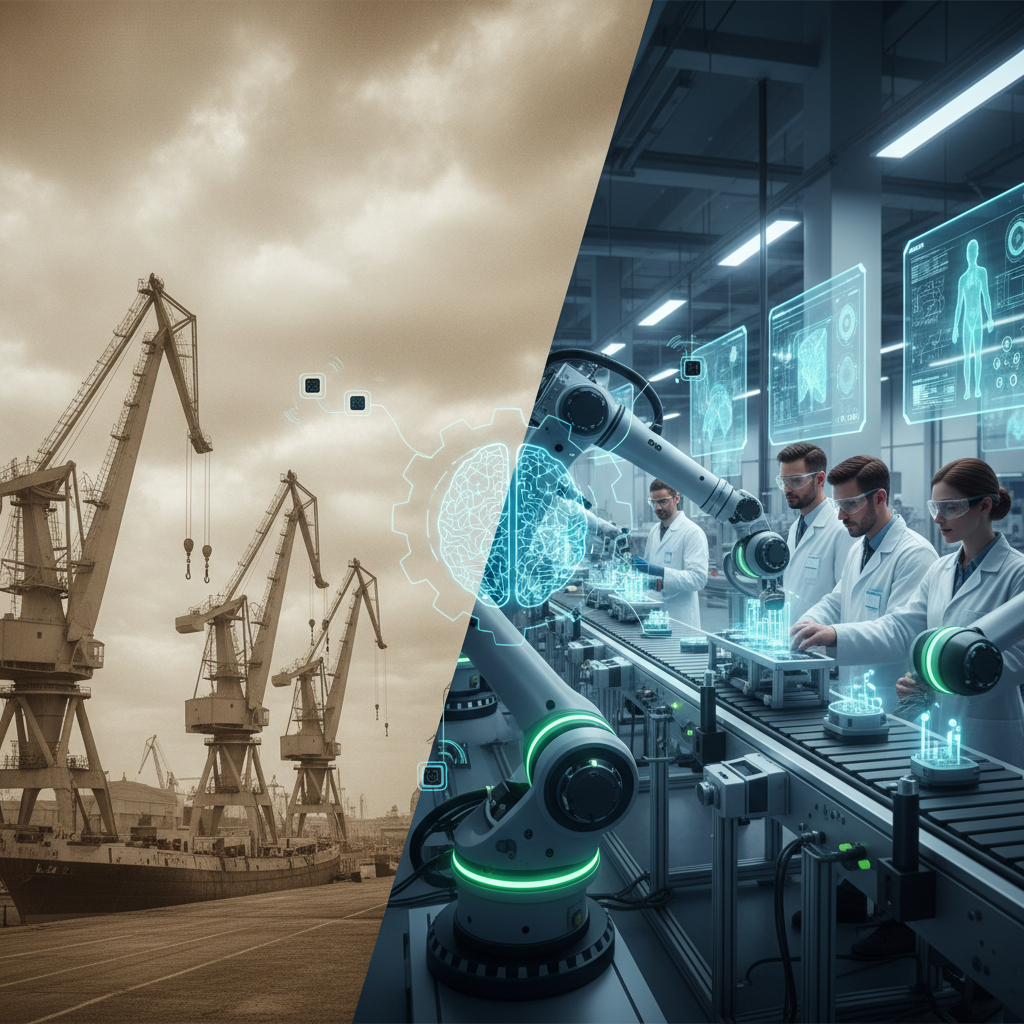

Dzień dobry, everyone! Agnieszka Kowalskà here, absolutely buzzing with excitement from Warsaw. You know, sometimes people think of manufacturing as this old, almost dusty world, full of heavy machinery and repetitive tasks. But let me tell you, if you peek behind the curtain today, especially here in Poland, what you’ll find is nothing short of a technological marvel. We are talking about factories that think, predict, and learn, all thanks to the incredible power of artificial intelligence.
Today, I want to pull back that curtain and show you exactly how AI is transforming our industrial landscape, from the bustling automotive plants in Silesia to the innovative electronics manufacturers near Poznań. We’re going to break down the magic behind predictive maintenance, razor-sharp quality control, and the concept of the truly smart factory. It might sound complex, but trust me, it’s all about making things better, safer, and more sustainable.
The Big Picture: What Does a Smart Factory Actually Do?
Imagine a factory where machines tell you they are about to break down days, even weeks, before it happens. Imagine a production line where every single product is inspected with superhuman precision, catching flaws that even the sharpest human eye might miss. This isn't science fiction, my friends, this is the reality of the AI-powered smart factory. Its core mission is to optimize every single process, reduce waste, increase efficiency, and ensure top-tier product quality, all while keeping human workers safe and productive.
This transformation is not just about adding a few robots, it’s about creating an interconnected ecosystem where data flows freely, analyzed by powerful AI algorithms that provide actionable insights. It’s like giving the factory a brain, a nervous system, and incredibly sharp senses all at once.
The Building Blocks: Key Components Explained Simply
To understand how these smart factories operate, let’s look at their fundamental elements:
- Sensors Everywhere: These are the eyes and ears of the smart factory. Think temperature sensors, vibration sensors, acoustic sensors, pressure sensors, cameras, and even thermal imaging devices. They are constantly collecting data from every piece of machinery and every stage of the production process.
- Connectivity (IoT): All that sensor data needs to go somewhere. This is where the Internet of Things, or IoT, comes in. It’s the network that connects all these sensors and machines, allowing them to communicate and send their data to a central processing unit, often in the cloud or on edge devices.
- Data Lake/Warehouse: This is where all the raw, unstructured data from the sensors is stored. It’s like a massive library, holding every piece of information about the factory’s operations, waiting to be analyzed.
- AI Algorithms: Ah, the brain of the operation! These are the sophisticated mathematical models, often based on machine learning and deep learning, that sift through the vast amounts of data. They look for patterns, anomalies, and correlations that humans simply cannot detect at scale. Companies like Google DeepMind and NVIDIA are constantly pushing the boundaries of what these algorithms can achieve, making them faster and more accurate.
- Actuators and Robotics: Once the AI makes a decision or prediction, something needs to act on it. This could be a robotic arm adjusting a component, a machine automatically slowing down, or an alert sent to a human operator. These are the hands and feet of the smart factory.
- Human-Machine Interface (HMI): This is how humans interact with the smart factory. Dashboards, tablets, and augmented reality glasses allow operators to monitor processes, receive alerts, and make informed decisions based on AI insights.
Step by Step: How It Works from Input to Output
Let’s walk through a typical scenario, like predictive maintenance for a critical piece of machinery:
Step 1: Data Collection: Imagine a large industrial press. It has vibration sensors on its moving parts, temperature sensors on its motors, and acoustic sensors listening for unusual noises. These sensors continuously stream data, perhaps hundreds of data points per second, to the factory’s central system. This is the input.
Step 2: Data Pre-processing: The raw data is often noisy and needs to be cleaned and organized. This involves filtering out irrelevant information, normalizing values, and structuring it for the AI model. It’s like tidying up your desk before you start a big project.
Step 3: Feature Engineering: AI models don't always work directly with raw data. Experts might extract specific 'features' from the data, such as the frequency of vibrations, the rate of temperature increase, or specific sound signatures. These features are more meaningful for the AI to learn from.
Step 4: AI Model Training: A machine learning model, often a deep learning neural network, is trained on historical data. This data includes periods when the machine was operating normally and periods leading up to a failure. The model learns to recognize the subtle patterns and deviations that precede a breakdown. For example, a slight increase in vibration amplitude combined with a specific temperature spike might indicate an impending bearing failure.
Step 5: Real-time Monitoring and Prediction: Once trained, the AI model continuously analyzes the live data stream from the press. It compares the current operational data against the patterns it learned during training. When it detects a pattern that strongly suggests an upcoming failure, it triggers an alert.
Step 6: Action and Intervention: An alert is sent to maintenance personnel, perhaps via a mobile app or a central control room dashboard. The alert might specify the predicted component failure, its likely timing, and even suggest a maintenance procedure. This allows the team to schedule maintenance proactively, ordering parts if needed, and replacing the component before it fails catastrophically, preventing costly downtime.
A Worked Example: Quality Control in Electronics Assembly
Consider a Polish startup, Infermedica, known for its AI diagnostic tools, but let’s imagine a similar innovative spirit applied to manufacturing. Let’s say a company producing circuit boards wants to ensure every solder joint is perfect. Traditionally, this involves human inspection, which can be slow and prone to error.
In an AI-powered quality control system, high-resolution cameras capture images of every single solder joint on every board as it moves down the assembly line. These images are fed into a pre-trained convolutional neural network (CNN), a type of deep learning model particularly adept at image recognition. The CNN has been trained on thousands of images of both perfect and flawed solder joints, learning to identify microscopic cracks, insufficient solder, or bridging between connections.
As each board passes, the AI instantly analyzes its images. If a flaw is detected, the system immediately flags the board, perhaps diverting it to a rework station or rejecting it entirely. This happens in milliseconds, ensuring 100% inspection coverage and significantly reducing the number of defective products reaching the customer. This Polish startup just might be the next big thing in manufacturing, too!
Why It Sometimes Fails: Limitations and Edge Cases
While AI in manufacturing is incredibly powerful, it’s not a magic wand. There are challenges:
- Data Quality and Quantity: AI models are only as good as the data they are trained on. If historical data is incomplete, biased, or insufficient, the model’s predictions will be unreliable. Getting clean, comprehensive data from legacy machinery can be a huge hurdle.
- Novel Failures: AI models learn from past events. If a machine experiences a completely new type of failure that the model has never seen before, it might not be able to predict it. Human expertise remains crucial for handling these unforeseen circumstances.
- Sensor Malfunctions: If the sensors themselves fail or provide inaccurate readings, the AI will be working with bad information, leading to incorrect predictions or quality assessments.
- Integration Challenges: Integrating new AI systems with existing, often proprietary, factory equipment can be complex and expensive. It requires significant investment and expertise.
- Cybersecurity Risks: As factories become more connected, they also become more vulnerable to cyberattacks. Protecting the data and control systems is paramount.
Where This Is Heading: Future Improvements
The future of AI in manufacturing is incredibly bright. I see a world where factories are not just smart, but truly autonomous and self-optimizing. Here's what's on the horizon:
- Generative AI for Design: Imagine AI designing new parts or even entire production lines based on desired specifications and material constraints. This could drastically speed up product development.
- Reinforcement Learning for Optimization: AI agents could learn to control complex processes, like chemical reactions or robotic assembly sequences, by trial and error in simulated environments, leading to unprecedented levels of efficiency.
- Digital Twins: Creating highly accurate virtual replicas of physical factories and machines will allow AI to simulate scenarios, test changes, and predict outcomes without disrupting real-world operations. This is already happening in some advanced facilities, and it’s truly revolutionary.
- Human-AI Collaboration: Instead of replacing humans, AI will increasingly augment their capabilities. Augmented reality tools will overlay AI insights onto the real world, guiding technicians through complex repairs or quality checks. This means Poland's tech talent is Europe's best-kept secret will be even more valuable, working hand-in-hand with intelligent systems.
As a journalist, I’ve had the privilege of seeing firsthand how our engineers and innovators in Poland are embracing these technologies. From the automotive sector to specialized electronics, we are not just adopting AI, we are shaping its future. The journey from traditional manufacturing to the intelligent, self-optimizing factory is a testament to human ingenuity and our relentless pursuit of progress. And believe me, the best is yet to come! The world is watching, and Warsaw is the new Berlin when it comes to this kind of innovation. It’s an exciting time to be alive, isn't it?