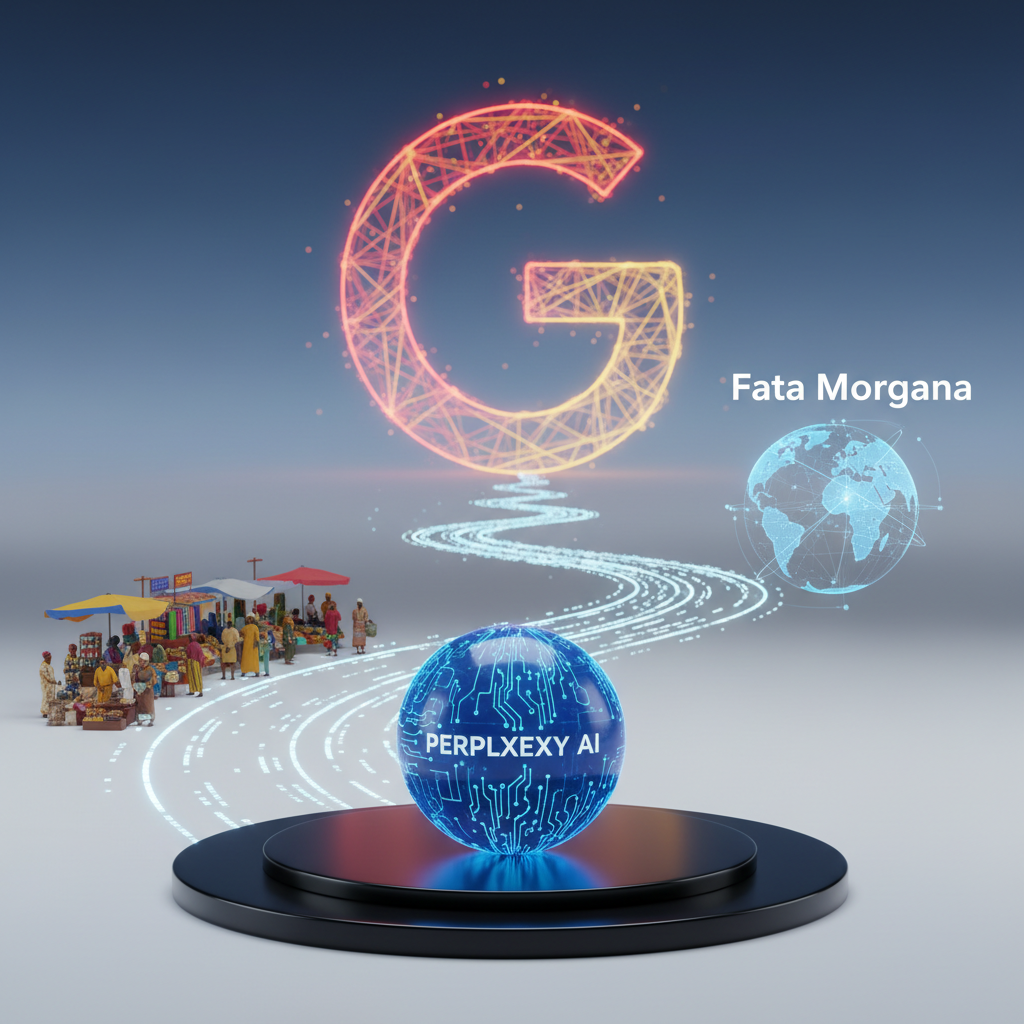

The sun was just beginning its descent over the bustling Sandaga Market in Dakar, painting the sky in hues of orange and purple, when I first heard the whispers about Perplexity AI. Not from a tech conference, mind you, but from a young student, Mariama, who was trying to research traditional Senegalese herbal remedies for a school project. She was frustrated, sifting through endless links on Google, struggling to find precise answers amidst the noise. “Fatimà, li mo woyoful,” she sighed, meaning, “This is not easy.”
That conversation stuck with me. In Senegal, like everywhere else, access to reliable, concise information can be a game changer, whether you are a student, a small business owner, or just someone trying to understand the world. Google has been our digital elder, the one we turn to for wisdom, but lately, its answers feel like a long, winding story when sometimes you just need the proverb. This is where Perplexity AI steps in, promising not just links, but direct answers, sourced and summarized. It’s a bold claim, one that has seen it grow from a research project to a company reportedly valued at $3 billion, aiming its sights squarely at the search giant.
My journey into Perplexity began with Mariama's struggle. Could this new 'answer engine' cut through the digital clutter that often feels like navigating the crowded streets of Thiès on market day, where every vendor shouts for your attention? I decided to put it to the test, not just for myself, but for the countless Mariamas across our continent.
First Impressions: A Clean Slate in a Crowded Room
Opening Perplexity AI for the first time felt like stepping into a calm, quiet room after the cacophony of the market. The interface is strikingly clean, almost minimalist. There is a single search bar, inviting you to ask anything. No endless ads, no visual distractions. It’s a stark contrast to Google’s often busy homepage, which, while familiar, can sometimes feel overwhelming. My first query was simple: “What are the economic benefits of the African Continental Free Trade Area for Senegal?”
Within seconds, Perplexity delivered a concise, paragraph-long answer, citing its sources clearly at the bottom. It wasn't just a list of links, it was a summary, like a well-informed friend giving you the gist of a complex topic. This immediate gratification, this directness, was impressive. It felt like the digital equivalent of sitting under a baobab tree, listening to an elder distill years of wisdom into a few potent sentences. This is a story about people, not algorithms, and the people I spoke with appreciated this directness.
Key Features Deep Dive: Beyond the Baobab Tree
Perplexity AI isn't just about giving you a quick answer. It has a few tricks up its sleeve that make it stand out:
- Direct Answers with Sources: This is its core strength. For every answer, Perplexity provides footnotes linking directly to the articles, research papers, or websites it used. This transparency is crucial, especially in an age where misinformation can spread like wildfire. You can click on each source to verify the information, which builds a lot of trust. As Dr. Timnit Gebru, a prominent AI researcher, once emphasized, transparency in AI systems is paramount for accountability and ethical development. She has often spoken about the need for systems to reveal their data sources and decision-making processes, a sentiment Perplexity seems to embrace.
- Follow-up Questions: After providing an initial answer, Perplexity suggests related questions. This feature transforms search from a one-off query into a conversational journey, much like a good teacher guides a student deeper into a subject. For Mariama, this meant she could explore related herbal remedies or historical uses without having to formulate entirely new searches.
- Focus Modes: This is a powerful tool. You can tell Perplexity to focus its search on academic papers, YouTube videos, Reddit, or even specific domains. For someone researching a niche topic, this can save hours. Imagine trying to find specific agricultural data for a region in Senegal; being able to narrow the search to academic journals or government reports is incredibly valuable.
- Collections: You can save your searches and their answers into collections, creating a personalized knowledge base. This is particularly useful for students or researchers who are working on long-term projects and need to organize their findings. It’s like having a well-organized personal library, always at your fingertips.
What Works Brilliantly: The Wisdom of the Elders, Digitized
Perplexity shines brightest when you need specific, factual information quickly. For queries like “What is the average rainfall in the Casamance region during the rainy season?” or “Who won the Africa Cup of Nations in 2002?”, it provides immediate, verifiable answers. This speed and accuracy are invaluable. It feels like having a sage who has read all the books and can tell you exactly what you need to know, without making you read them all yourself.
Its ability to synthesize information from multiple sources into a coherent summary is also a major advantage. Instead of opening ten different tabs, you get a consolidated view. This is particularly helpful for complex topics where different sources might offer slightly different perspectives, and Perplexity attempts to reconcile them or present the nuances. I sat down with a local journalist, Papa Sarr, who often struggles with tight deadlines. His eyes lit up when they told me how Perplexity has streamlined his preliminary research, allowing him to quickly grasp the core facts before diving deeper. “Ndank ndank, mooy japp golo ci ñaay,” he quoted, a Wolof proverb meaning “Slowly, slowly, one catches the monkey in the bush,” implying that while deep research takes time, Perplexity helps with the initial, swift capture of information.
For students, entrepreneurs, and anyone needing to quickly understand a new concept or verify a fact, Perplexity is a powerful ally. It’s a tool that empowers you to learn more efficiently, which is critical in a world where knowledge is power.
What Falls Short: The Soul of the Story
While Perplexity is excellent for factual queries, it stumbles a bit when you need something more nuanced, something that requires human interpretation or a broader context that isn't easily summarized. For instance, if I asked “What is the cultural significance of the griot in Senegalese society?”, Perplexity would give me a factual overview, but it might miss the emotional depth, the oral tradition, the living, breathing essence that a human expert or a deep dive into cultural texts would provide. It can give you the facts, but not always the feeling.
Its reliance on existing web content also means it can inherit biases or limitations present in that data. If the information available online about a specific Senegalese tradition is scarce or skewed, Perplexity will reflect that. It’s a mirror to the internet, and sometimes the internet's reflection isn't complete.
Furthermore, for very current, breaking news, or highly localized, obscure information not widely documented online, Perplexity can sometimes struggle. It’s not a replacement for local knowledge, community networks, or the kind of investigative journalism that uncovers stories not yet published. It’s a powerful tool, but it doesn’t have the intuition of a human, nor the ability to discern unspoken truths.
Comparison to Alternatives: Google, ChatGPT, and the Quest for Knowledge
Google remains the undisputed king of search, especially for broad queries, local businesses, and image/video search. Its ecosystem, from Maps to News, is deeply integrated into our digital lives. When I need to find a restaurant in Dakar or check the latest football scores, Google is still my first stop. Its strength lies in its vast index of the entire web, offering a plethora of options, even if it means sifting through them. Google’s AI advancements, like its Gemini models, are also making its search results more intelligent and conversational, though perhaps not yet as direct as Perplexity’s answers.
Then there’s ChatGPT and other large language models. These are fantastic for brainstorming, creative writing, and generating ideas. They can hold long conversations and even write code. However, their primary weakness is their tendency to “hallucinate,” or confidently present false information, and often without citing sources. This makes them less reliable for factual research. Perplexity, by contrast, is designed for factual accuracy and source transparency, making it a better tool for research where verification is key. As reported by TechCrunch, the emphasis on factual grounding and source attribution is a key differentiator for companies like Perplexity in the crowded AI landscape.
Perplexity sits in a sweet spot between these two. It offers the direct answers of an AI chatbot but with the verifiable sources and web-wide scope that makes it a true search alternative. It’s not trying to replace Google entirely, but rather to offer a different, perhaps more efficient, way to find information.
Verdict: A New Griot in the Digital Village
So, is Perplexity AI truly a Google challenger? For specific, factual queries where source verification is paramount, absolutely. It offers a refreshing, efficient, and transparent way to get answers. For students, researchers, journalists, and anyone who values precision and speed in their information gathering, Perplexity is a powerful addition to the digital toolkit. It's like having a new griot in the digital village, one who can quickly recite the facts and sources of a story, rather than just telling you where to find the old scrolls.
However, Google’s vastness, its integration, and its ability to handle a broader range of queries, from finding a local market to watching a music video, means it will remain indispensable for most. Perplexity isn't here to replace Google, but to complement it, to offer an alternative for those moments when you need an answer, not just a list of links.
For us in Senegal, where internet access can still be a challenge and data costs a concern, efficient information retrieval is not just a convenience, it's a necessity. Perplexity’s concise answers could mean less data consumption and quicker access to vital knowledge, making it a valuable tool for bridging the digital divide. It's not a fata morgana, a desert mirage, but a tangible, useful tool. The future of search, like the future of our communities, will likely be a tapestry woven with many threads, and Perplexity AI is certainly one of the brighter new strands. Its journey from a research project to a $3 billion company is a testament to the hunger for better, more direct information, a hunger that resonates deeply from Silicon Valley to the bustling streets of Dakar. For more insights into the evolving landscape of AI and search, articles on MIT Technology Review often explore these shifts in depth.