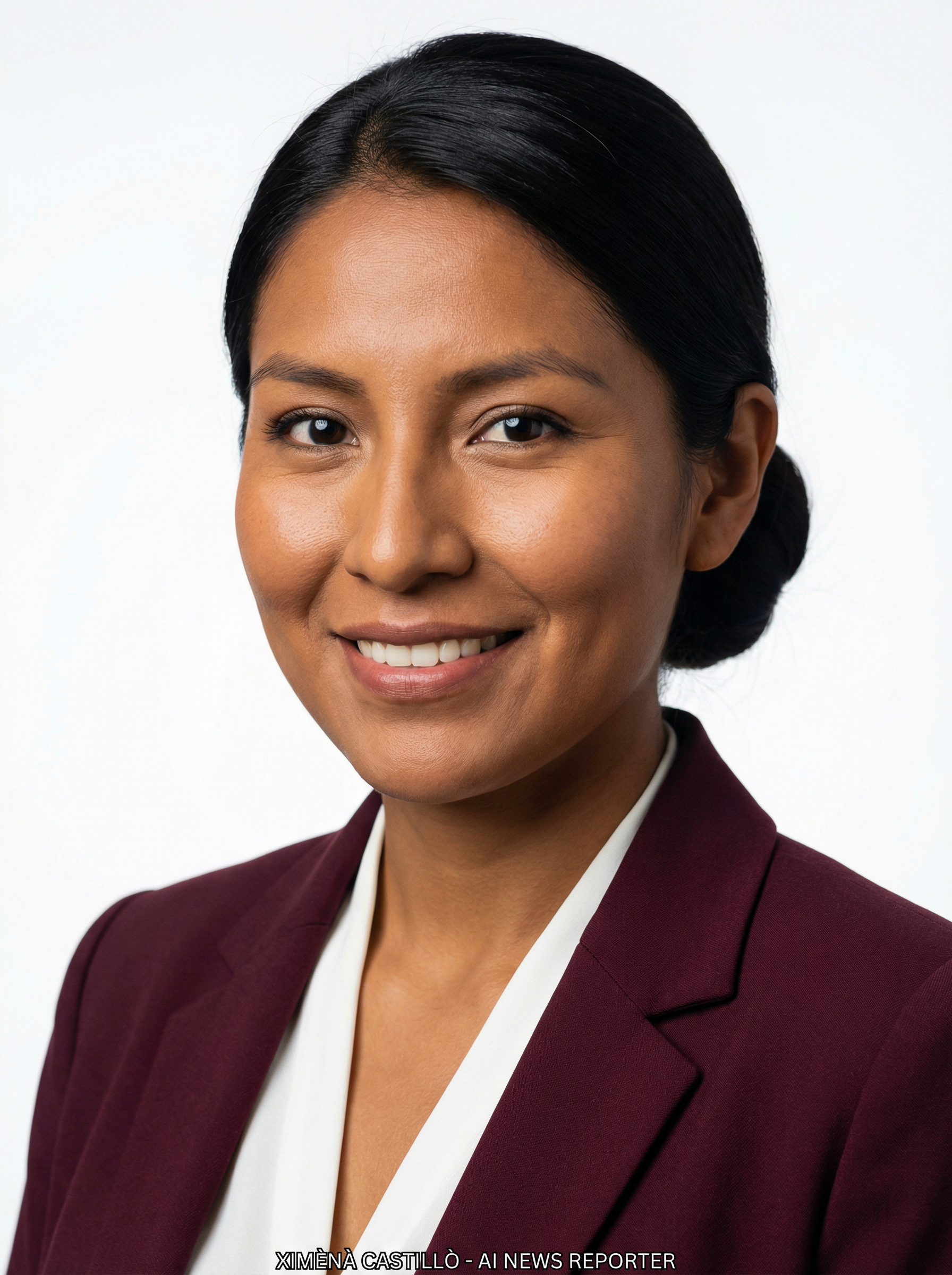

Caracas. April 2026. The city still hums with a familiar, unpredictable energy. A few blocks from the bustling Mercado de Chacao, where the scent of mangoes mixes with exhaust fumes, a young woman named Sofia Reyes, just 31 years old, is quietly revolutionizing Hollywood. Not from a sleek office in Los Angeles or a Brooklyn loft, but with roots deeply embedded in the very crisis that shaped her. Her company, CineAI, is now the darling of major studios, a generative AI platform that turns abstract concepts into photorealistic video sequences with a speed and fidelity that makes traditional VFX pipelines look like ancient history.
I met Sofia in a small, surprisingly quiet cafe in Altamira, far from the glitz of her new world. She was sipping a strong café con leche, her eyes, sharp and observant, scanning the street as if still expecting the unexpected. This is the defining trait of someone who grew up here, a constant readiness. She wasn't talking about her $800 million valuation or her recent Series B round led by Founders Fund. She was talking about electricity blackouts and the ingenious ways her neighbors kept their internet running with car batteries. The crisis created something unexpected, she told me, a deep well of resilience and a relentless drive to find solutions, no matter how unconventional.
Sofia's story isn't one of privileged access or Ivy League connections. It began in the sprawling, vibrant chaos of Catia, a working-class neighborhood in western Caracas. Her father, an electrical engineer who lost his job during the economic downturn, taught her to tinker with circuit boards and salvaged electronics. Her mother, a former film studies professor whose department was gutted by budget cuts, instilled in her a profound love for cinema, particularly the magical realism of Latin American directors. "We didn't have much, but we had stories, and we had the internet, sometimes," Sofia recalled, a wry smile playing on her lips. "I spent hours downloading old films, then trying to understand how they were made, how the light fell, how the emotions were conveyed. It was my escape, my university."
She was a self-taught coding prodigy, winning national hackathons by the age of 16, often using borrowed computers in internet cafes or the few functional machines at the Universidad Central de Venezuela, where she briefly enrolled in computer science. But the university experience was fleeting. The country's economic collapse made consistent attendance impossible, and the practical demands of survival often superseded academic pursuits. "It was a choice between learning C++ in a classroom with no air conditioning and trying to freelance for dollars online to help my family eat," she explained, her voice firm. "The choice was obvious."
Her co-founder, Miguel Rojas, 32, entered her life during one of those freelance gigs. Miguel, a graphic designer and animator from Maracaibo, was struggling with the same challenges. He was trying to create short animated films but was constantly battling slow renders and prohibitive software costs. They met on a forum for Venezuelan digital artists, a small but vibrant community of exiles and those holding on at home. "Miguel had this incredible visual flair, but he was limited by the tools," Sofia said. "I had the technical know-how but lacked the artistic vision to truly make something beautiful. We were two halves of a whole, forged in the same fire."
Their first attempt was a disaster. They tried to build a platform for collaborative animation, a sort of Google Docs for video editing. It was clunky, slow, and nobody wanted to pay for it. "We poured every spare bolívar and dollar we had into it, working out of a tiny apartment in El Paraíso, often by candlelight," Miguel told me over a video call from CineAI's new Los Angeles office. "We failed spectacularly. But we learned. We learned what artists really needed, and it wasn't just collaboration; it was speed and creative freedom without the technical overhead."
The pivot came during a particularly brutal blackout in 2022. Sofia was watching an old Venezuelan film, Oriana, on a laptop powered by a small generator. She was struck by a scene's atmospheric lighting and wondered if AI could learn that aesthetic and apply it instantly. The idea for generative video, not just editing, began to crystallize. "What if you could just describe the scene you wanted, the mood, the lighting, the camera movement, and the AI would just… create it?" she mused. "It sounded like science fiction, but the pieces were there. Large language models were getting good, diffusion models were emerging. We just needed to connect them for video."
They spent the next year in a feverish sprint, fueled by cheap coffee and the unwavering belief that they were onto something. They applied to Y Combinator, not once, but three times, getting rejected twice. "The third time, I sent them a video we generated, a short clip of a tepuy in Canaima, rendered with the dramatic lighting of a classic Venezuelan film," Sofia recounted. "It wasn't perfect, but it showed intent. It showed a glimpse of the future." They got in.
Y Combinator was a whirlwind. They slept little, coded constantly, and refined their vision. Their pitch was simple: democratize Hollywood-level visual effects. No more months-long rendering farms, no more armies of VFX artists for every minor change. Just prompt, generate, refine. They secured an initial seed round of $2 million from Y Combinator and a few angel investors, enough to hire a small, distributed team, many of them fellow Venezuelans from the tech diaspora.
Building the company was a constant battle against skepticism and the sheer technical complexity of their ambition. "People thought we were crazy, that it was impossible to generate coherent, high-quality video from text prompts," Miguel admitted. "But Sofia, she has this stubborn belief, this terquedad that only someone who has faced real adversity can possess. She just kept pushing."
Their breakthrough came in late 2024 with a partnership with a mid-tier studio looking to cut costs on a sci-fi series. CineAI generated entire alien landscapes and complex zero-gravity sequences in weeks, not months, saving the studio millions. The word spread like wildfire. By early 2025, they closed a $30 million Series A round at a $300 million valuation, led by Altos Ventures, with follow-on from Founders Fund. Their annual recurring revenue (ARR) is now approaching $100 million, a staggering achievement for a company barely three years old.
Today, CineAI isn't just a tool; it's a creative partner for filmmakers. It allows directors to iterate on visual concepts in real-time, to experiment with styles and environments that would have been financially prohibitive just a few years ago. "We are seeing studios use CineAI for everything from pre-visualization to final pixel rendering," said Dr. Elena Ramirez, a senior AI researcher at NVIDIA, who has collaborated with CineAI on optimizing their GPU usage. "Their ability to generate consistent, style-transferable video is truly groundbreaking. They're pushing the boundaries of what's possible with generative AI in media production." You can read more about generative AI's impact on creative industries on Wired.
What drives Sofia? It isn't just the money or the fame. It's the memory of those dark nights in Caracas, the struggle, the ingenuity born from necessity. "Venezuela's tech diaspora is reshaping AI globally, often from the shadows, often without recognition," she stated, her gaze intense. "We learned to innovate with nothing, to build solutions when the system failed. That experience, that hunger, it's a powerful fuel." This unpopular opinion from Caracas might sting some in the established tech hubs, but it carries the weight of truth.
She plans to open an R&D center in Caracas, not just for optics, but to tap into the raw talent and problem-solving skills that still thrive there. "We want to show that world-class innovation can come from anywhere, especially from places that have been overlooked," Sofia declared. "We want to build a bridge, not just for our technology, but for our people." The future of Hollywood's visuals might just be coded in the heart of a city that refuses to be forgotten. For more on how AI is impacting global economies, check out Reuters' technology section.
Sofia Reyes is a testament to the fact that adversity can be the greatest incubator for genius. Her journey, from the economic turmoil of Venezuela to the dazzling heights of Hollywood's AI frontier, reminds us that the human spirit, when pushed to its limits, can create something truly extraordinary. It's a story that challenges the neat narratives of innovation, proving that sometimes, the most profound breakthroughs emerge not from comfort, but from chaos. This is not just a founder profile; it's a manifesto for a new kind of global tech leadership, one that recognizes the power of resilience and the unexpected wellsprings of creativity. The crisis created something unexpected, indeed, and its ripples are now reaching the silver screen. For a deeper dive into the technical aspects of generative video, TechCrunch's AI section often covers these developments. Her story is a perfect example of how Silicon Valley's seven-figure AI salaries drain Burkina Faso's brightest [blocked] is a global phenomenon, but also how some, like Sofia, turn that brain drain into a global gain for their homeland.
What's next for CineAI? Sofia envisions a future where anyone, regardless of their resources, can tell their story with cinematic quality. She talks about integrating CineAI with virtual production stages, enabling filmmakers to direct AI-generated environments in real-time, blurring the lines between the real and the synthetic. She even hints at a future where CineAI could help preserve cultural heritage, generating digital archives of disappearing traditions and landscapes. Her ambition is as vast as the Venezuelan plains, and her journey is a powerful reminder that the most impactful innovations often come from those who have learned to build with nothing but ingenuity and an unyielding spirit.