
G'day, everyone. Braideùn O'Sullivàn here, buzzing with excitement from DataGlobal Hub's Sydney office. You know, sometimes you stumble upon a story that just grabs you by the collar and screams, 'This is it, mate. This is the future.' Well, I've found one, and it's brewing right here in our own backyard, promising to transform the global real estate game.
Meet Dr. Anya Sharma, the brilliant mind behind TerraSense AI. Anya's journey began not in a Silicon Valley garage, but amidst the vibrant, ever-changing tapestry of Sydney's property market. Growing up in a family of real estate agents, she witnessed firsthand the sheer guesswork, the emotional rollercoasters, and the often opaque nature of property transactions. "My parents, bless them, they worked tirelessly," Anya told me over a flat white in Surry Hills. "But so much of their expertise was gut feeling, local knowledge, and pure grind. I kept thinking, there has to be a smarter way, a way to bring clarity and certainty to what is often the biggest financial decision of people's lives." Her 'aha moment' wasn't a sudden flash, but a slow burn, fueled by years of watching her family navigate market shifts, interest rate hikes, and the perennial question: 'What's this place really worth?'
After completing her PhD in geospatial AI at the University of New South Wales, Anya spent several years at Google's Sydney office, working on advanced mapping and data visualization projects. But the pull of her original passion, solving the real estate riddle, was too strong. She saw the immense potential of integrating satellite imagery, drone data, local council records, and real-time market sentiment, all processed by sophisticated AI, to create something truly revolutionary. She left Google in late 2023, a move that raised a few eyebrows at the time, but now looks like pure genius.
The problem TerraSense AI is solving is monumental: the lack of accurate, real-time, and unbiased property valuation and market prediction. Traditional valuations are often slow, reliant on human interpretation, and can miss crucial micro-market dynamics. Virtual tours, while helpful, rarely capture the true essence or future potential of a property. And market predictions? Well, they're often as reliable as a weather forecast in Melbourne, changing every five minutes. This isn't just an Australian problem, it's a global one. From the bustling streets of London to the sprawling suburbs of Los Angeles, buyers, sellers, investors, and lenders are all crying out for better data, for a crystal ball that actually works.
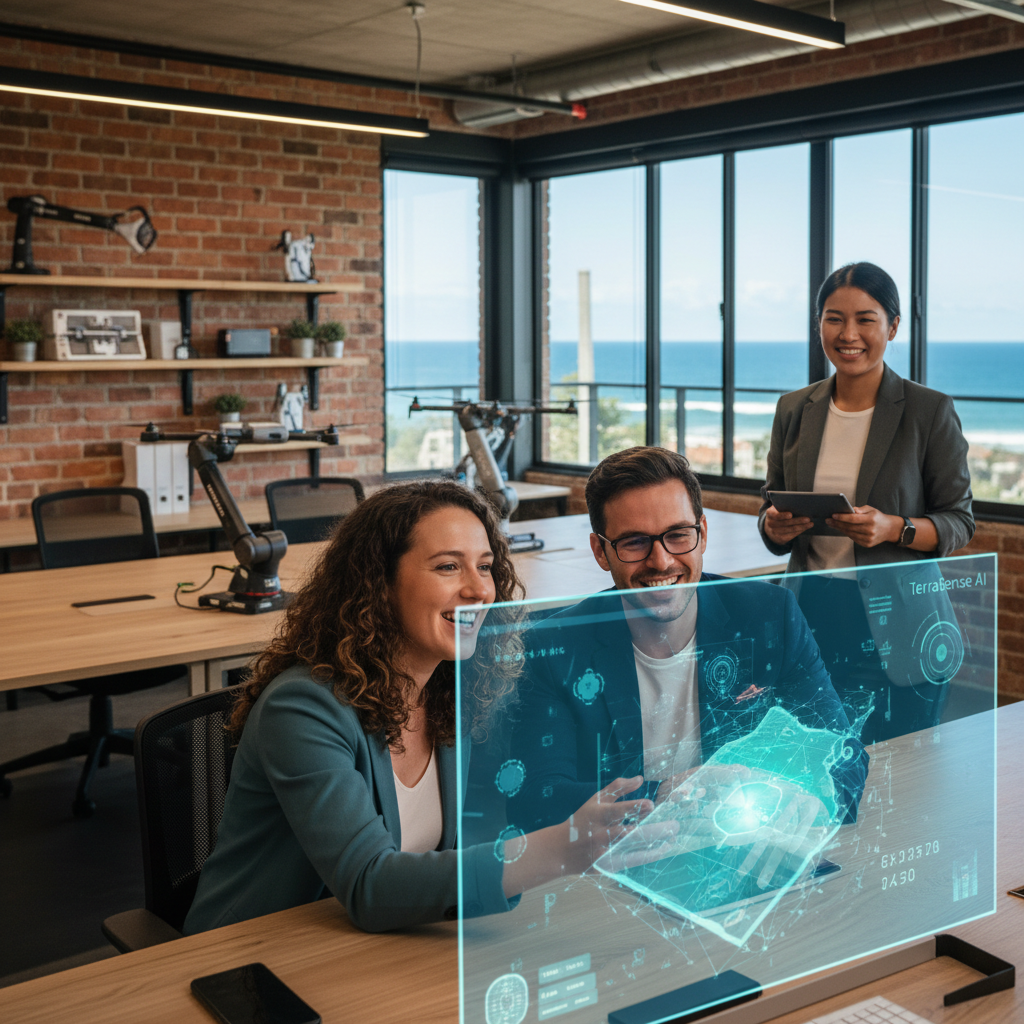
TerraSense AI's technology is nothing short of breathtaking. They've developed a proprietary AI model, affectionately dubbed 'The Oracle' by Anya's team, that fuses an unprecedented array of data points. Imagine this: high-resolution satellite imagery is continuously fed into the system, detecting changes in land use, urban development, and even micro-climates. Drones capture detailed 3D models of properties, integrating structural integrity data, material quality, and environmental factors like sun exposure and noise levels. Then, 'The Oracle' layers on public records, zoning laws, demographic shifts, local amenities, and even social media sentiment analysis specific to neighborhoods. It's not just about what a house looks like, it's about its entire ecosystem, its past, present, and predicted future. "We're moving beyond simple comparables," explains Dr. Liam O'Connell, TerraSense AI's Chief Data Scientist, a fellow Irish-Australian with a sharp wit and even sharper algorithms. "Our deep learning models, powered by NVIDIA's latest GPUs, can identify subtle patterns that human valuers or even simpler AI models would completely miss, like the impact of a new bike path on property values two streets away, or the long-term effect of tree canopy cover on energy efficiency. We're predicting not just value, but livability, sustainability, and investment potential with astounding accuracy." The company has even integrated a 'future-gazing' module that simulates the impact of planned infrastructure projects, climate change scenarios, and economic shifts on specific properties over a 5, 10, and 20-year horizon. It's like having a time machine for your property portfolio.
The market opportunity for TerraSense AI is absolutely staggering. The global real estate market is valued in the hundreds of trillions of dollars, with valuation and analytics alone representing a multi-billion dollar segment. Property transactions are inherently high-value, high-stakes events. By providing unparalleled accuracy and foresight, TerraSense AI can save buyers from overpaying, help sellers maximize returns, and enable investors to make truly data-driven decisions. "We're seeing interest from major financial institutions, property developers, and even government bodies," says Sarah Chen, TerraSense AI's Head of Business Development. "Our initial pilot programs with Australian banks showed a 15% reduction in loan default risk for properties assessed by TerraSense, and a 20% faster transaction time for properties listed with our predictive analytics. The ROI is undeniable." The company recently closed a Series B funding round of AUD$85 million, led by global venture capital firm Sequoia Capital and Australia's own Blackbird Ventures, bringing their total funding to over AUD$120 million. This kind of investment speaks volumes about the perceived potential.
Now, let's talk about the competitive landscape. Sure, there are other players in the AI real estate space. Zillow and Redfin in the US have their 'Zestimates' and 'Redfin Estimates,' but these are largely based on publicly available sales data and basic property attributes. Google, with its vast mapping capabilities, could theoretically enter this space, but their current focus is broader, more generalized mapping. Major real estate portals like Domain and RealEstate.com.au in Australia offer some data insights, but nothing with the predictive power and granular detail of TerraSense. "My Irish roots taught me to question, my Australian home taught me to build," Anya reflected. "We questioned the status quo and built something genuinely new. We're not just digitizing existing processes; we're reinventing them from the ground up." The key differentiator for TerraSense is their multi-modal data fusion and their deep learning architecture, which allows for dynamic, real-time adjustments and highly localized insights. They're not just looking at past sales; they're predicting future value based on an incredibly rich tapestry of evolving data. This is where they truly stand apart from the pack, even from the likes of OpenAI's GPT models, which, while powerful for text, don't have the specialized geospatial and property-specific data ingestion capabilities that TerraSense has meticulously developed. You can read more about how other startups are tackling AI challenges on TechCrunch's AI section.
What's next for TerraSense AI? Expansion, and fast. They're currently focusing on rolling out their platform across Australia, with plans to enter the New Zealand and Southeast Asian markets by early 2027. "There's something happening in the Southern Hemisphere that Silicon Valley hasn't noticed yet," Anya quipped, a twinkle in her eye. "We're building solutions tailored for diverse geographies and unique market dynamics, not just a one-size-fits-all approach." They're also exploring partnerships with insurance companies for more accurate risk assessment and with urban planners for sustainable city development. Imagine AI-powered virtual tours that not only show you the inside of a home but also let you 'walk' through its future neighborhood, seeing planned parks and infrastructure before they even break ground. It's a future where buying a home is less about crossed fingers and more about informed confidence. This kind of innovation is precisely what we need to see more of, especially when you consider the global housing challenges. For more on the broader implications of AI, MIT Technology Review often covers these societal shifts.
TerraSense AI isn't just a startup; it's a paradigm shift. It's a testament to what happens when brilliant minds, fueled by a genuine desire to solve real-world problems, combine cutting-edge AI with deep industry knowledge. This isn't just about selling houses; it's about empowering people with knowledge, democratizing access to superior market intelligence, and building a more transparent, efficient, and ultimately fairer property ecosystem. And frankly, as an Aussie, it makes me incredibly proud to see this kind of world-leading innovation coming from our shores. The future of property is here, and it's powered by TerraSense AI. For a deeper dive into the ethical considerations of such powerful AI, you might find this article on AI ethics [blocked] insightful.