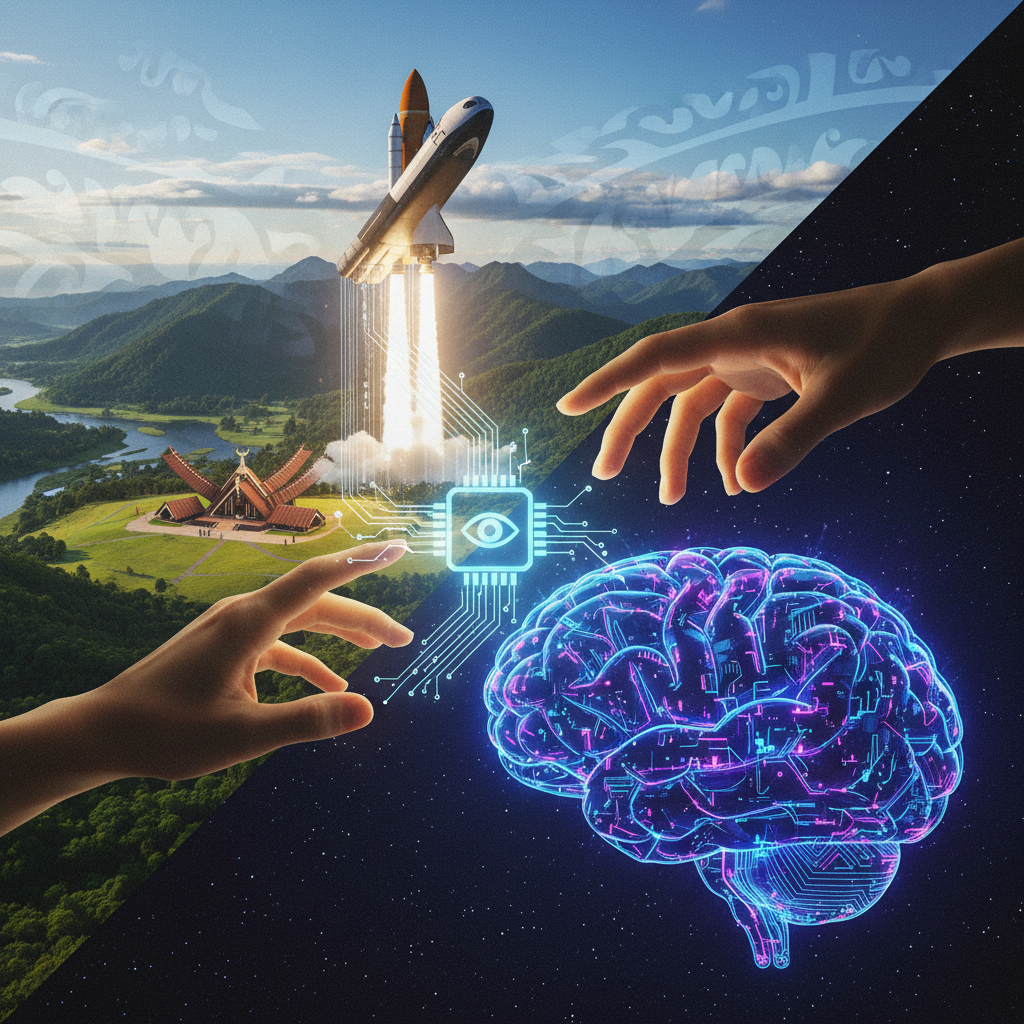

The universe, vast and unknowable, has always captivated humanity. From the ancient Māori navigators who charted their course across the Pacific by the stars, to the modern-day scientists peering through powerful telescopes, our gaze has been drawn upwards. Now, a new frontier is opening, not just in space itself, but in how we explore it. Artificial intelligence is no longer a futuristic concept confined to science fiction; it is actively shaping our journey to the stars, from Mars missions to the search for extraterrestrial intelligence. But here in Aotearoa, we must ask: are we truly ready for the implications of an AI-driven cosmos, and what wisdom do we bring to this grand endeavor?
The Headline Development: AI's Cosmic Takeover
What is happening is nothing short of a quiet revolution. AI is becoming an indispensable co-pilot in space exploration. Think of the Mars rovers, like NASA's Perseverance, which uses sophisticated AI algorithms to navigate treacherous terrain, identify scientifically interesting rock formations, and even prioritize data transmission back to Earth. These machines are not just following commands; they are making autonomous decisions millions of miles away, adapting to unforeseen challenges in real-time. This capability significantly accelerates discovery, allowing missions to achieve more in less time, reducing reliance on constant human oversight which is often delayed by light-speed communication lags.
Beyond Mars, AI is transforming satellite operations. Swarms of small satellites, often developed by companies like Planet Labs or Spire Global, are now equipped with AI that processes vast amounts of Earth observation data onboard, identifying patterns related to climate change, illegal fishing, or disaster response before transmitting only the most critical information. This edge computing in space is a game-changer, making data more actionable and reducing bandwidth demands. Furthermore, the search for extraterrestrial intelligence, or Seti, is being supercharged by AI. Projects like Breakthrough Listen are employing machine learning to sift through petabytes of radio telescope data, looking for anomalies or patterns that might indicate intelligent life, far beyond what human analysts could ever hope to process. The sheer volume of data generated by these cosmic endeavors would be meaningless without AI to make sense of it.
Why Most People Are Ignoring It: The Terrestrial Gaze
For many, the wonders of AI in space feel distant, disconnected from their daily lives. The news cycles are dominated by more immediate concerns: economic shifts, social justice issues, the latest political drama, or even the newest consumer tech gadget. Space exploration, despite its inherent awe, often gets relegated to the realm of niche scientific interest. People struggle to see how a rover on Mars or an AI sifting through radio waves affects their mortgage, their job, or the price of kai at the supermarket. The focus remains largely terrestrial, and understandably so. The immediate impact of AI on jobs, privacy, and algorithmic bias right here on Earth often overshadows the more abstract, long-term implications of its use in the cosmos.
Yet, this oversight is a missed opportunity. The innovations spurred by space AI, from advanced robotics to resilient autonomous systems, inevitably trickle down, influencing everything from self-driving cars to environmental monitoring here on Earth. More profoundly, the questions AI in space forces us to ask about intelligence, consciousness, and our place in the universe are deeply human, and deeply relevant to how we define ourselves and our future.
How It Affects YOU: More Than Just Stargazing
So, how does AI in space exploration touch your life, here in Aotearoa or anywhere else? Firstly, consider the data. The Earth observation satellites, enhanced by AI, provide critical information for climate modeling, agricultural planning, and disaster prediction. For a country like New Zealand, vulnerable to extreme weather events and reliant on its primary industries, this data is invaluable. AI-powered insights from space can help us better manage our natural resources, protect our unique biodiversity, and prepare for the impacts of a changing climate. It is about resilience, about knowing what is coming and how to adapt. Our farmers, our scientists, our emergency services all benefit from this eye in the sky, made smarter by AI.
Secondly, the technological advancements are far-reaching. The miniaturization of AI hardware, the development of robust, self-correcting algorithms for harsh environments, and breakthroughs in energy efficiency are all driven by the demands of space. These innovations find their way into our everyday technology, making our devices smarter, more reliable, and more autonomous. This means better navigation systems, more efficient logistics, and potentially, new industries and job opportunities right here in our communities. The space sector, while seemingly distant, is a powerful engine for innovation that directly impacts our economy and quality of life.
The Bigger Picture: Sovereignty, Ethics, and Our Cosmic Identity
The implications extend far beyond practical applications. The increasing autonomy of AI in space raises profound ethical questions. Who is responsible when an AI makes a critical decision millions of miles away? How do we ensure these systems align with human values, especially when those values can differ across cultures? For Māori, the concept of kaitiakitanga, guardianship over our environment and resources, extends to how we interact with all aspects of the natural world, including the cosmos. As AI takes on more decision-making roles, we must ensure that these systems are imbued with principles of responsible stewardship, not just efficiency.
Furthermore, the search for extraterrestrial intelligence, while exciting, also brings questions of planetary protection and cultural impact. If AI helps us discover other life, how do we engage with it responsibly? How do we ensure that our pursuit of knowledge does not inadvertently harm or exploit? These are not just scientific questions; they are deeply philosophical and cultural ones. In Te Reo Māori, we have a word for this: whanaungatanga, which speaks to our interconnectedness and kinship with all things. This principle must guide our journey into the cosmos, ensuring that our technological prowess is balanced with a deep sense of responsibility and respect.
What Experts Are Saying: A Call for Deliberation
Leaders in the field are urging a thoughtful approach. Dr. Sarah Kenderdine, a leading figure in digital humanities and cultural heritage, often speaks about the importance of diverse perspectives in technology.