The hum of servers, the sheer energy consumption, the colossal carbon footprint. For years, the narrative around advanced AI has been dominated by these powerful, often prohibitive, realities. Training a cutting-edge large language model can cost tens of millions of dollars and require data centers the size of small towns, guzzling electricity like there’s no tomorrow. This has created a chasm, widening the gap between those with abundant resources and those without, particularly impacting regions like my home, Aotearoa New Zealand, and our Pacific neighbours.
But a quiet revolution is brewing, one that speaks to the heart of equity and accessibility. New AI training techniques are dramatically reducing compute requirements, shifting the paradigm from 'bigger is better' to 'smarter is sustainable.' This isn't just about saving money or energy, it's about democratizing access to powerful tools, ensuring that technology serves the people, not the other way around.
In Te Reo Māori, we have a word for this concept of balance and interconnectedness: whanaungatanga. It speaks to our relationships, our shared humanity, and our responsibility to each other and to the land. When I look at these advancements in efficient AI, I see a reflection of whanaungatanga in the digital realm. We are moving towards an AI future that is less extractive and more integrated, a future where the benefits can reach everyone, not just the privileged few.
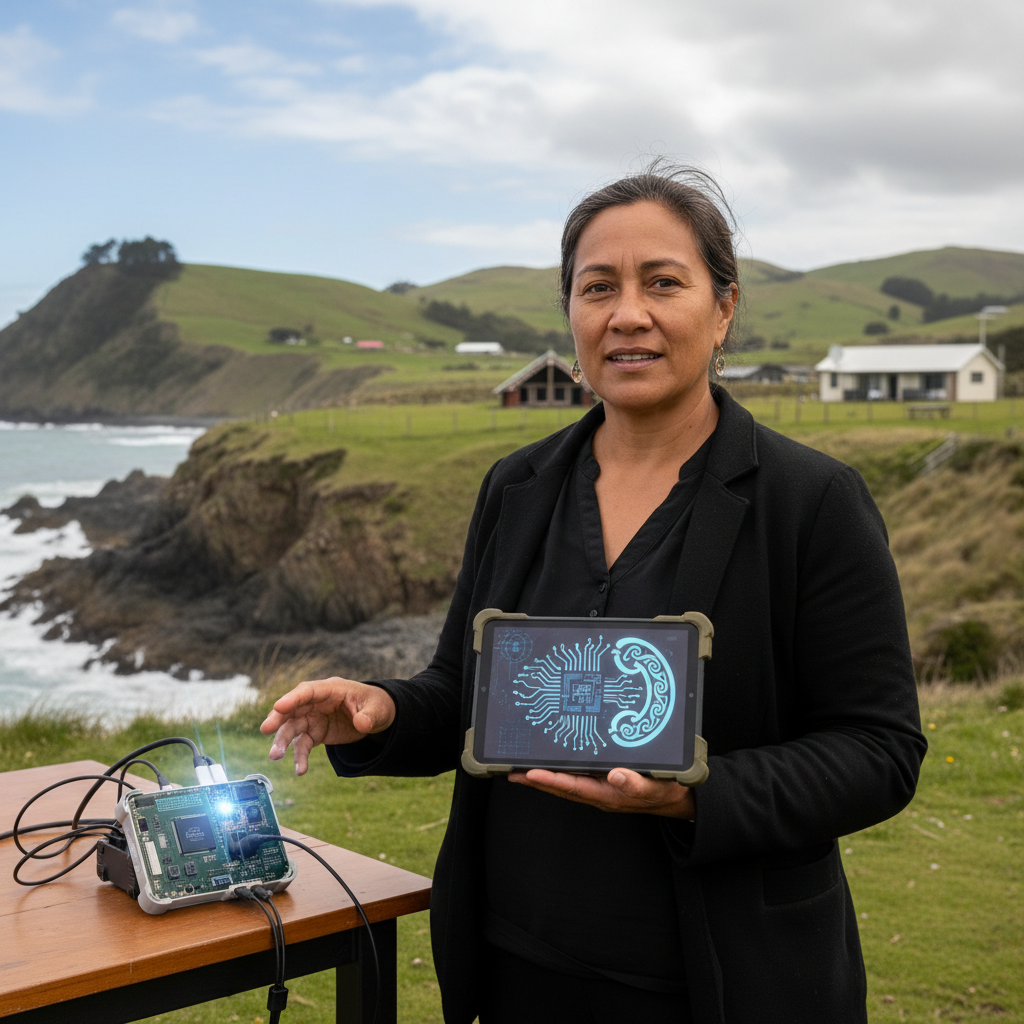
One of the most exciting developments is the rise of TinyML, or Tiny Machine Learning. Imagine sophisticated AI models running on microcontrollers, devices no bigger than a fingernail, powered by a small battery. This isn't science fiction, it's happening now. Companies like Google and NVIDIA are pouring resources into optimizing models for these constrained environments. NVIDIA's Jetson platform, for instance, is bringing powerful edge AI capabilities to devices that can operate independently, far from the cloud. This has profound implications for places like rural New Zealand, where internet connectivity can be patchy and reliable access to large data centers is a pipe dream.
Dr. Hine Te Rangi, a lead researcher at the University of Auckland's AI for Social Good Institute, has been a vocal advocate for this shift. “For too long, the promise of AI in healthcare has been tethered to immense computational power and centralized infrastructure,” she explained to me during a recent video call. “That model simply doesn't work for our remote Māori communities, for our Pacific island whānau. TinyML, coupled with robust data sovereignty frameworks, allows us to deploy diagnostic tools, environmental monitors, and even early warning systems for natural disasters right where they are needed most, without relying on external servers or constant internet access. This is about self-determination in the digital age.”
Her team is currently piloting a TinyML-powered device designed to detect early signs of rheumatic fever, a preventable but devastating disease that disproportionately affects Māori and Pacific children in New Zealand. The device, roughly the size of a small smartphone, uses a pre-trained neural network to analyze throat swab images on the spot, providing immediate feedback to community health workers. This drastically reduces the time to diagnosis and treatment, which is critical for preventing long-term heart damage. The model itself was trained using a technique called 'quantization aware training,' reducing its size by over 80% without significant loss of accuracy, making it suitable for the device’s limited processing power.
This move towards efficient AI is gaining traction globally. Researchers at MIT Technology Review recently highlighted several breakthroughs in 'sparsification' and 'pruning' techniques, where unnecessary connections and weights in neural networks are removed after training, drastically shrinking model size and inference costs. This means that once a model is trained, its operational footprint becomes much smaller, making it viable for deployment on edge devices.
Another key player in this space is Anthropic, known for its focus on AI safety and interpretability. While their flagship Claude models are still substantial, their research into 'constitutional AI' and self-correction mechanisms is indirectly pushing for more efficient, targeted training. By embedding ethical principles directly into the training process, they aim to reduce the need for massive, brute-force data sets that often contain biases, potentially leading to more focused and less resource-intensive training pipelines in the long run. Their approach suggests that a 'smarter' model might not always need to be the 'biggest' model.
The implications extend beyond healthcare. Consider environmental monitoring, a critical area for a country like New Zealand, with its unique biodiversity and vulnerability to climate change. Imagine small, solar-powered sensors equipped with TinyML models, deployed deep within our native forests or along our coastlines. These devices could identify invasive species by their calls, detect changes in water quality, or monitor seismic activity, all in real time, without needing to constantly upload data to the cloud. This local processing capability is not just efficient, it’s resilient, operating even when traditional communication infrastructure fails.
“The shift to edge AI and reduced compute is not just an engineering feat, it’s a philosophical one,” says Dr. Liam O’Connell, a senior data scientist at Spark, New Zealand’s leading telecommunications provider. “It forces us to ask what truly matters in an AI model. Is it sheer parameter count, or is it impactful, localized utility? For us, it’s about enabling solutions that genuinely benefit New Zealanders, particularly in areas where connectivity is a challenge. We're exploring partnerships with local iwi to deploy these technologies in ways that respect Māori data sovereignty principles.”
Aotearoa's approach to AI is rooted in indigenous wisdom, emphasizing guardianship, collective well-being, and long-term sustainability. This is why the move towards more efficient, localized AI resonates so deeply here. It aligns with our values of kaitiakitanga, the guardianship of our natural resources and cultural heritage, and manaakitanga, the practice of extending care and hospitality to others. When AI models are smaller, more transparent, and can run on local devices, they are inherently more controllable and accountable to the communities they serve.
This isn't to say the challenges are gone. Developing these compact, efficient models requires specialized expertise, and ensuring their accuracy and fairness on limited data sets remains a significant hurdle. Furthermore, the ethical considerations around data collection, even for local processing, are paramount. Māori data sovereignty initiatives, which advocate for Māori control over their own data, are crucial here, ensuring that these powerful new tools are used in a way that empowers, rather than exploits.
The global trend towards reduced compute requirements, driven by innovations from giants like Google and NVIDIA, is more than just a technical optimization. It’s a pathway to a more equitable and sustainable AI future. For New Zealand, it means the promise of advanced healthcare, environmental protection, and community empowerment can finally move from the abstract to the tangible, bringing the benefits of AI to every corner of our beautiful land. It’s a future where the power of technology is truly shared, reflecting the interconnectedness that defines us all. This is the kind of progress that makes my heart sing. For more on how AI is impacting healthcare, you can read about how AI is impacting healthcare in other regions, for example, When Algorithms Judge: The €50 Million Question Facing European Firms in the AI Hiring Bias Wars [blocked].