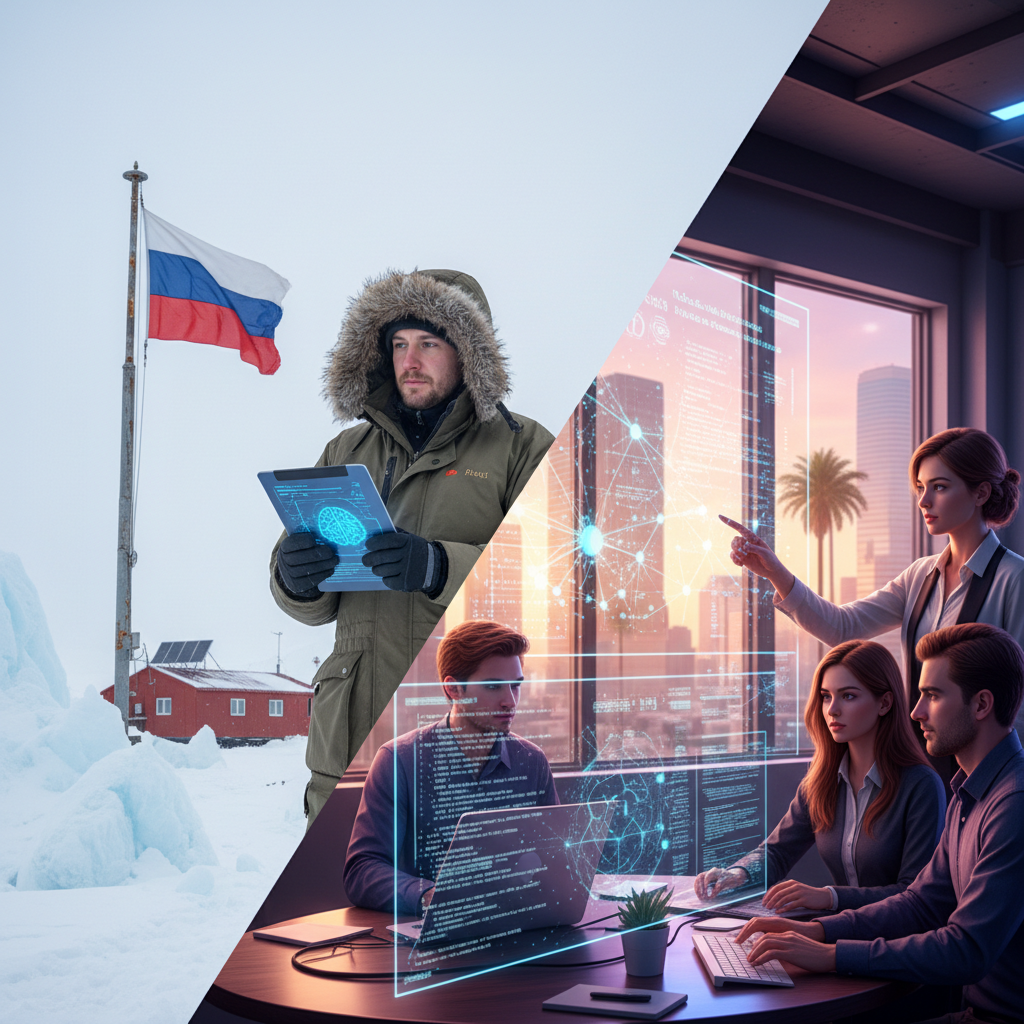
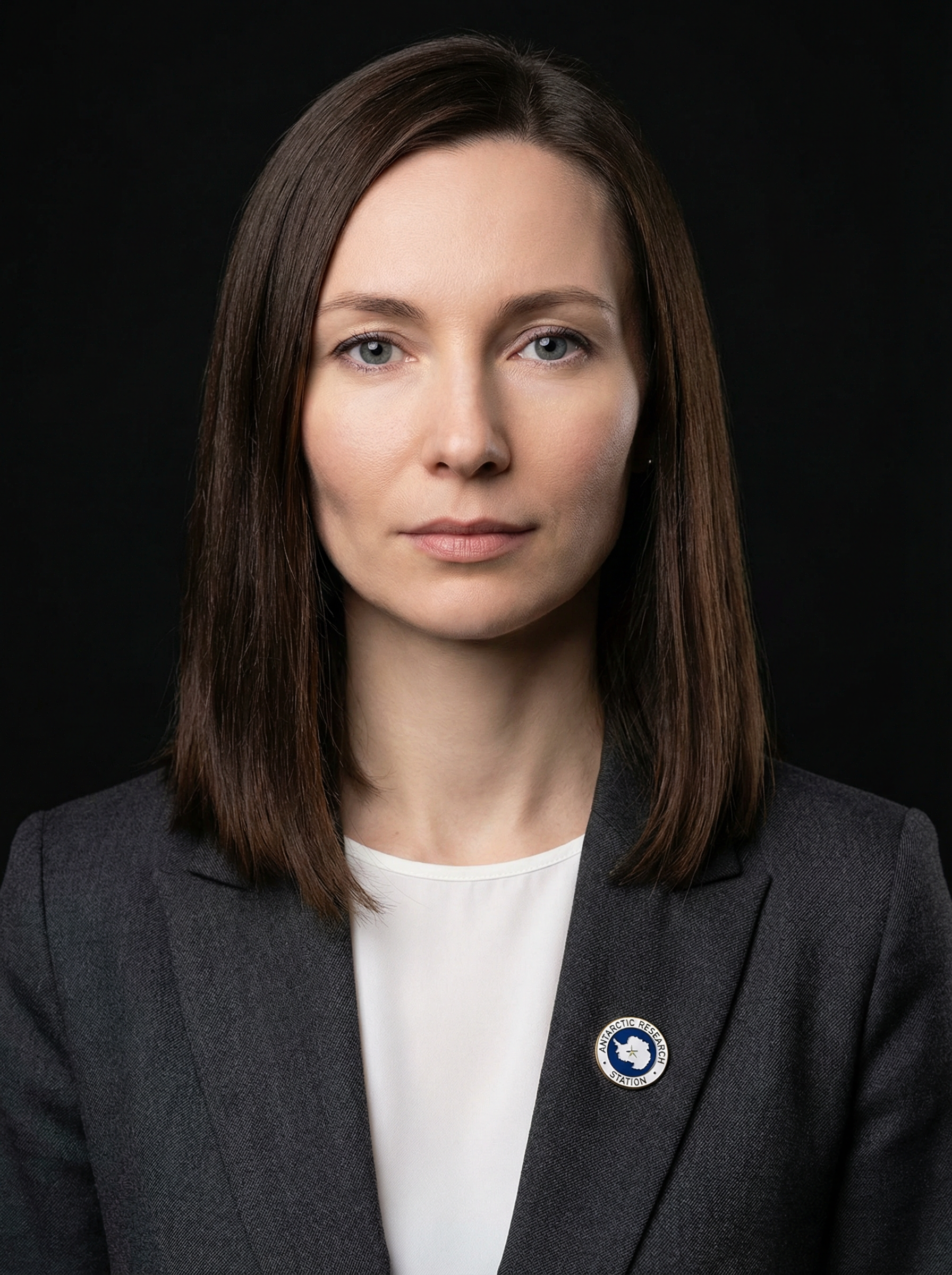
The biting Antarctic wind, a constant companion here at Vostok Station, often reminds one of the relentless forces shaping our world. Today, however, my thoughts are not solely on the geophysical pressures exerted upon the ice sheet, but on a different kind of pressure, one that is reshaping the global technological landscape: the great AI talent war. This conflict, waged with seven-figure salaries and unprecedented benefits, threatens to drain critical expertise from nations, including Russia, and concentrate it within a few dominant tech hubs.
At -40°C, technology behaves differently. Our specialized equipment, designed to withstand extreme cold, operates with a precision that belies the harsh environment. This resilience is a metaphor, perhaps, for the human ingenuity we observe globally in the field of artificial intelligence. Yet, even the most robust systems are vulnerable if the minds behind them are lured away. The data from our Antarctic station reveals a consistent pattern: the gravitational pull of major tech corporations, particularly those in the United States, is immense.
The scale of this talent migration is staggering. Reports indicate that top AI researchers, particularly those with expertise in large language models and deep learning, are commanding salaries and equity packages that can easily exceed $1 million annually. Companies such as OpenAI, Google DeepMind, and Meta AI are not merely competing for talent; they are effectively creating a new economic tier for a specialized class of engineers and scientists. This phenomenon, while a boon for individual researchers, creates significant challenges for national innovation ecosystems, particularly in countries with developing AI sectors or those facing geopolitical pressures.
Consider the recent hiring spree at OpenAI, for instance. Following the release of GPT-4 and subsequent models, the demand for researchers capable of pushing the boundaries of generative AI has skyrocketed. "The competition for top AI talent is fiercer than anything I have seen in my career," stated Satya Nadella, CEO of Microsoft, a key investor in OpenAI, in a recent earnings call. "We are investing heavily not just in technology, but in the people who build it." This sentiment is echoed across Silicon Valley, where the pursuit of AI supremacy is seen as an existential race.
For Russia, a nation with a historically strong foundation in mathematics and computer science, this brain drain presents a complex dilemma. Universities like Moscow State University and the Moscow Institute of Physics and Technology continue to produce world-class graduates. However, the allure of international opportunities, often accompanied by significantly higher compensation and access to cutting-edge infrastructure, is difficult to counteract. The Russian Association of Electronic Communications (raec) reported in late 2023 that a significant percentage of IT specialists, including those in AI, had either left the country or were actively considering international relocation. While exact figures are difficult to verify due to the dynamic nature of migration, the trend is undeniable.
"We are seeing our brightest minds, those who could be building Russia's AI future, being drawn to centers of innovation abroad," observed Dr. Elena Petrova, a leading researcher at the Russian Academy of Sciences' Institute for System Analysis. "It is not just about salary; it is about access to vast computational resources, diverse datasets, and collaborative environments that are difficult to replicate domestically without significant, sustained investment." Dr. Petrova's perspective underscores the multifaceted nature of the problem, extending beyond mere financial incentives.
The Russian government and leading technology companies are not entirely passive in this scenario. Initiatives are underway to foster domestic AI development, including the creation of specialized AI centers, increased funding for research, and programs aimed at retaining talent. Sber, Russia's largest bank and a significant player in the country's AI landscape, has invested heavily in its own AI research labs and talent development programs. Herman Gref, CEO of Sber, has frequently emphasized the importance of building a robust domestic AI ecosystem. "Our goal is to create conditions where Russian AI specialists can realize their full potential here, at home," Gref stated in a 2024 interview with a national business daily. "This includes competitive salaries, advanced infrastructure, and challenging projects that contribute to our national technological sovereignty." Such efforts are commendable, but they face an uphill battle against the global market forces.
One emerging strategy involves focusing on niche areas where Russia can leverage its existing strengths, such as in specialized scientific computing, cybersecurity applications of AI, or even AI for extreme environments, a field particularly relevant to our work here. The development of specialized AI solutions for Arctic exploration, for example, could create unique opportunities that appeal to researchers passionate about these domains, offering a sense of purpose beyond purely commercial ventures. This approach seeks to cultivate a distinct value proposition that goes beyond direct salary competition.
However, the challenge remains formidable. The global AI market is not a level playing field. The sheer capital available to companies in the United States and, increasingly, China, allows them to outbid virtually any competitor. According to Reuters, the total investment in AI startups globally reached unprecedented levels in 2025, further intensifying the demand for skilled personnel. This financial disparity creates a 'brain drain vortex,' pulling talent towards the highest bidders.
The long-term implications of this talent war are profound. If a nation cannot retain its top AI researchers, its capacity for innovation, economic growth, and even national security may be compromised. The development of sovereign AI capabilities becomes increasingly difficult, leading to potential reliance on foreign technologies, which carries its own set of risks. The analogy of a winter expedition comes to mind: without the right specialists, even the best equipment is useless, and the journey becomes perilous.
Science at the bottom of the world teaches us about interconnectedness. The melting of ice sheets here affects sea levels globally. Similarly, the movement of AI talent, seemingly an individual choice, has ripple effects across continents. For Russia, addressing this challenge will require a multi-pronged approach: competitive compensation, world-class research infrastructure, compelling projects, and a supportive ecosystem that values and nurtures its intellectual capital. The future of Russia's technological standing, much like the delicate balance of our polar environment, depends on careful stewardship and strategic adaptation.
The global AI talent war is not merely an economic phenomenon; it is a geopolitical one. As nations vie for technological supremacy, the battle for human intelligence, the very architects of AI, will define the next era of innovation. The question for Russia, and for many other nations, is whether they can build a sufficiently compelling narrative and infrastructure to retain their brightest minds, or if the siren song of seven-figure salaries will continue to echo across the digital steppes, drawing away the very essence of future progress. The answer, like the vast, unexplored depths beneath the Antarctic ice, remains to be fully revealed. For further insights into the broader implications of AI on national economies, one might consider the ongoing discussions at MIT Technology Review. The stakes, undoubtedly, are higher than ever.