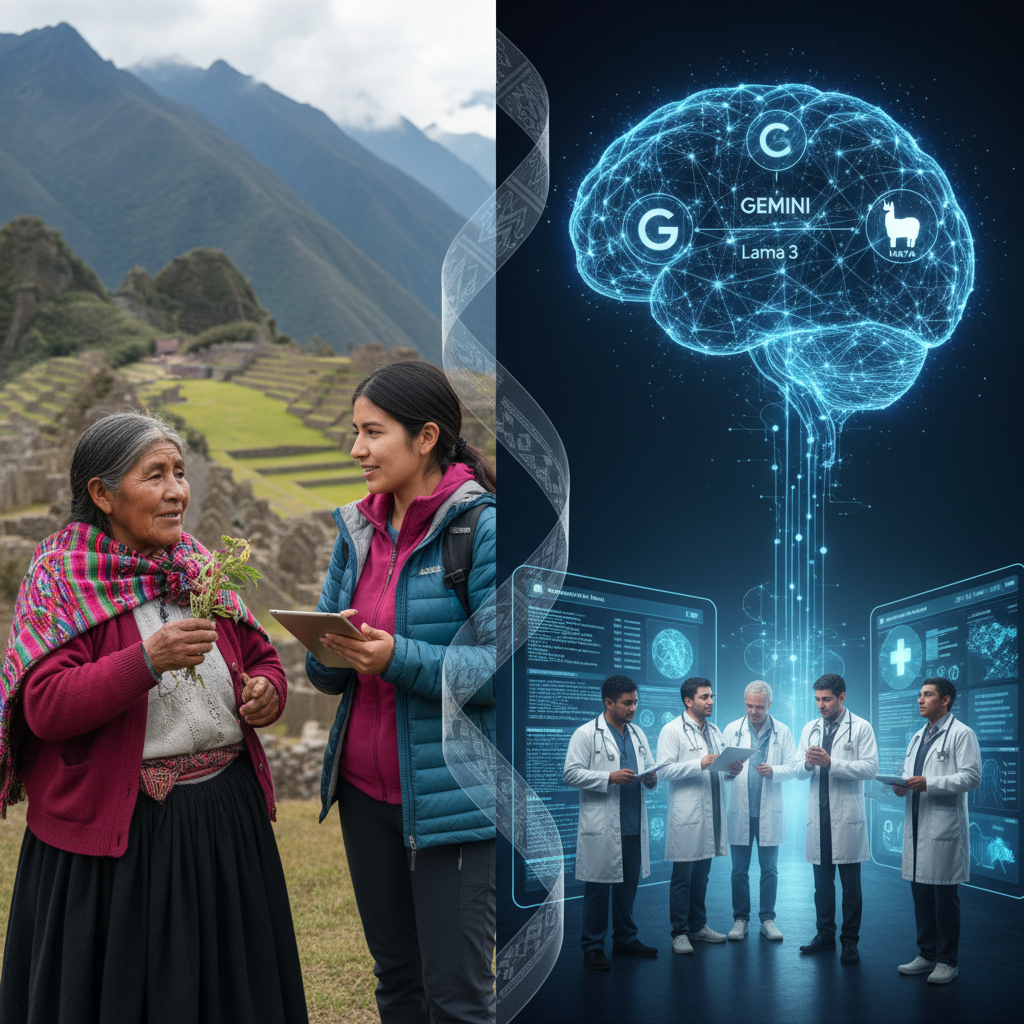

The air in the highlands of Peru carries stories, whispered by the wind through ancient ruins and across vibrant markets. It is a land where knowledge has been passed down through generations, often without the need for written words or complex machinery. So, when I hear about the latest advancements in artificial intelligence, particularly those that promise to dramatically reduce compute requirements, my mind immediately turns to these remote communities, to the people who could benefit most from technology that respects their context, their resources, and their way of life.
For too long, the promise of AI felt distant, a luxury for well-resourced labs in Silicon Valley or bustling urban centers. The sheer computational power, the vast datasets, and the energy consumption required to train large language models seemed insurmountable for places like our Andean villages. But something is shifting. Companies like Google and Meta are pushing the boundaries, not just in making AI bigger, but in making it smarter and more efficient, creating models that can run on smaller devices, with less energy, and learn from more modest data inputs. This is not just technical progress, it is a pathway to inclusion, a bridge to communities that have historically been left behind by the digital divide.
Consider the recent breakthroughs in what researchers call 'efficient AI' or 'tiny AI.' We are seeing models like Google's Gemini Nano, designed to run directly on devices like smartphones, and Meta's Llama 3, which offers impressive performance even in its smaller iterations. These are not just scaled-down versions of their larger siblings, they are engineered from the ground up for efficiency. They employ techniques such as quantization, pruning, and knowledge distillation, essentially teaching a smaller model the 'wisdom' of a larger one without needing all the raw data and processing power. This means AI can move from the cloud to the edge, to the very hands of the people who need it most, even in areas with limited internet connectivity or unreliable power grids.
I recently spoke with Dr. Elena Quispe, a public health specialist working with the Peruvian Ministry of Health in Cusco. She showed me something that changed my understanding of what AI could mean for rural health. Her team is piloting a diagnostic aid, a small application running on a robust tablet, powered by an optimized AI model. "For years, diagnosing certain parasitic infections or early stages of malnutrition in remote areas was a challenge," Dr. Quispe explained, her voice earnest. "Our doctors and nurses are heroes, but they cannot carry a full lab in their backpacks. Now, with these new, efficient AI models, we can analyze images of blood samples or even patient symptoms on the spot. It is not about replacing human expertise, but augmenting it, giving our frontline workers tools that were once unimaginable." This initiative, still in its early stages, is a testament to the potential of accessible AI.
The implications for healthcare in a country like Peru are profound. Imagine a community health worker, kilometers from the nearest clinic, using a smartphone app to help identify early signs of respiratory illness in children, or to guide mothers on nutritional practices based on local available foods. These localized applications, trained on smaller, culturally relevant datasets, can be far more effective than a monolithic, global model. The reduction in compute requirements means these tools are not just theoretical, they are becoming practical realities, deployable at a fraction of the cost and energy.
According to a recent report by MIT Technology Review, the global push for AI efficiency is driven by both environmental concerns and the desire for broader accessibility. Training a single large language model can consume as much energy as several homes for a year, a staggering figure that highlights the urgency of these new techniques. Researchers are exploring novel architectures and training methodologies that promise to deliver powerful AI with significantly less carbon footprint. This is particularly crucial for developing nations, where energy resources are often precious and environmental sustainability is a pressing concern.
One of the key figures in this movement is Dr. Juan Carlos Mamani, a Quechua linguist and computer scientist from the Universidad Nacional Mayor de San Marcos in Lima. Dr. Mamani is working on developing low-resource language models for indigenous languages, a field that directly benefits from these compute-efficient techniques. "Our languages, like Quechua and Aymara, have been marginalized in the digital space," Dr. Mamani told me during a video call, his passion evident. "Building traditional large language models for these languages is incredibly difficult due to the scarcity of digital text data. But with techniques that allow models to learn more effectively from less data, and run on less powerful hardware, we can finally create AI tools that speak our languages, preserving our heritage and connecting our communities in new ways." This is a story about ancient wisdom meeting modern AI, where technology can serve as a guardian of culture, not a threat.
The shift towards more efficient AI is also attracting significant investment. While exact figures are often proprietary, analysts estimate that major tech companies are pouring billions into research and development for smaller, faster, and more energy-efficient AI models. This is not just altruism, it is smart business. The market for on-device AI, particularly in emerging economies, is vast. Reuters has reported on the increasing focus of chip manufacturers like Qualcomm and NVIDIA on optimizing their hardware for these smaller, edge-based AI applications, signaling a clear industry trend.
What does this mean for the future? It means that AI is no longer confined to the data centers of the powerful. It is becoming a tool that can be wielded by anyone, anywhere, with the right approach. For Peru, this opens up possibilities in areas beyond health, such as precision agriculture in the Sacred Valley, where small drones equipped with efficient AI could monitor crop health with minimal energy, or in cultural preservation, where AI could help catalog and translate oral histories. The potential for local innovation, driven by local needs and local knowledge, is immense.
However, we must proceed with caution and thoughtfulness. The deployment of AI, even efficient AI, must be guided by ethical considerations and community involvement. It is not enough to simply deliver technology; we must ensure it serves the people, respects their autonomy, and empowers them. The lessons from our ancestors, who lived in harmony with the land and each other, are more relevant than ever. As we embrace these powerful new tools, we must remember that the most profound intelligence often lies not in complex algorithms, but in human connection and shared wisdom. The path forward for AI in Peru, and indeed across the globe, must be one of collaboration, respect, and a deep understanding of the human heart. This is how we ensure that technology truly uplifts, rather than overshadows, the rich tapestry of human experience.