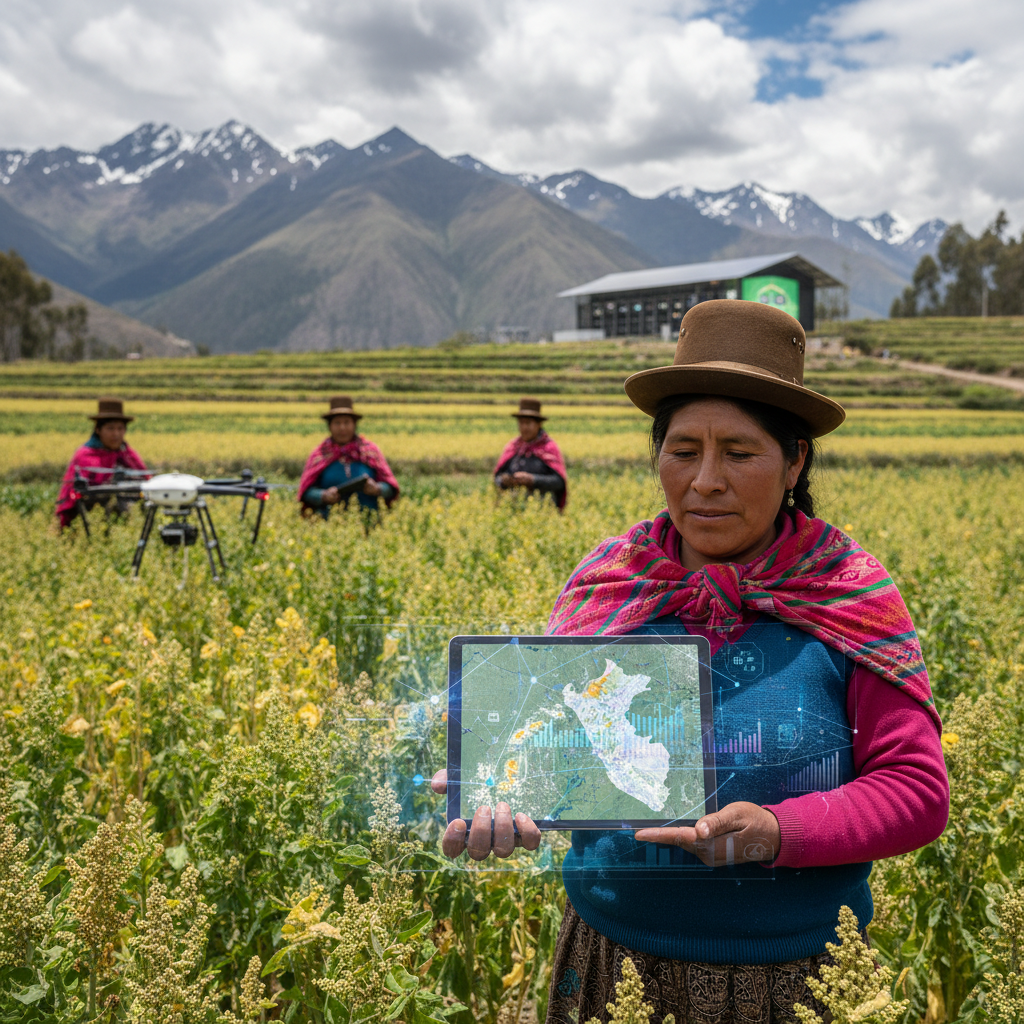
The air in the Andean highlands is thin and crisp, carrying the scent of rich earth and distant eucalyptus. Here, amidst the terraced fields that climb towards the sky, lives a community whose knowledge of agriculture spans millennia. For generations, the farmers of the Cooperativa Agrícola de Patacancha, nestled high above the Sacred Valley, have cultivated native potato varieties, each one a tiny miracle of resilience, adapted to the harsh, unpredictable climate. But even their deep ancestral wisdom is being tested by our changing world. The seasons are no longer reliable, the rains arrive too late or too fiercely, and pests, once rare, are becoming a constant threat.
It was here, in this remote corner of Peru, that I met Elara Quispe, a young agronomist who returned to her family's lands after studying in Lima. She showed me something that changed my understanding of how technology can truly serve humanity. Elara, with her bright, determined eyes and hands calloused from working the soil, isn't just planting potatoes; she's planting data. Her cooperative is using Weights & Biases, a leading MLOps platform, to build and manage AI models that predict everything from optimal planting times to early disease detection, transforming their ancient practices with cutting-edge tools.
“For us, every potato variety is a piece of our history, our identity,” Elara told me, gesturing towards a field dotted with vibrant purple and yellow tubers. “Climate change doesn't just threaten our harvest; it threatens our culture. We needed a way to fight back, a way that respected our traditions but also gave us new power.”
Her journey began with a small grant from the Peruvian Ministry of Agriculture and a partnership with a local tech incubator, InnovaAndina. The idea was simple, yet profound: use satellite imagery, local weather station data, and historical yield records to train machine learning models. The challenge, however, was not just building the models, but managing their lifecycle, ensuring they were accurate, fair, and continuously improving in a dynamic environment. This is where Weights & Biases became their unexpected ally.
“Initially, we struggled with tracking experiments, reproducing results, and deploying models reliably,” explained Dr. Ricardo Morales, the lead data scientist at InnovaAndina, who has been instrumental in supporting the Patacancha project. “We were using a patchwork of scripts and spreadsheets. It was chaotic. When we introduced Weights & Biases, it was like someone turned on the lights in a dark room. Suddenly, we had a single source of truth for all our model development, from hyperparameter tuning to version control. It allowed Elara's team, who are not traditional data scientists, to understand and trust the process.”
Dr. Morales emphasized the platform's role in democratizing AI. “The visual dashboards and clear reporting in Weights & Biases mean that Elara and her fellow farmers can see exactly how a model is performing, what data it's using, and why it's making certain predictions. This transparency is crucial for adoption in communities where trust is paramount. It’s not a black box; it’s a tool they can understand and influence.”
The impact has been tangible. In 2025, a year marked by an unusually early frost, the cooperative used their W&B-managed models to identify specific microclimates within their fields that were at highest risk. They were able to deploy protective measures, like traditional 'qochas' or water reservoirs, and prioritize harvesting in those areas, saving an estimated 15% of their potato crop. This might sound like a small number, but for a community living close to the land, it represents the difference between sustenance and scarcity.
“We've seen a 20% reduction in pesticide use because our models are more precisely identifying pest outbreaks, allowing for targeted interventions instead of broad spraying,” Elara proudly shared. “And our yield predictions are now 85% accurate, which helps us plan better for market and storage.” This level of precision, supported by robust MLOps, is a game-changer for food security in vulnerable regions.
Weights & Biases, often seen as a tool for Silicon Valley giants and cutting-edge research labs, is proving its versatility in unexpected corners of the world. Its ability to streamline the machine learning workflow, from tracking experiments to monitoring deployed models, has made it indispensable for teams across various sectors. Companies like OpenAI and NVIDIA rely on it for their massive, complex AI projects, but its value extends far beyond the tech elite. According to a recent report by TechCrunch, the MLOps market is projected to reach over $4 billion by 2027, with platforms like Weights & Biases leading the charge due to their comprehensive feature sets and ease of integration.
What makes Weights & Biases particularly effective in a context like Patacancha is its focus on collaboration and reproducibility. “When we iterate on a model, everyone can see the changes, the metrics, the impact,” Dr. Morales added. “This collaborative environment is essential for a project that involves both highly technical data scientists and deeply experienced farmers. It builds bridges.”
This is a story about ancient wisdom meeting modern AI, but it is also a story about human ingenuity and the power of community. The farmers of Patacancha are not just adopting technology; they are adapting it, shaping it to fit their unique needs and values. They are showing that AI, when implemented thoughtfully and ethically, can be a powerful force for preservation, not just disruption.
“We are not replacing our grandmothers' knowledge,” Elara clarified, her voice firm. “We are honoring it, and giving it new tools to thrive in a world that is changing faster than ever before. This is about ensuring our children, and their children, will still know the taste of a native Peruvian potato.”
Her words resonate deeply. In a global landscape often dominated by discussions of AI's potential for job displacement or ethical dilemmas, the Patacancha cooperative offers a refreshing counter-narrative. It highlights AI's capacity to empower, to protect, and to sustain. The success here is not just about a platform or an algorithm; it is about the people who wield these tools with purpose and heart. As the world grapples with climate change and food insecurity, the lessons from these Andean fields, meticulously tracked and optimized through platforms like Weights & Biases, offer a beacon of hope and a model for sustainable innovation. You can learn more about the broader implications of AI in climate tech by visiting MIT Technology Review.
The journey of the Patacancha cooperative is a testament to the fact that the most impactful technological advancements often emerge from the most pressing human needs. It’s a reminder that even in the face of global challenges, local solutions, amplified by smart technology, can pave the way for a more resilient future. The work being done here is not just about improving crop yields; it is about cultivating hope and preserving a way of life, one data point and one potato at a time. The global conversation around MLOps, often focused on enterprise efficiency, finds a profound, human echo in the high Andes of Peru. For more insights into how AI is being deployed in diverse global contexts, consider exploring Reuters' technology section.