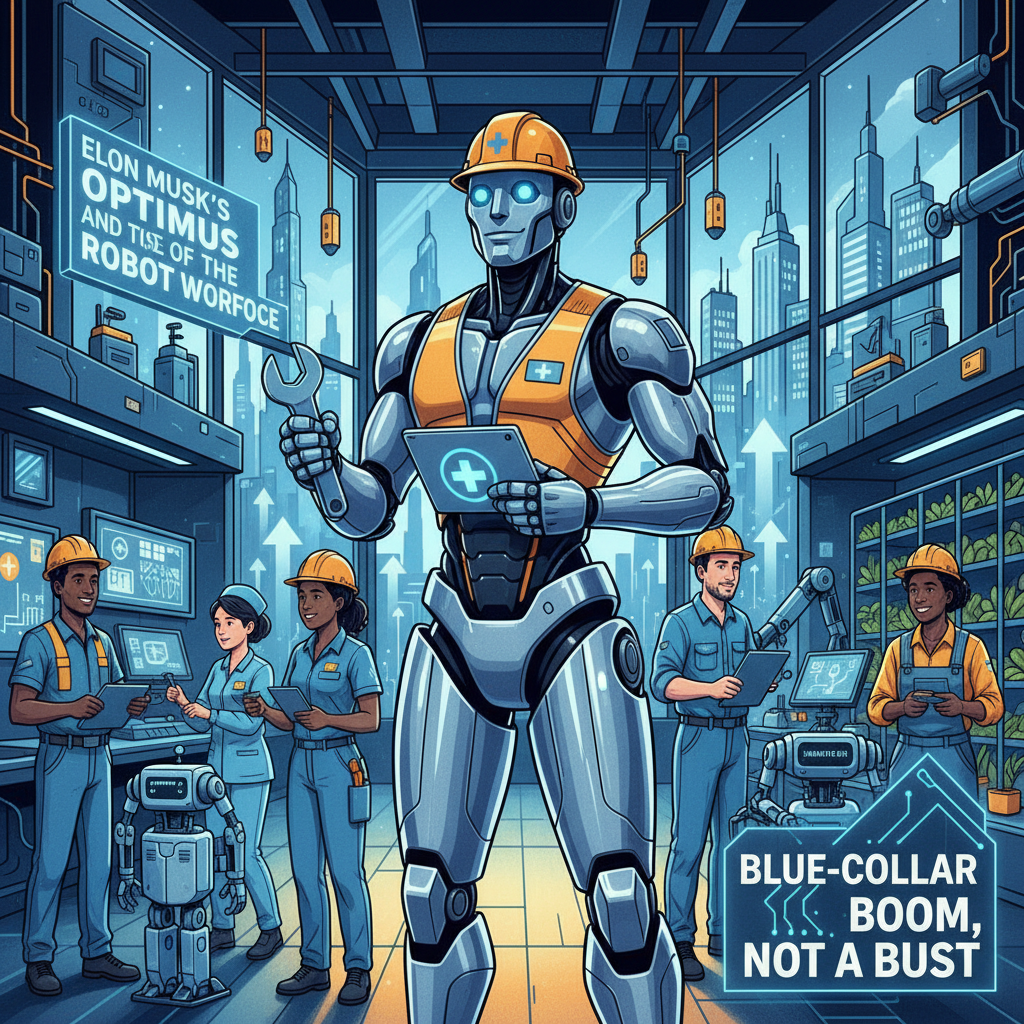

Let's be real, folks. When you hear about robots taking over jobs, your mind probably goes straight to some sci-fi flick where humanity is out of work and living in pods. But that's not the future I see, not from my perch here in the heart of America. What I'm witnessing, what's brewing in the industrial heartlands and even in our local retail spots, is something far more nuanced and, dare I say, exciting. We're talking about humanoid robots, machines like Tesla's Optimus, Figure's 01, and Boston Dynamics' Atlas, stepping onto factory floors, into restaurant kitchens, and even stocking shelves. And trust me, this isn't the job-killer apocalypse; it's a profound opportunity to rebuild, to re-skill, and to re-energize our communities.
My take is this: the arrival of humanoid robots in the workforce, especially in sectors like manufacturing, logistics, and service, is not just inevitable, it's necessary for America to maintain its competitive edge and improve the quality of life for its citizens. We're facing labor shortages in critical areas, an aging workforce, and a constant demand for higher productivity and safer working conditions. These robots aren't just replacing human hands; they're augmenting our capabilities, taking on the dangerous, dirty, and dull tasks that humans increasingly don't want to do, or shouldn't have to do.
Think about it. For decades, American manufacturing has struggled with overseas competition and the perception of declining job quality. Now, with companies like Tesla pushing hard on humanoid development, and others like Agility Robotics deploying their Digit robots in Amazon warehouses, we're seeing a pathway to bring production back home. These robots can work 24/7, handle heavy loads, and perform repetitive tasks with precision, freeing up human workers for supervision, maintenance, programming, and more complex problem solving. This isn't just about efficiency; it's about creating a new class of skilled technical jobs that are more engaging and higher paying.
I recently spoke with Dr. Ken Goldberg, a professor at UC Berkeley who's been at the forefront of robotics for years. He told me, "The fear of robots taking all jobs is often overblown. Historically, new technologies create more jobs than they destroy, albeit different kinds of jobs. The key is how we adapt and invest in human training." That's the money quote right there. It's not about if these robots arrive, but how we prepare our workforce for their arrival. The future of AI is being built in places you'd never expect, and those places need to be ready.
Of course, I hear the counterarguments loud and clear. "What about the jobs lost?" people cry. "Won't this just exacerbate inequality?" These are valid concerns, and we'd be foolish to ignore them. The transition won't be seamless, and there will undoubtedly be disruption. Some jobs, particularly those that are highly repetitive and physically demanding, will indeed be automated. This isn't a secret. But this is where our collective responsibility comes in, from government to industry to educational institutions.
My rebuttal is simple: this isn't a zero-sum game. We're not just trading a human for a robot. We're evolving the nature of work itself. The jobs created will be in robot maintenance, programming, data analysis, ethical oversight, and human-robot collaboration design. These are often higher-skill, higher-wage roles. We need to invest heavily in vocational training programs, community college initiatives, and corporate re-skilling efforts. Imagine a former assembly line worker, now trained to troubleshoot a fleet of Optimus robots, earning a better wage and working in a safer environment. That's not a fantasy; that's a tangible outcome if we play our cards right.
Look at what's happening in places like Detroit. Once the manufacturing powerhouse of the world, it's now seeing a resurgence with new tech investments. Companies are looking at how advanced robotics can make American production competitive again. Forget the Valley, look at Atlanta, Detroit, Houston. These cities, with their rich industrial heritage and diverse populations, are perfectly positioned to lead this next wave of innovation. They understand hard work, and they understand the need to adapt.
Consider the restaurant industry, for instance. Faced with chronic labor shortages and high turnover, particularly for back-of-house roles, robots are already making inroads. Flippy, the burger-flipping robot from Miso Robotics, is in use at some fast-food chains. While it might take over the grill, it allows human staff to focus on customer service, order fulfillment, and food preparation that requires a human touch. This isn't about replacing the chef; it's about supporting the kitchen crew and making those jobs more sustainable. As The Verge reported, the pace of AI integration into daily life is accelerating across all sectors.
Then there's the retail sector. Stocking shelves, moving inventory, cleaning floors, these are all tasks that humanoid robots could handle, especially during off-hours. This frees up human employees to interact with customers, provide personalized service, and manage the overall store experience, which are the aspects that truly drive customer loyalty. It transforms retail jobs from grunt work into customer-centric roles. This shift could make retail jobs more appealing and reduce the physical strain on workers.
It's not just about the big tech giants either. Smaller startups are innovating too. Companies like Sanctuary AI are developing general-purpose humanoid robots, aiming for broad applicability across various industries. Their approach emphasizes cognitive AI capabilities, allowing robots to learn and adapt to new tasks, which is crucial for real-world deployment. This kind of innovation, driven by both established players and nimble startups, means we're going to see these robots everywhere, faster than many anticipate.
We need to approach this with a clear-eyed optimism, not a fear-mongering pessimism. The United States has always been a nation of innovators and adapters. We embraced the automobile, the computer, and the internet, each bringing its own set of challenges and transformations. This robot revolution is no different. We have the ingenuity, the resources, and the entrepreneurial spirit to navigate this change successfully.
The real challenge isn't stopping the robots; it's ensuring that the benefits of this technological leap are broadly shared. It means prioritizing education and training, fostering a culture of lifelong learning, and creating social safety nets that support workers through transitions. It means thinking beyond the next quarter and planning for the next decade. If we do this right, humanoid robots won't just be an economic boon; they'll be a tool for social uplift, creating better jobs and stronger communities across America. This is the real AI revolution, and it's going to reshape our future in ways we're only just beginning to imagine. As Reuters often highlights, the economic implications of these shifts are massive, and we need to be prepared. Let's make sure our communities are at the forefront, not left behind.