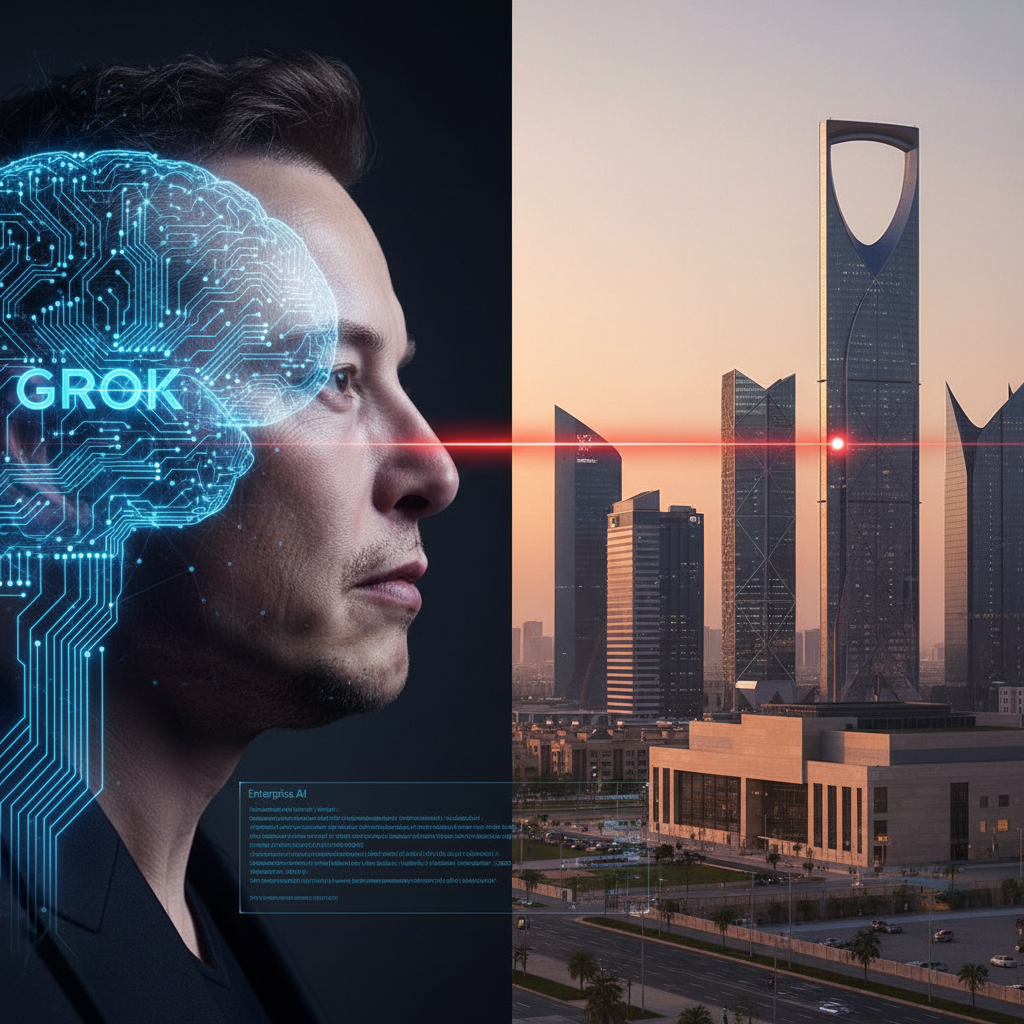
The global discourse surrounding artificial intelligence often converges on a handful of dominant players and their iterative advancements. We hear much about OpenAI's GPT series, Google's Gemini, and Anthropic's Claude, each vying for supremacy in benchmarks and user adoption. Yet, a different drumbeat has been sounding from Elon Musk's xAI, particularly with its Grok model. This challenger, often characterized by its direct access to real-time information from the X platform and a willingness to engage with controversial topics, represents more than just another large language model. It embodies a distinct philosophical approach to AI development, one that prioritizes speed, unfiltered access, and a certain irreverence. For a nation like Saudi Arabia, deeply committed to its Vision 2030 and investing billions in AI infrastructure, understanding this divergence is not merely academic, it is strategic.
Why Most People Are Ignoring It
The prevailing narrative in AI often centers on safety, alignment, and the pursuit of general artificial intelligence, or AGI. Companies like OpenAI and Anthropic have positioned themselves as paragons of responsible AI development, emphasizing guardrails and ethical considerations. This focus, while crucial, can inadvertently overshadow alternative methodologies. Grok, with its stated goal to "understand the true nature of the universe" and its integration with the often-unfiltered stream of X, appears to operate on a different set of principles. Its early iterations were noted for their candid, sometimes sarcastic, responses, a stark contrast to the more cautious and curated outputs of its competitors. Many observers, accustomed to the polished presentations of mainstream AI, might dismiss Grok as an outlier, a reflection of Musk's personal brand rather than a serious technological contender. The sheer volume of AI news also contributes to this oversight, making it difficult to discern truly disruptive shifts from mere product updates.
How It Affects You
The philosophical underpinnings of Grok, particularly its emphasis on real-time data and a less constrained approach to information, have tangible implications for individuals. Consider the rapid dissemination of news and information, often without immediate editorial oversight. If an AI model like Grok is trained to ingest and synthesize this stream directly, its outputs could reflect a more immediate, albeit potentially less verified, understanding of current events. For consumers of information, this means a shift in how knowledge is accessed and interpreted. Imagine an AI assistant that not only summarizes the day's headlines but also provides a raw, unfiltered perspective based on live social media discourse. This could empower individuals with more immediate insights, but it also places a greater burden on critical thinking and discernment. For professionals, particularly those in fields requiring rapid information processing, such as finance, journalism, or strategic analysis, an AI with real-time capabilities could offer an unprecedented edge. However, it also introduces new challenges related to data veracity and algorithmic bias, issues that are amplified when the data source is as dynamic and diverse as X.
The Bigger Picture
On a societal and economic level, the rise of a distinct AI philosophy embodied by xAI and Grok has profound implications. Nations, including Saudi Arabia, are not merely adopting AI, they are shaping its future through investment and policy. The Kingdom's Vision 2030 demands results, not promises, and this includes building a robust, AI-driven economy. If the dominant AI models are all converging on a similar, cautious approach, a vacuum might be created for alternative paradigms. Grok's integration with X, a global platform, could give it a unique advantage in understanding and responding to global events as they unfold, potentially offering a different lens for geopolitical analysis or market trends. This real-time capability could be particularly attractive to sectors requiring rapid decision-making, from national security to energy trading. Furthermore, the very notion of an AI that is less constrained by traditional ethical guardrails, while concerning for some, might appeal to others seeking a more "truthful" or unvarnished perspective, even if that truth is subjective or controversial. This could foster a diversification of AI applications and services, moving beyond the current homogeny.
From a regional perspective, the Middle East is rapidly becoming a significant player in the global AI landscape. With substantial investments in data centers and AI research, exemplified by projects like Neom, the region is actively cultivating its own AI ecosystems. The desert is blooming with data centers, attracting talent and fostering innovation. The availability of diverse AI models, each with its own strengths and philosophical bent, allows for greater strategic choice. Rather than relying solely on models developed with Western cultural biases, nations can explore options that might better align with their specific needs and values. Grok's unique architecture and training data could offer a different perspective on global information flows, potentially reducing dependence on a single worldview embedded in mainstream AI. This diversification is crucial for digital sovereignty and for ensuring that AI serves local, as well as global, interests.
What Experts Are Saying
Experts hold varied views on xAI's trajectory and Grok's potential impact. Dr. Faisal Al-Khamis, a leading AI researcher at King Abdullah University of Science and Technology (kaust), commented, "Grok's real-time access to X data is a significant differentiator. While it presents challenges regarding data quality and bias, its ability to process and react to live information streams could unlock novel applications in areas like disaster response or dynamic market analysis." He emphasized the need for careful evaluation of its outputs.
Conversely, Dr. Aisha Al-Mubarak, an ethicist specializing in AI governance at the Mohammed bin Zayed University of Artificial Intelligence in Abu Dhabi, expressed caution. "The unconstrained nature of Grok raises serious questions about misinformation and algorithmic amplification of harmful content. While innovation is vital, it must be balanced with robust ethical frameworks and transparency. We cannot sacrifice societal well-being for speed." Her concerns echo those of many who advocate for responsible AI development.
Sam Altman, CEO of OpenAI, has consistently highlighted the importance of safety and careful deployment of powerful AI systems. While not directly commenting on Grok, his company's approach underscores a belief in a more controlled, iterative release of AI capabilities, prioritizing alignment and societal benefit. This stands in contrast to xAI's more rapid and open-ended development philosophy.
Jensen Huang, CEO of NVIDIA, whose GPUs power much of the AI revolution, often speaks about the accelerating pace of AI development and the need for powerful, efficient compute. From his perspective, any model that pushes the boundaries of performance and capability, regardless of its philosophical approach, contributes to the overall advancement of the field. The demand for compute, he implies, will only grow as more diverse models emerge.
What You Can Do About It
For individuals and organizations, the emergence of Grok and its distinct philosophy necessitates a proactive approach. First, cultivate critical information literacy. Understand that different AI models will present information with varying degrees of filtering and bias. Do not rely on a single source, even an AI, for absolute truth. Second, experiment with these new tools. Explore Grok, compare its outputs with ChatGPT or Gemini, and discern its strengths and weaknesses for your specific needs. Third, engage in the discourse. Policy makers, researchers, and citizens must contribute to the ongoing conversation about AI ethics, regulation, and societal impact. For businesses, consider diversifying your AI strategy. Relying on a single vendor or a single type of model might limit your adaptability in a rapidly evolving landscape. Explore how real-time, less constrained AI could augment your operations, but always with a clear understanding of its inherent risks and limitations. Oil money meets machine learning in the Gulf, and this investment must be guided by informed decisions, not just by the loudest voice in the room.
The Bottom Line
In five years, the impact of xAI and Grok will likely be seen not just in its market share, but in its influence on the broader AI ecosystem. It challenges the prevailing orthodoxy of AI development, pushing boundaries on what is considered acceptable in terms of AI behavior and data access. This philosophical divergence will force other AI developers to re-evaluate their own approaches, potentially leading to a more diverse and robust landscape of AI models. We may see a future where specialized AIs, each with distinct personalities and access parameters, cater to different user needs and ethical tolerances. The debate around AI safety and censorship will intensify, fueled by models that deliberately push against conventional guardrails. For Saudi Arabia, a nation building its future on technological prowess, understanding and engaging with this diversity of AI philosophies is paramount. It is not merely about choosing the 'best' AI, but about strategically leveraging the spectrum of available intelligence to achieve national ambitions. The future of AI is not monolithic, and Grok is a potent reminder of that reality, one that demands our attention and careful consideration. The Verge and TechCrunch regularly report on these evolving dynamics, providing valuable insights into the competitive landscape. For a deeper dive into the technical aspects, MIT Technology Review offers comprehensive analysis.