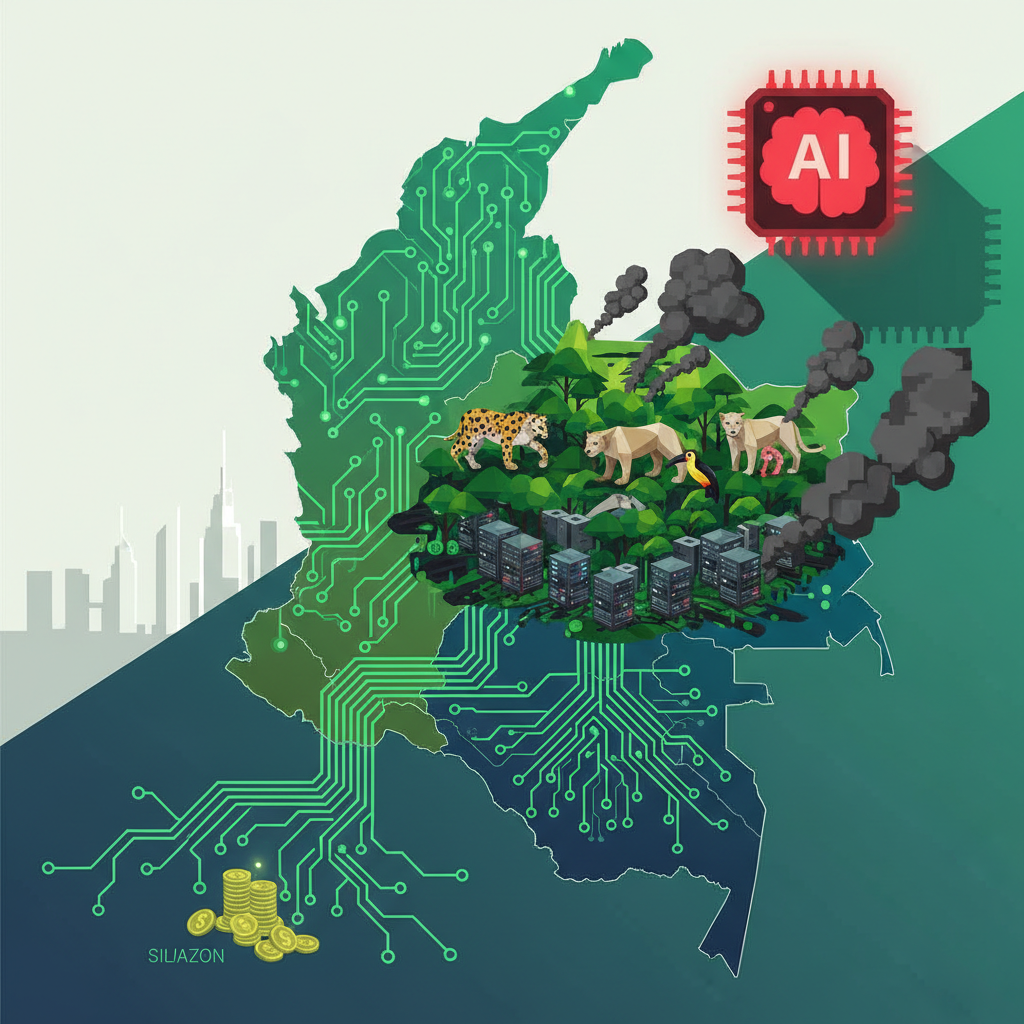

The hum of servers, the glow of screens, the endless stream of data: this is the soundtrack of our digital revolution. Artificial intelligence, with its dazzling promises of efficiency, discovery, and even peace, has captivated the world. But beneath the surface of this technological marvel, a darker truth is emerging, one that demands our immediate attention, especially here in Colombia, a nation fighting every day to protect its natural treasures.
I am talking about the environmental cost of AI, specifically its voracious appetite for energy and the carbon footprint it leaves behind. We are quick to celebrate the breakthroughs from OpenAI, Google DeepMind, and NVIDIA, and rightly so, but we are often silent about the immense power required to train and run these sophisticated models. This silence is a luxury we cannot afford, not when our Amazon rainforest, our páramos, and our vibrant ecosystems are already under siege.
My conviction is clear: the current trajectory of AI development is unsustainable. We are building a future that is intelligent, yes, but potentially at the expense of a livable planet. The energy consumption of large language models, for instance, is staggering. Training a single large AI model can emit as much carbon as five cars over their entire lifespan, or even more. Imagine the cumulative impact of hundreds, thousands, of such models being developed and deployed globally. This is not just a theoretical problem for distant data centers in California, this is a global crisis that will disproportionately affect countries like ours, nations that are already on the front lines of climate change.
We in Colombia understand the delicate balance between progress and preservation. Our history is etched with the struggle for a better future, often against immense odds. We have seen how extraction, whether of gold, oil, or now data, can devastate communities and ecosystems if not managed with profound care and foresight. For us, the environmental impact of AI is not an abstract concept, it is a very real threat to our biodiversity and the well-being of our people.
Some will argue that the benefits of AI outweigh its environmental costs. They will point to AI's potential in climate modeling, in optimizing energy grids, or in developing sustainable agriculture. And yes, these applications are vital. I am not anti-AI, I am pro-responsible AI. But we cannot allow the promise of future solutions to blind us to the present damage. It is a dangerous gamble to say that AI will fix the problems it is simultaneously creating. This is about more than technology because it is about justice, about ensuring that the pursuit of innovation does not deepen the existing inequalities between those who benefit and those who bear the environmental burden.
“The energy demands of AI are escalating at an alarming rate, and we are simply not prepared for the infrastructure required, let alone the carbon emissions,” warned Dr. Elena Rojas, a leading environmental scientist at the Universidad Nacional de Colombia. “We are talking about data centers consuming as much power as small cities, and these demands are projected to double every few years. Where will this energy come from? Often, it will come from sources that are far from clean, especially in regions with less developed renewable energy grids.” Her words echo a growing concern among experts.
Indeed, a recent report from the MIT Technology Review highlighted that the carbon footprint of AI is not just about training, but also about inference, the process of running these models repeatedly. Every query to a ChatGPT or a Claude, every image generated by a Midjourney, consumes energy. As these tools become ubiquitous, the cumulative effect becomes monumental. We are talking about a scale of consumption that could undermine global efforts to reach net-zero emissions.
So, what is the counterargument? The tech giants, of course, are investing in renewable energy for their data centers. Google, Meta, and others frequently publish reports detailing their efforts to reach carbon neutrality. They emphasize efficiency gains in hardware and algorithms. “We are committed to powering our operations with 100 percent carbon-free energy,” stated David Patterson, a spokesperson for a major cloud provider, in a recent online forum. “Our innovations in chip design and cooling technologies are continuously reducing the energy footprint per computation.”
While these efforts are commendable and necessary, they are often outpaced by the sheer growth in AI demand. It is like trying to fill a bathtub with a thimble while the tap is wide open. The exponential increase in model size and complexity means that even with efficiency improvements, the total energy consumption continues to climb. Furthermore, the supply chains for AI hardware, from rare earth minerals to chip manufacturing, also carry significant environmental costs that are often externalized and overlooked in these corporate reports.
Colombia's AI story deserves to be heard in this global conversation, not just as a consumer of technology, but as a voice for sustainable development. We are a nation blessed with incredible natural resources, and we are also a nation that has suffered greatly from the exploitation of those resources. We know the price of unchecked progress. Our startups, our researchers, and our government must champion a different path, one where AI serves humanity and the planet, not just profit margins.
Consider the work being done at institutions like Ruta N in Medellín, where they are fostering innovation with a strong social and environmental conscience. Or the burgeoning tech scene in Bogotá, where young entrepreneurs are looking for solutions that align with our national values. We need to invest in green AI research, in algorithms that are inherently more energy-efficient, and in hardware designed for sustainability. We need to demand transparency from tech companies about their full environmental impact, from mining to disposal.
This is not just about reducing emissions; it is about rethinking our entire approach to technological development. It is about asking: what kind of future are we truly building? Is it one where our children inherit a world of dazzling algorithms but depleted natural wonders? Or one where intelligence, both human and artificial, works in harmony with the Earth?
Latin America is rising, and with that rise comes the responsibility to lead by example. We have the opportunity to shape a future where AI is a tool for true progress, not another engine of environmental degradation. Let us not squander this chance. Let us demand a green AI revolution, one that protects our green gold, our Amazon, and our future. The time for action is now, before the price of progress becomes too high to pay.
For more insights into the broader implications of AI, you can explore articles on Wired's AI section or follow the latest industry news on TechCrunch's AI category. The conversation around responsible AI is global and ongoing, and our contributions from Colombia are more vital than ever.