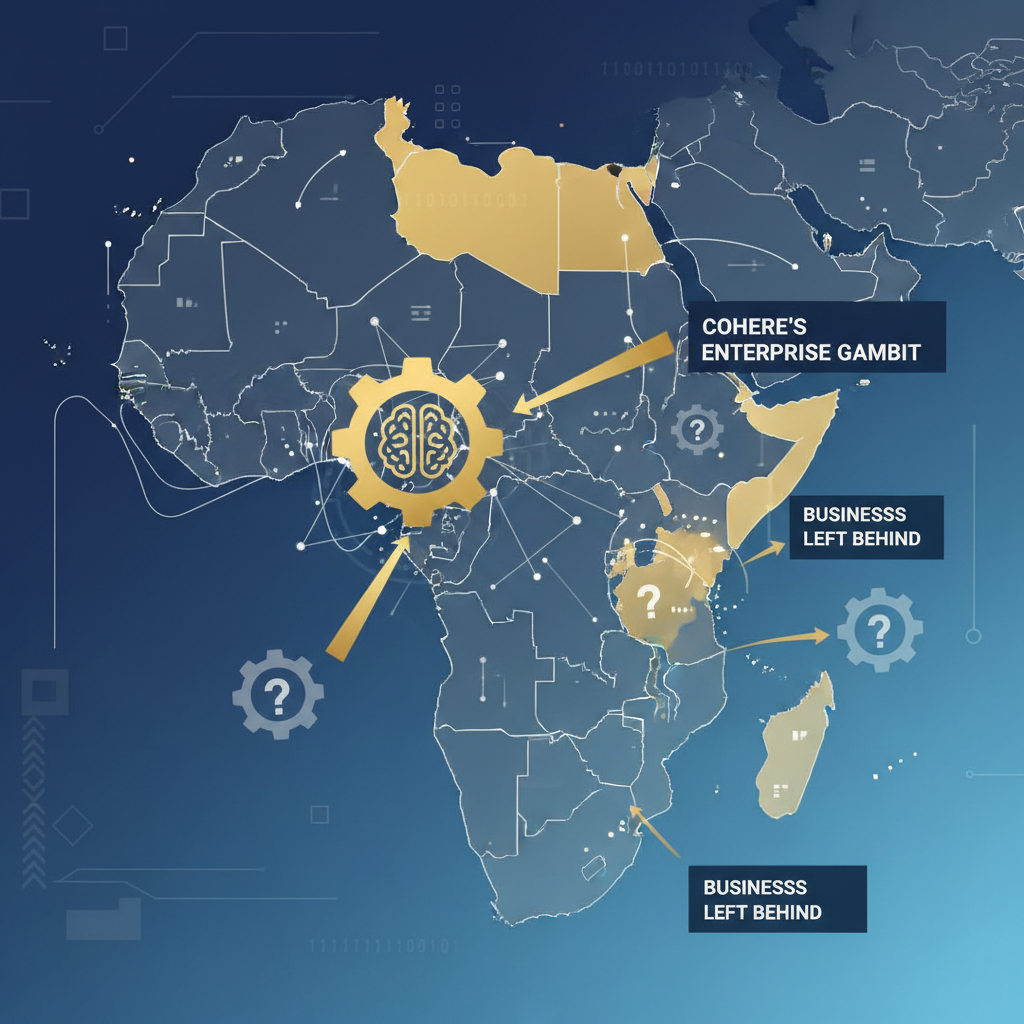

The drumbeat of innovation in artificial intelligence is relentless, a rhythm that often feels distant from our bustling markets and vibrant communities here in Ghana. Yet, the decisions made in Silicon Valley boardrooms, particularly concerning large language models, reverberate globally. We need to talk about this, because the race to dominate the enterprise B2B LLM market, spearheaded by players like Cohere and OpenAI, is not just about profit margins, it is about shaping the very infrastructure of our digital future, and that affects every single one of us.
For too long, the narrative around AI has been consumer-centric, focused on the flashy chatbots and image generators that capture public imagination. But beneath that surface, a more profound battle is unfolding: the fight for the backbone of business operations. Companies like Cohere have explicitly staked their claim on the enterprise, arguing that general purpose models are not robust or secure enough for corporate needs. They are building models designed from the ground up for specific business applications, aiming for accuracy, data privacy, and control that consumer models often lack. This is not a new strategy in tech, but its application to LLMs carries significant implications.
Think back to the early days of the internet. It was a wild, open frontier, but eventually, specialized solutions emerged for businesses. Email services, CRM systems, cloud computing infrastructure, these all evolved to meet the stringent demands of enterprises. We are seeing a similar maturation in the LLM space. OpenAI, initially known for its broad consumer appeal with ChatGPT, has also pivoted aggressively towards enterprise solutions, offering API access and custom model fine-tuning for businesses. Microsoft, with its deep integration of OpenAI models into Azure and its Copilot suite, is a formidable force in this arena, leveraging its existing enterprise relationships.
But Cohere, founded by former Google Brain researchers Aidan Gomez, Nick Frosst, and Ivan Zhang, has been enterprise-focused from the start. Their argument is compelling: businesses need models that understand their specific jargon, their proprietary data, and their compliance requirements. They are not looking for a general conversationalist, they are looking for a highly specialized tool that can automate customer support, analyze complex legal documents, or generate nuanced marketing copy tailored to their brand voice. This focus has reportedly attracted significant investment, with Cohere raising substantial capital to fuel its B2B ambitions, positioning it as a direct competitor to OpenAI and Anthropic in this crucial sector. According to TechCrunch, the enterprise AI market is projected to grow exponentially, and these companies are vying for a significant slice of that pie.
So, what does this mean for us, for the burgeoning tech scene in Accra, for the small businesses in Kumasi, or the startups in Cape Coast? The promise is tantalizing: access to powerful AI tools that can streamline operations, boost productivity, and open new avenues for innovation. Imagine a Ghanaian e-commerce platform using a custom LLM to provide hyper-personalized customer service in Twi or Ga, or a local agricultural tech company leveraging AI to analyze crop data and provide precise farming advice. The potential for efficiency and growth is immense.
However, the reality is often more complex. These enterprise models come with hefty price tags and require significant technical expertise to implement and maintain. While large corporations in the West might have the resources, many African businesses, particularly SMEs, struggle with basic digital infrastructure, let alone advanced AI deployment. The risk is that this enterprise-first strategy could inadvertently widen the digital divide, creating a two-tiered system where only the most well-resourced companies can truly harness the power of AI.
Dr. Nii Quaynor, a pioneer of internet development in Africa, has often spoken about the need for local ownership and relevant technology. He might ask, as I do, if these powerful B2B LLMs will be truly adaptable to our unique contexts, our diverse languages, and our specific economic realities. Will the data used to train these models reflect our African experiences, or will they perpetuate biases inherent in predominantly Western datasets? Silence is complicity if we do not ask these questions now.
I recently spoke with Ama Serwaa, a tech entrepreneur in Accra who is building an AI-powered logistics platform. She expressed both excitement and trepidation. “The capabilities of these models are incredible,” she told me, “but accessing them, customizing them, and ensuring they understand our local nuances, that is the real challenge. We need solutions that are affordable and that can be easily integrated by local talent, not just those with deep pockets and Silicon Valley connections.” Her concerns echo those of many across the continent. Will these enterprise solutions empower local innovation, or will they simply become another layer of dependency?
Furthermore, the race to own this market raises questions of data sovereignty and intellectual property. When businesses feed their proprietary data into these models, who truly owns the insights generated? What are the long-term implications for competitive advantage if a handful of global tech giants control the underlying AI infrastructure? The Akan principle of Sankofa, looking back to retrieve what is valuable, reminds us that we must learn from past technological shifts. We cannot afford to be passive consumers of technology designed elsewhere; we must be active participants in shaping its future.
My verdict is clear: the enterprise-first strategy for LLMs is not a fad, it is the new normal. The demand for specialized, secure, and performant AI for business applications is undeniable and will only grow. However, this trend carries a significant risk of exacerbating existing inequalities if not approached with intentionality and foresight. For businesses in Ghana and across Africa, the challenge is not just about adopting AI, but about demanding equitable access, culturally relevant models, and the capacity to build and customize these tools locally. We must advocate for open standards, affordable access, and investment in local AI talent and infrastructure. Otherwise, this gold rush for enterprise AI could leave many of us behind, watching from the sidelines as others reap the rewards. The future of our digital economy depends on how we navigate this crucial moment. For more insights into the broader implications of AI, consider exploring articles on MIT Technology Review.