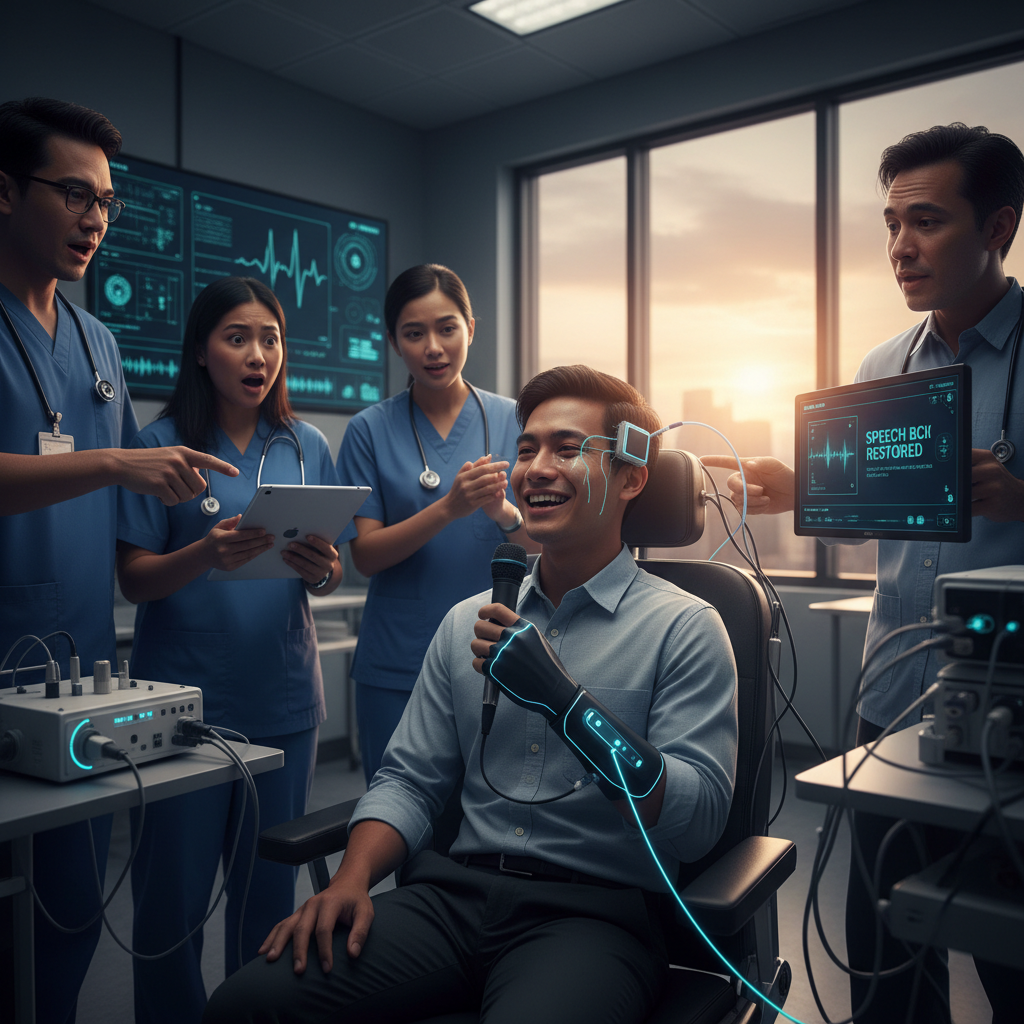

The air in the Kuala Lumpur General Hospital's neuro-rehabilitation ward was thick with anticipation, then disbelief, and finally, a wave of profound emotion. Just yesterday, a 58-year-old stroke survivor, Puan Aminah binti Hassan, who had been unable to speak for five years, articulated a full sentence: “Saya rindu anak-anak saya,” which translates to “I miss my children.” This was not a whisper, not a strained sound, but clear, synthesized speech, generated directly from her thoughts via a Neuralink brain-computer interface (BCI) powered by advanced AI.
This isn't just another tech announcement; this is a seismic shift. For years, the promise of BCIs felt like science fiction, a distant dream confined to research labs in the West. But with Neuralink's latest clinical trial, conducted in partnership with Malaysia's Ministry of Health and Universiti Malaya Medical Centre, that future has arrived on our shores, bringing with it an urgency and importance that cannot be overstated. It's a testament to how rapidly AI is transforming the very essence of human capability.
The Breaking News Lead: A Voice Reclaimed
Puan Aminah, whose identity was protected until now with her family's consent, is one of three Malaysian participants in Neuralink's expanded 'Link-Up' trial. Her breakthrough, publicly announced this morning by Malaysia's Minister of Health, Dr. Dzulkefly Ahmad, marks the first successful restoration of complex speech in a BCI trial within Southeast Asia. The device, a tiny implant roughly the size of a coin, deciphers neural signals associated with intended speech and translates them into audible words through a sophisticated AI model trained on vast linguistic datasets. The architecture is fascinating, combining ultra-low latency signal processing with generative AI algorithms that reconstruct speech patterns, intonation, and even emotional nuance.
“This is beyond a medical milestone; it is a humanitarian triumph,” stated Dr. Dzulkefly Ahmad at a press conference earlier today. “Puan Aminah's ability to communicate again, to express her deepest feelings, offers a beacon of hope to countless Malaysians and indeed, people worldwide, living with severe neurological impairments. Our collaboration with Neuralink underscores Malaysia's commitment to cutting-edge medical innovation.”
Key Details: How the AI Works Its Magic
Neuralink's BCI system, often referred to as 'The Link,' involves surgically implanting a chip with thousands of microscopic electrodes into the brain's motor cortex, the area responsible for planning and executing movements, including those for speech. These electrodes detect electrical signals from neurons. What makes this recent breakthrough particularly remarkable is the AI component. Earlier BCI iterations could allow users to control cursors or type slowly. However, Neuralink's system, leveraging large language models (LLMs) and advanced machine learning, has learned to decode the intent of speech directly from neural activity, bypassing the need for physical articulation. It's like the AI is listening to the brain's internal monologue and giving it a voice.
According to Dr. Tan Cheng Hoe, lead neurosurgeon for the Malaysian trial, the AI model underwent extensive personalized training for each participant. “Imagine teaching a child to speak, but instead of listening to their vocalizations, you are learning from the very impulses that intend to create those sounds,” Dr. Tan explained. “The AI adapts, learns, and refines its understanding of the individual's unique neural 'language.' This adaptive learning is crucial for achieving such fluid, natural-sounding speech.” The system boasts an accuracy rate of over 90% in word prediction and a speech rate approaching 70 words per minute, a significant improvement over previous BCI technologies.
Official Reactions: Hope and Caution
The news has predictably sent shockwaves through the global medical and technology communities. Elon Musk, CEO of Neuralink, took to X (formerly Twitter) to express his enthusiasm, posting, “Another human voice reclaimed. The future is speaking. Thank you, Malaysia!”
Locally, the response has been a mix of elation and thoughtful consideration. The Malaysian Medical Association (MMA) issued a statement praising the scientific achievement while also calling for robust ethical frameworks. “While we celebrate this incredible advancement, we must also ensure that the deployment of such powerful technology is guided by strict ethical oversight and patient welfare,” said Dr. Azizan Abdullah, President of the MMA. “Accessibility, affordability, and data privacy will be paramount considerations as this technology matures.”
Expert Analysis: A New Frontier, New Questions
Professor Dr. Haryani Haron, a leading AI ethicist from Universiti Kebangsaan Malaysia, emphasized the profound implications. “This moves beyond mere assistive technology; it enters the realm of cognitive augmentation,” she told DataGlobal Hub. “The ability to directly translate thought into speech, or eventually, into action, opens up incredible possibilities for those with severe disabilities. However, it also raises complex questions about identity, agency, and the very definition of human communication. We must ask: who owns the 'voice' generated by the AI? What are the implications for mental privacy? These are not trivial concerns.”
She drew an analogy to the rich tapestry of Malaysian languages. “Just as we navigate the nuances of Malay, Mandarin, Tamil, and indigenous languages, understanding that each carries cultural weight, we must now learn to navigate this new 'language' of thought-to-speech. It is a new dialect in the human experience.”
Indeed, the data-driven approach to understanding the brain is accelerating. As MIT Technology Review has extensively covered, the convergence of neuroscience and AI is creating breakthroughs that challenge our traditional understanding of consciousness and communication. This Malaysian trial is a vivid illustration of that trend.
What Happens Next: Scaling and Scrutiny
The immediate next steps involve continuing the current trial participants and expanding the cohort. Neuralink aims to refine the AI models further, enhance speech naturalness, and explore applications beyond speech, such as controlling prosthetics or interacting with digital devices purely through thought. The company has indicated plans for further trials in other Asian countries, recognizing the vast potential market and the diverse patient needs across the continent. Regulatory bodies, both in Malaysia and internationally, will be closely watching for long-term safety data and efficacy.
Malaysia is positioning itself perfectly as a hub for medical technology and AI innovation. The government's digital economy blueprint, MyDIGITAL, explicitly encourages the adoption of cutting-edge technologies in healthcare. This trial, therefore, is not just a medical story; it is a strategic national development.
Why Readers Should Care: A Future Where Thought is Action
Let me explain why this matters for Southeast Asia. Our region has a significant population affected by neurological disorders, strokes, and spinal cord injuries. According to the World Health Organization, stroke is a leading cause of disability in many Asean nations. For individuals who have lost the ability to communicate or move, this technology represents not just a medical device, but a return to dignity, independence, and connection with their loved ones. Imagine the impact on families, on communities, when a parent can speak to their child again, or an artist can create through thought alone.
Beyond medical applications, this breakthrough hints at a future where our interaction with technology becomes seamless, intuitive, and perhaps, profoundly personal. While the ethical debates will undoubtedly intensify, the human story of Puan Aminah, reclaiming her voice in a Malaysian hospital, reminds us of the immense, transformative power of AI when applied to humanity's most pressing challenges. This is not just about restoring function; it is about restoring hope, one thought, one word, at a time. The journey has just begun, and the world is watching. For more on the broader implications of AI in healthcare, you can follow developments on Reuters Technology.
This trial also highlights the growing importance of regional collaborations in advanced tech. As countries like Malaysia invest in their digital infrastructure and research capabilities, they become vital partners in shaping the global AI landscape, moving beyond being mere consumers of technology to active contributors and innovators. The implications for our regional digital economy are immense, fostering specialized talent and attracting further investment in high-tech medical fields. The path ahead will be complex, filled with both promise and peril, but one thing is certain: the conversation around human-AI integration has just become much louder, and much more personal.