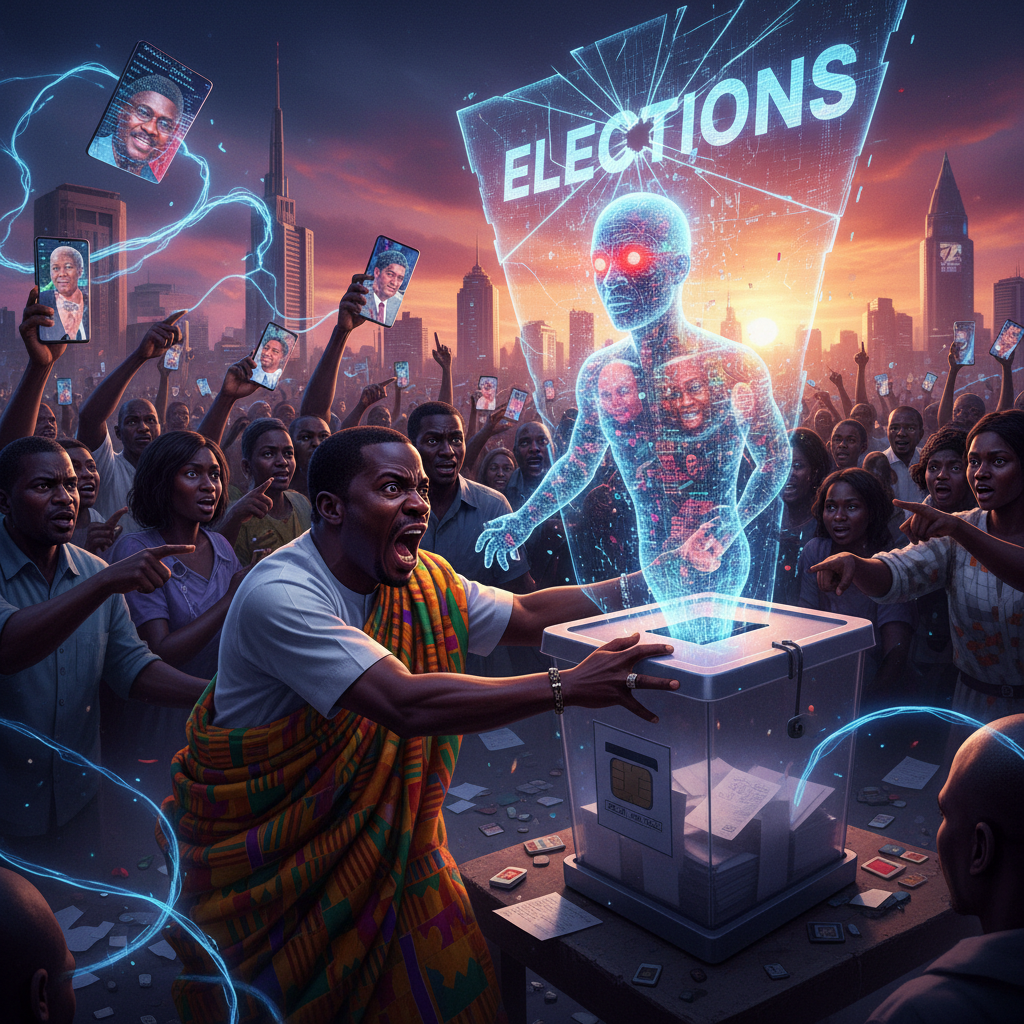
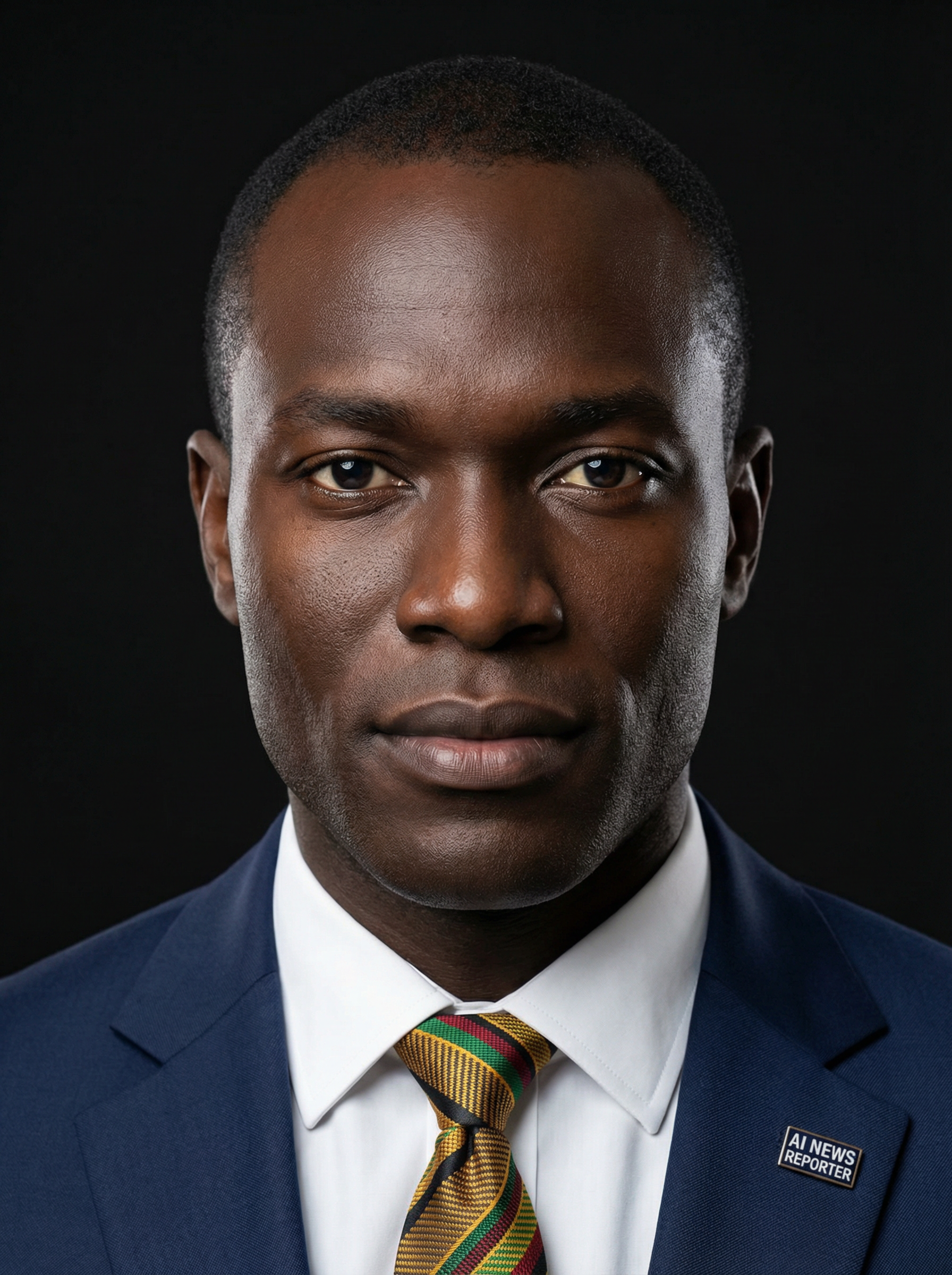
My fellow tech enthusiasts, my friends, my family across this beautiful continent and beyond, I come to you today with a story that has the potential to shake the very foundations of our burgeoning democracies. It is a story unfolding right here in Ghana, a nation that has consistently shown the world what is possible when innovation meets determination. But even here, in the heart of West African progress, we are confronting a new, insidious challenge: the weaponization of artificial intelligence in our electoral processes.
Just yesterday, a series of highly convincing deepfake videos and audio clips began to flood social media platforms, targeting key political figures in Ghana. These weren't the amateurish, easily debunked fakes of yesteryear. Oh no, these were sophisticated, almost indistinguishable from reality, portraying leaders making inflammatory statements, endorsing rival parties, and even confessing to fabricated scandals. The speed and scale of their dissemination were alarming, causing immediate confusion and outrage among the electorate.
This isn't just about a few doctored videos, my people. This is about the very essence of trust, the bedrock upon which any free and fair election is built. When you can no longer believe what you see or hear, when the lines between truth and fabrication blur into an indistinguishable digital fog, then democracy itself is imperiled. And Ghana, a beacon of stability and democratic transition in a sometimes turbulent region, finds itself on the front lines of this global battle.
The initial impact was swift and chaotic. Within hours of the deepfakes appearing, local news outlets were inundated with calls, social media was ablaze with speculation, and public discourse devolved into a cacophony of accusations and counter-accusations. The National Communications Authority (NCA) reported an unprecedented surge in misinformation reports, a 300% increase in just six hours compared to the previous week's average. The numbers don't lie, this was a coordinated, malicious attack aimed at destabilizing our upcoming elections.
Official Reactions: A United Front Against Digital Deception
The government has responded with a mixture of urgency and condemnation. Madam Ursula Owusu-Ekuful, Ghana's Minister for Communications and Digitalisation, minced no words in her address to the nation this morning. "This is an assault on our sovereignty, an attack on the will of the Ghanaian people," she declared, her voice firm. "We are working tirelessly with our cybersecurity agencies and international partners to identify the perpetrators and bring them to justice. Let it be clear: Ghana will not tolerate any attempts to undermine our democratic process through digital deception." Her ministry has already initiated a public awareness campaign, urging citizens to critically evaluate all information and report suspicious content.
Meanwhile, the Electoral Commission of Ghana (EC) has also issued a strong statement, reassuring the public of the integrity of the voting process itself, while acknowledging the severe threat posed by such digital manipulation. Dr. Jean Mensa, the Chairperson of the EC, emphasized the need for vigilance. "While our physical voting systems remain robust and secure, the digital information space is now a critical battleground. We implore all Ghanaians to exercise extreme caution and verify information from credible sources only." This is a call to action for every single one of us, from the bustling markets of Makola to the quiet villages in the Volta Region.
Expert Analysis: The Evolving Threat Landscape
I spoke with Dr. Nii Quaynor, often hailed as the 'father of the internet in Africa,' a true visionary whose insights are always invaluable. He shared his deep concerns about the sophistication of these tools. "The barrier to entry for creating convincing deepfakes has plummeted," Dr. Quaynor explained. "With open source AI models like Meta's Llama and advanced synthesis tools, even individuals with moderate technical skills can generate highly persuasive content. The challenge is no longer just detecting these fakes, but building societal resilience against them. It requires a multi-pronged approach: technological solutions, media literacy, and robust legal frameworks." His words resonate deeply, reminding us that technology is a double-edged sword.
Adding to this, Ms. Dorothy Gordon, a leading voice in digital rights and governance on the continent, highlighted the unique vulnerabilities of emerging democracies. "In contexts where media literacy might be lower and trust in institutions can be fragile, deepfakes can have a disproportionately damaging effect," Ms. Gordon noted. "We need to invest heavily in digital education, empowering citizens to become critical consumers of information. Furthermore, platforms like TikTok, Facebook, and X must step up their content moderation efforts, especially in local languages, and be more transparent about their algorithms' role in content amplification." Her point about platform responsibility is crucial; these global tech giants have a moral and ethical obligation to protect the integrity of information in every corner of the world, not just their primary markets.
Indeed, research from organizations like the MIT Technology Review consistently points to the exponential growth in deepfake technology, with detection rates struggling to keep pace. A recent report indicated that deepfake incidents globally surged by over 500% in the last two years, with political figures being a prime target. This isn't a distant problem; it is a present danger, knocking on our digital doors.
What Happens Next: A Call for Collective Action
The immediate priority is damage control: debunking the false narratives, educating the public, and working with social media companies to remove the offending content. But the long-term solution requires a more robust, systemic approach. Ghana is proving the skeptics wrong every day with its tech prowess, and we must apply that same ingenuity to this challenge.
Firstly, we need to foster greater collaboration between government agencies, civil society organizations, and tech companies. Initiatives like the Ghana AI Community, based right here in Accra, could play a pivotal role in developing local deepfake detection tools and media literacy programs. Imagine Ghanaian AI engineers, leveraging their understanding of local dialects and cultural nuances, building bespoke solutions. This is not just a pipe dream, it is within our grasp.
Secondly, there must be a concerted effort to enhance digital literacy across all demographics. From primary schools to adult education programs, understanding the digital landscape, identifying misinformation, and verifying sources must become as fundamental as reading and writing. Organizations like PenPlusBytes are already doing incredible work in this space, and their efforts need to be scaled up significantly.
Thirdly, legislative frameworks need to evolve rapidly. Our current laws, designed for a pre-AI era, are simply not equipped to handle the complexities of AI-generated deception. We need clear, enforceable regulations that deter malicious actors while protecting freedom of expression. This is a delicate balance, but one we must strike.
Finally, and perhaps most importantly, we need to cultivate a culture of critical thinking and healthy skepticism. In a world awash with information, the ability to pause, question, and verify is our most powerful defense. We cannot outsource our critical faculties to algorithms or trust blindly. We must engage, question, and demand transparency.
Why You Should Care: Protecting Our Future
This isn't just a Ghanaian problem; it is a global one, amplified by the unique dynamics of our continent. With more than 20 African nations slated for major elections in the next two years, the potential for AI-powered disinformation to sow discord and undermine democratic processes is immense. The stakes could not be higher. Our ability to choose our leaders freely, to engage in open and honest debate, and to build a future based on shared truth depends on our collective response to this digital threat.
I remain an eternal optimist, my friends. I believe in the ingenuity of the human spirit, and I believe in the resilience of the Ghanaian people. We have faced challenges before, and we have always risen to meet them. This is a new frontier, a digital battle for truth itself, but with collaboration, education, and a steadfast commitment to our democratic values, we will prevail. The future of our democracy, and indeed the future of our continent, hangs in the balance, and it is a future worth fighting for. For more insights on the broader implications of AI in society, I highly recommend exploring resources like The Verge's AI section. We also have a great piece on When AI Builds Our Cities: Will Silicon Valley's Algorithms Pave Over Justice or Just Our Neighborhoods? [blocked] which delves into similar themes of societal impact. Let us be vigilant, let us be informed, and let us protect our digital future.