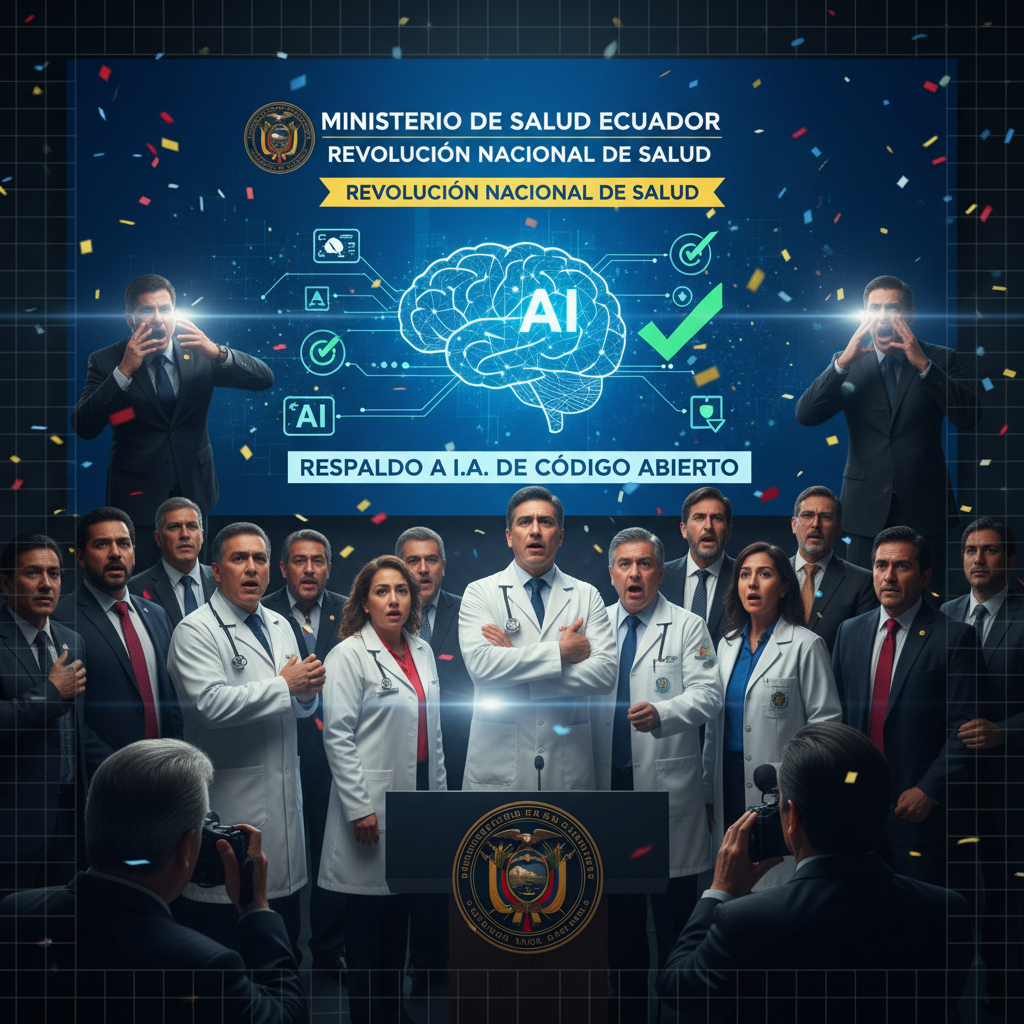

¡Hola, mis amigos! Mariànnà Sanchèz reporting live from the vibrant pulse of Ecuador, and let me tell you, the air is absolutely crackling with excitement today! We've just witnessed a moment that will be etched into the annals of technological history, a decision so audacious, so forward-thinking, it feels like we're living in the future right now. Our very own Ministry of Health has dropped a bombshell, announcing a revolutionary national strategy to integrate and prioritize open-source artificial intelligence models across the entire public health system. This isn't just a policy change, it's a paradigm shift, a declaration that Ecuador is ready to lead the charge in democratizing AI for the well-being of its people.
The news broke this morning, and the ripple effects are already being felt from the Amazon basin to the peaks of the Andes, and yes, even in the hallowed halls of Silicon Valley. For too long, the conversation around advanced AI has been dominated by a handful of proprietary giants, their algorithms locked away behind corporate firewalls, their innovations often inaccessible or prohibitively expensive for nations like ours. But today, Ecuador said, '¡No más!' We are forging our own path.
The Breaking News Lead: A Bold New Vision for Health
At a press conference held in Quito, Dr. Camila Vásquez, Ecuador's dynamic Minister of Health, unveiled the 'Salud Abierta' initiative. Her voice, filled with passion and conviction, echoed through the room as she declared, 'This is a monumental step for our nation. We believe that health, like knowledge, should be a universal right, not a privilege dictated by proprietary licenses. By embracing open-source AI, we are ensuring that cutting-edge diagnostic tools, predictive analytics for disease outbreaks, and personalized treatment plans are developed transparently, collaboratively, and are accessible to every single Ecuadorian, from the bustling streets of Guayaquil to the remote communities of the Oriente.'
The initiative, which has been in the works for over a year, will focus on developing and deploying AI solutions for early disease detection, optimizing resource allocation in hospitals, improving epidemiological surveillance, and enhancing telemedicine services, especially in underserved rural areas. Imagine, an AI model, trained on anonymized, diverse Ecuadorian health data, helping a doctor in a small Amazonian clinic diagnose a rare condition with the same precision as a specialist in a major city. This is the dream, and it's becoming a reality.
Key Details: Why Open Source is the Answer for Ecuador
The Ministry's decision stems from a deep understanding of the unique challenges and opportunities facing a biodiverse nation like Ecuador. Proprietary models, while powerful, often come with black-box limitations, making it difficult to audit for bias, adapt to local contexts, or ensure long-term sustainability without vendor lock-in. Open-source, on the other hand, offers transparency, flexibility, and community-driven innovation.
'We conducted extensive research,' explained Ing. Ricardo Flores, lead AI architect for the Ministry of Health's digital transformation unit. 'Our analysis showed that relying solely on proprietary solutions would create significant dependencies, potentially stifling local innovation and making us vulnerable to fluctuating international pricing. With open-source, we can build upon global advancements, customize them for our specific needs, and crucially, foster a vibrant ecosystem of local developers and researchers. We estimate this approach will reduce our long-term AI infrastructure costs by at least 40% over the next five years, freeing up vital funds for direct patient care.'
The 'Salud Abierta' platform will leverage existing open-source frameworks like TensorFlow and PyTorch, and will encourage contributions from Ecuadorian universities, startups, and international collaborators. It's a truly collaborative vision, a testament to the spirit of 'minga' that runs deep in our culture, where communities come together for a common good.
Official Reactions: A Chorus of Support and Some Raised Eyebrows
The announcement has been met with overwhelming enthusiasm domestically. President Guillermo Lasso, speaking from the Carondelet Palace, lauded the initiative as 'a beacon of progress for Latin America, demonstrating that innovation and equity can go hand in hand.'
Internationally, the reaction has been a mix of admiration and, let's be honest, a bit of shock from the established tech players. While some, like Meta AI, have been champions of open-source models, others, whose business models rely heavily on proprietary licensing, are undoubtedly reassessing their strategies. A spokesperson for a major US-based AI company, who wished to remain anonymous, expressed 'surprise at the speed and scale of Ecuador's commitment,' adding, 'We respect their sovereignty, but we believe our closed-source models offer unparalleled security and reliability.'
Expert Analysis: The Galápagos of Technology Emerges
I spoke with Dr. Elena Morales, a renowned AI ethics researcher at the Universidad San Francisco de Quito, who has been a vocal advocate for ethical and accessible AI. 'This is a monumental victory for digital sovereignty and health equity,' she told me, her eyes sparkling with hope. 'Ecuador's biodiversity meets AI and it's magical. We are creating a unique 'Galápagos of technology' here, where models can evolve and adapt to our specific environmental and social conditions, free from the constraints of distant corporate agendas. This move sets a powerful precedent for other developing nations, showing that you don't need to be a tech superpower to harness AI for the good of your people.'
Indeed, the implications are vast. As MIT Technology Review has extensively covered, the debate between open and closed AI models is one of the most critical discussions of our time, touching upon issues of control, ethics, and innovation. Ecuador's decision adds a powerful new voice to the open-source camp, demonstrating a tangible, national-level commitment.
What Happens Next: Building the Future, Brick by Digital Brick
The Ministry of Health has outlined an ambitious timeline. The first phase, focusing on a pilot program for AI-powered diagnostic support in primary care centers, is expected to launch within six months. This Ecuadorian startup, 'SaludTech,' a local AI firm specializing in medical imaging analysis, has already been contracted to help develop and implement the initial open-source models, working closely with public health experts.
Training programs for medical professionals and IT specialists will commence next quarter, ensuring that the human element remains central to this technological revolution. The government has also pledged to invest significantly in digital infrastructure, particularly in expanding high-speed internet access to rural areas, recognizing that even the most brilliant AI is useless without connectivity.
Why Readers Should Care: A Blueprint for Global Health Equity
This isn't just a story about Ecuador, my friends. This is a story about the future of global health, about the power of nations to reclaim their digital destiny, and about the incredible potential of open-source collaboration. It's about ensuring that the benefits of AI are shared equitably, not hoarded by a select few.
For those of us who dream of a world where technology serves humanity, where innovation is a tool for justice, and where every person, regardless of their zip code, has access to the best possible care, this news from Ecuador is a powerful affirmation. It's a reminder that truly transformative change often begins in unexpected places, driven by vision, courage, and a deep commitment to the well-being of all. The world is watching, and I, for one, cannot wait to see what incredible breakthroughs emerge from this open, collaborative spirit. You can read more about the broader implications of open-source AI on platforms like TechCrunch and The Verge as this story continues to unfold globally.