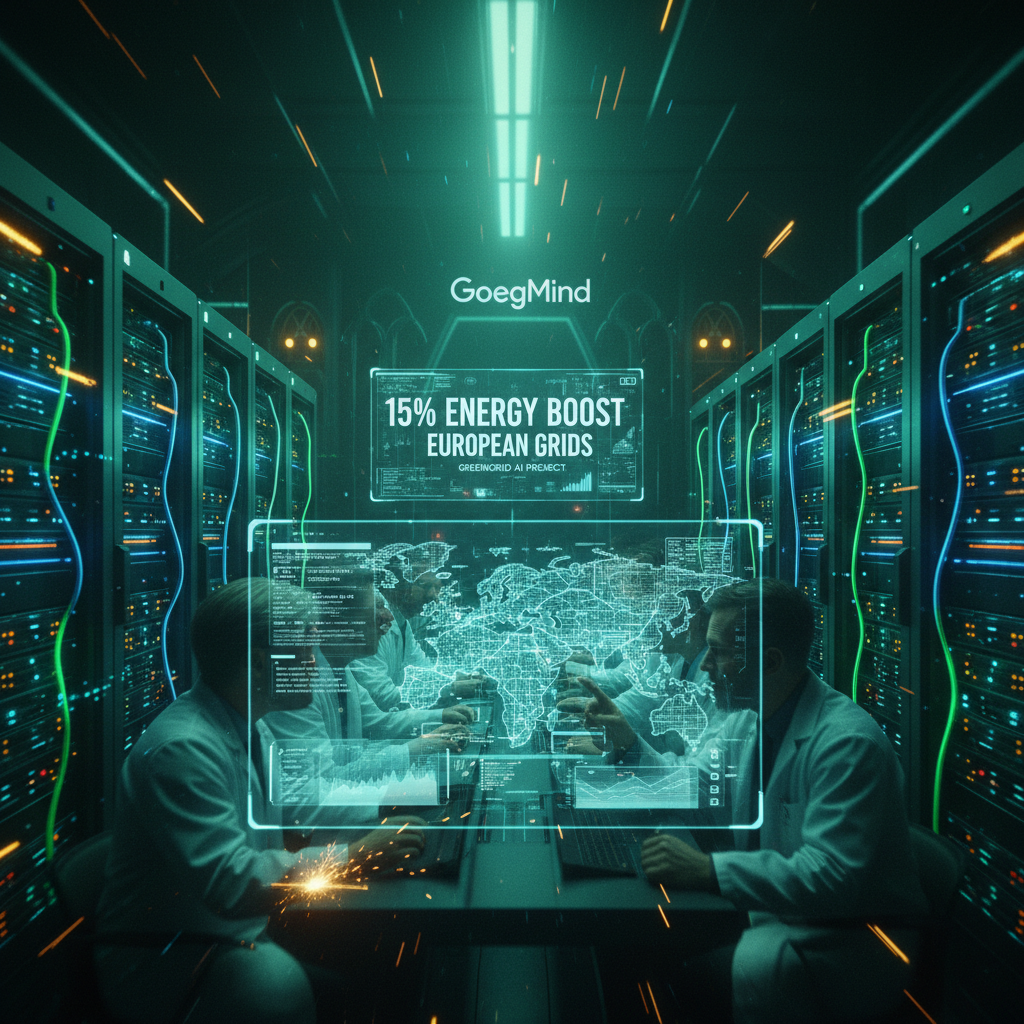

The air in Prague today crackles not just with the scent of spring, but with the palpable energy of a monumental announcement. In a development that could redefine Europe's approach to energy sustainability, a consortium led by researchers from the Czech Technical University in Prague (ČVUT) and powered by the formidable capabilities of Google DeepMind has launched 'GreenGrid AI'. This ambitious project, unveiled this morning at a press conference in the historic Bethlehem Chapel, promises to deliver a staggering 15% improvement in energy efficiency across the region's electrical grids within the next five years. This is not merely an incremental upgrade; it is a fundamental re-engineering of how we manage power, driven by artificial intelligence.
For too long, the discourse around AI and climate change has often felt abstract, a theoretical promise whispered in academic halls. Today, that narrative shifts dramatically. GreenGrid AI is a concrete, data-driven solution emerging from the very heart of Europe, demonstrating how Prague's engineering tradition meets modern AI to tackle one of humanity's most pressing challenges. The project's core innovation lies in its sophisticated predictive model, which leverages DeepMind's advanced reinforcement learning algorithms to anticipate energy demand fluctuations and optimize supply in real time, minimizing waste and enhancing grid resilience.
Let me walk you through the architecture. The system ingests vast streams of data, from weather patterns and historical consumption records to real-time sensor readings from power plants and substations. This includes data from renewable sources, such as solar and wind farms, which are inherently intermittent. DeepMind's AI then processes this information, learning complex correlations and predicting energy needs with unprecedented accuracy. Instead of relying on static, rule-based systems, GreenGrid AI dynamically adjusts energy flow, storage, and even generation, ensuring that power is produced and distributed precisely when and where it is needed. This intelligent orchestration reduces the need for fossil fuel 'peaker' plants, which are typically fired up to meet sudden surges in demand, thereby cutting carbon emissions substantially.
Official reactions have been overwhelmingly positive. "This collaboration represents a pivotal moment for the Czech Republic and for Europe," stated Karel Novák, the Czech Minister of Industry and Trade, during the press conference. "Our energy infrastructure, like many across the continent, faces immense pressure from increasing demand and the imperative to decarbonize. GreenGrid AI offers a robust, scalable solution. We anticipate not only significant environmental benefits but also substantial economic savings for both consumers and producers, estimated at over 200 million Euros annually for the Czech Republic alone." Minister Novák emphasized the project's alignment with the European Green Deal objectives, positioning the Czech Republic as a leader in sustainable energy innovation.
From the academic front, Professor Jana Dvořáková, head of ČVUT's Department of Cybernetics, highlighted the intellectual rigor behind the initiative. "Our team has spent years developing robust, interpretable AI models for critical infrastructure," she explained. "Partnering with Google DeepMind allowed us to scale our research with their unparalleled computational resources and expertise in deep reinforcement learning. The Czech approach is methodical and effective; we built this system with transparency and reliability as paramount concerns, understanding that trust is essential when managing something as vital as a nation's power supply." She noted that initial simulations showed a 15% reduction in grid losses and a 20% improvement in the integration of intermittent renewable energy sources.
Representatives from Google DeepMind were equally enthusiastic. "Our mission at DeepMind is to solve intelligence to advance science and humanity," said Dr. Demis Hassabis, CEO of Google DeepMind, via a pre-recorded statement. "The GreenGrid AI project is a perfect embodiment of this. By applying our cutting-edge AI research to complex real-world problems like energy management, we can deliver tangible environmental and economic benefits. We are particularly impressed by the engineering talent and foresight within ČVUT and the Czech government, which made this ambitious undertaking possible." He further elaborated on the potential for this model to be adopted by other European nations, creating a continental network of intelligently managed grids.
What happens next? The initial phase of GreenGrid AI will focus on a pilot deployment across selected regions of the Czech Republic, encompassing approximately 30% of the national grid, over the next 18 months. This will involve integrating the AI system with existing Scada systems and smart meters, a complex task requiring meticulous software engineering and cybersecurity protocols. Following successful validation, the plan is to scale the solution across the entire Czech national grid and then offer it as a blueprint for other European Union member states. Discussions are already underway with grid operators in Slovakia and Poland, suggesting a rapid expansion could be imminent.
This is not a mere technological curiosity; it is a vital step towards a sustainable future. The ability of AI to optimize complex systems, to see patterns and predict outcomes beyond human capacity, is its true superpower in the fight against climate change. GreenGrid AI offers a compelling vision: a future where our energy infrastructure is not just resilient, but intelligent, adaptive, and inherently green. It underscores the critical role that advanced software engineering and academic research play in translating grand environmental ambitions into practical, impactful solutions. For those of us who believe in the power of innovation, this is a moment to watch closely.
Readers should care because this development directly impacts energy costs, environmental quality, and the stability of the power supply across Europe. As climate change continues to present unprecedented challenges, solutions like GreenGrid AI demonstrate that technology, when harnessed responsibly and intelligently, can be a powerful ally. This is not just a story about algorithms; it is a story about a more secure, sustainable future for all of us. For more insights into AI's role in global challenges, you might consult MIT Technology Review or Reuters Technology. The future of our planet may well depend on such intelligent collaborations, turning data into decisive action. For further reading on similar initiatives, consider the broader landscape of AI applications in energy management as discussed on TechCrunch.