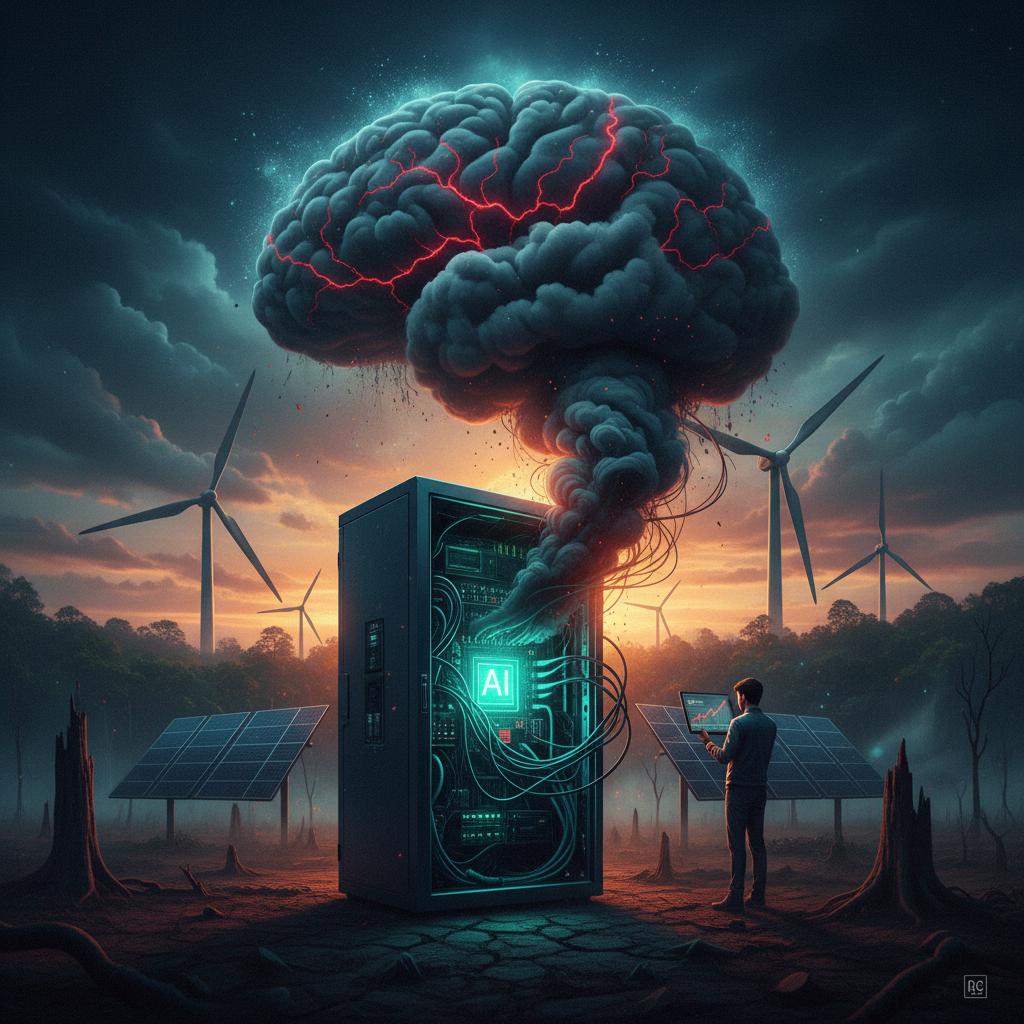

The Amazon rainforest, a global lung, battles deforestation daily. Now, a new, insidious threat emerges, not from chainsaws, but from algorithms. A groundbreaking report, leaked to DataGlobal Hub this morning, details the alarming energy consumption and carbon footprint of Brazil's rapidly expanding artificial intelligence infrastructure. This is not merely a technical issue, it is an economic and environmental reckoning that threatens to undermine our nation's climate commitments and expose a dangerous blind spot in the AI gold rush.
For months, whispers have circulated in São Paulo's tech hubs and Brasília's corridors of power about the insatiable energy demands of large language models and advanced AI computations. Today, those whispers coalesce into a stark, undeniable truth. The confidential report, compiled by a consortium of environmental scientists and energy analysts, estimates that Brazil's AI sector, driven by a 45% increase in data center capacity over the past two years, is projected to consume 18 terawatt-hours of electricity annually by 2028. This figure alone is equivalent to the entire energy consumption of a major Brazilian state, like Ceará, for a full year.
My investigation reveals that while venture capital flows into promising AI startups, little attention has been paid to the foundational infrastructure powering these innovations. The investment trail leads to a landscape dominated by a few key players, including the Brazilian subsidiaries of global tech giants and emerging domestic unicorns, all vying for computational supremacy without adequate environmental oversight. This report, titled 'The Silent Burn: Brazil's AI Energy Crisis,' paints a grim picture of unchecked growth.
Dr. Sofia Almeida, lead author of the report and a climate scientist at the Federal University of Rio de Janeiro, spoke with me exclusively. "We are witnessing a digital gold rush with a very real, very physical cost," she stated, her voice firm. "Companies are deploying increasingly complex AI models, requiring massive computational power, often located in energy-intensive data centers that rely heavily on our national grid. The carbon emissions from these operations are not being adequately tracked, let alone mitigated. We are building an AI future on a fossil fuel foundation, and that is simply unsustainable."
The implications are profound. Brazil, a signatory to the Paris Agreement, has pledged to reduce its greenhouse gas emissions. The surge in AI-related energy demand, if left unaddressed, could severely jeopardize these targets. The report highlights that a significant portion of Brazil's electricity still comes from hydroelectric sources, but thermal power plants, often burning natural gas or coal, are frequently brought online to meet peak demand. AI's constant, high-intensity processing could push the grid past its sustainable limits, forcing a greater reliance on these dirtier energy sources.
Reactions from official channels have been swift, though varied. The Ministry of Science, Technology, and Innovation acknowledged the report's findings, promising a