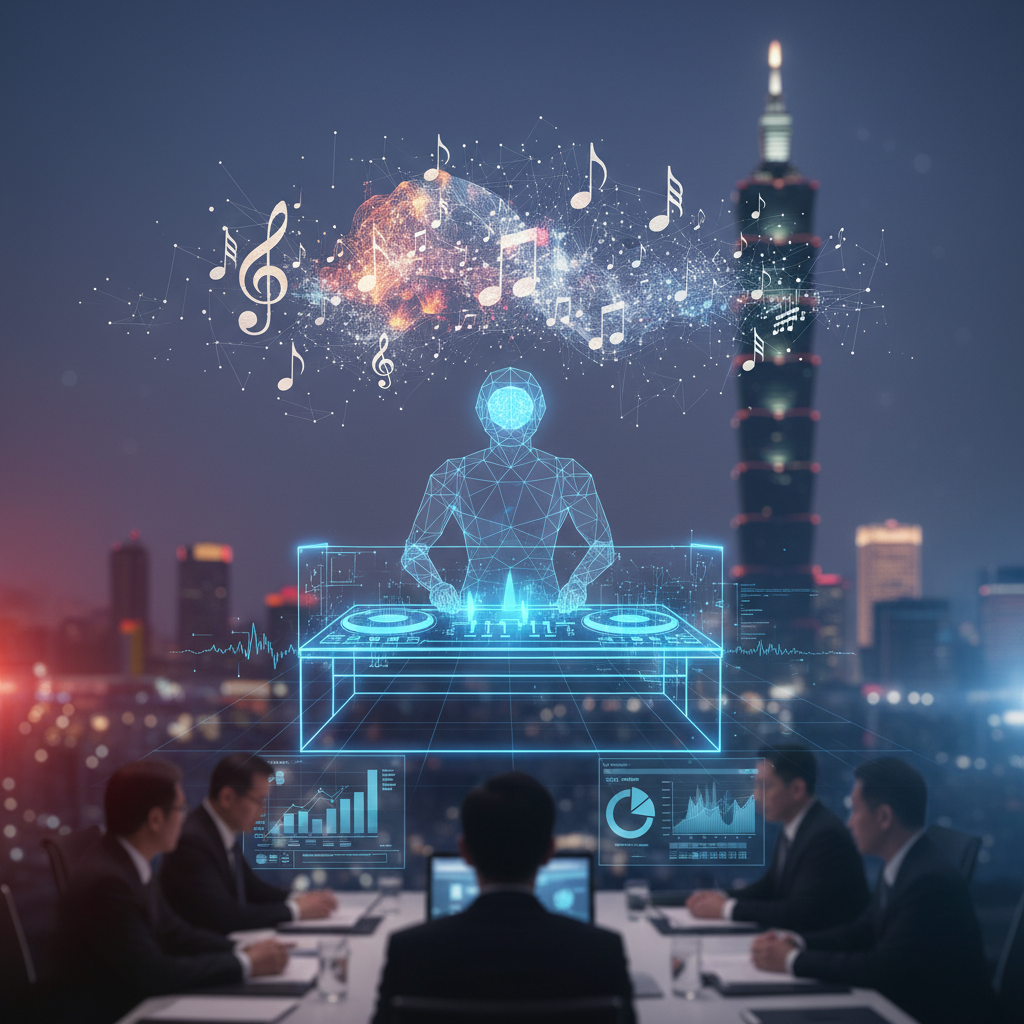

The digital soundscape, once a vast, untamed ocean of tracks, is increasingly shaped by unseen currents: algorithms. Spotify's AI DJ, launched with considerable fanfare, represents a bold step towards a more conversational and contextually aware music discovery experience. For an advanced technical audience, however, the pertinent question is not merely 'does it work,' but 'how does it work,' and more critically, 'what are its limitations, particularly when navigating the intricate cultural tapestries of regions like Taiwan?'
The technical challenge at its core is a multi-modal, real-time recommendation problem, layered with natural language generation and speech synthesis. Traditional music recommendation systems, while sophisticated, often operate on explicit user feedback and implicit listening patterns. The AI DJ, in contrast, aims to mimic a human radio host, providing spoken commentary, genre transitions, and personalized selections. This necessitates a profound shift from passive recommendation to active, dynamic curation.
Architecture Overview: A Symphony of Microservices
Spotify's AI DJ is not a monolithic entity, but rather a distributed system leveraging several specialized microservices. At a high level, the architecture can be conceptualized into three primary layers: the Recommendation Engine, the Contextual Understanding and Generation Module, and the Speech Synthesis and Delivery System.
-
Recommendation Engine: This is the bedrock, evolving from Spotify's existing infrastructure. It employs a blend of collaborative filtering, content-based filtering, and deep learning models. Techniques such as matrix factorization for implicit feedback, often seen in models like Word2vec for music embeddings (e.g., 'item2vec' or 'track2vec'), are fundamental. More recently, graph neural networks (GNNs) have gained traction for modeling complex relationships between users, artists, and tracks within a vast knowledge graph. The engine must not only predict the 'next best song' but also identify suitable tracks for specific contextual prompts generated by the AI DJ.
-
Contextual Understanding and Generation Module: This is where the 'DJ' persona truly resides. It comprises several sub-components:
- Natural Language Understanding (NLU): Processes user input, if any, and analyzes the current listening context (genre, mood, tempo, time of day, user activity). This often involves transformer-based models fine-tuned for music-related semantics.
- Content Selection and Sequencing: Based on the NLU output and recommendations, this module selects a sequence of tracks and determines appropriate transitions. It needs to consider musical coherence, user preferences, and novelty. A critical aspect here is balancing exploration versus exploitation, ensuring users discover new music without alienating them.
- Natural Language Generation (NLG): This component generates the spoken commentary. It's likely powered by a large language model (LLM), potentially a variant of models like GPT or a custom-trained model, fine-tuned on vast amounts of radio host dialogue and music commentary. The NLG needs to be context-aware, referencing artists, genres, and even user listening history in a natural, engaging manner. This is where the challenge of cultural nuance becomes particularly acute. A comment that resonates in one cultural context might fall flat or even be misinterpreted in another.
- Speech Synthesis and Delivery System: The final layer converts the generated text into natural-sounding speech. Spotify leverages advanced text-to-speech (TTS) technology, likely incorporating deep learning models like WaveNet or Tacotron derivatives, to produce a voice that is both intelligible and engaging. The specific voice used for the AI DJ is often a cloned voice of a real human, adding to the perceived authenticity.
Key Algorithms and Approaches
The sophistication lies in the integration. Consider the pseudocode for a simplified DJ turn:
FUNCTION AIDJ_Turn(user_profile, current_context, listening_history):
 // Step 1: Understand current context and user state
 mood, genre_tendency = NLU_Analyze(current_context, user_profile)

// Step 2: Generate candidate tracks
 candidate_tracks = RecommendationEngine.get_candidates(user_profile, mood, genre_tendency, listening_history)
 selected_track = SelectBestTrack(candidate_tracks, novelty_bias=0.2)

// Step 3: Generate spoken commentary
 commentary_template = NLG_GenerateTemplate(selected_track, mood, genre_tendency, user_profile)
 final_commentary = FillTemplateWithDetails(commentary_template, selected_track.artist, selected_track.title)

// Step 4: Synthesize speech
 audio_speech = TTS_Synthesize(final_commentary)

Return audio_speech, selected_track
FUNCTION AIDJ_Turn(user_profile, current_context, listening_history):
 // Step 1: Understand current context and user state
 mood, genre_tendency = NLU_Analyze(current_context, user_profile)

// Step 2: Generate candidate tracks
 candidate_tracks = RecommendationEngine.get_candidates(user_profile, mood, genre_tendency, listening_history)
 selected_track = SelectBestTrack(candidate_tracks, novelty_bias=0.2)

// Step 3: Generate spoken commentary
 commentary_template = NLG_GenerateTemplate(selected_track, mood, genre_tendency, user_profile)
 final_commentary = FillTemplateWithDetails(commentary_template, selected_track.artist, selected_track.title)

// Step 4: Synthesize speech
 audio_speech = TTS_Synthesize(final_commentary)

Return audio_speech, selected_track
The SelectBestTrack function, for instance, is far more complex in reality, incorporating multi-objective optimization to balance relevance, diversity, and freshness. The NLG_GenerateTemplate function must also consider cultural appropriateness and linguistic subtleties. MIT Technology Review has highlighted the significant challenges in making LLMs culturally sensitive, a hurdle Spotify must constantly address.
Implementation Considerations and Trade-offs
Building such a system involves significant engineering trade-offs. Real-time inference is paramount. Latency in generating recommendations or speech would break the illusion of a live DJ. This demands highly optimized models, potentially quantized for faster execution, and a robust, low-latency serving infrastructure, likely leveraging cloud-native solutions and edge computing for speech synthesis where feasible.
Data privacy is another critical consideration. The system relies heavily on user listening data, necessitating strict adherence to regulations like GDPR and local privacy laws. For instance, in Taiwan, the Personal Data Protection Act (pdpa) dictates how personal information, including listening habits, can be collected, processed, and used. Spotify must ensure its data pipelines are compliant.
Scalability is also a non-negotiable. Serving hundreds of millions of users globally, each with unique preferences, requires an infrastructure capable of handling immense computational loads. This often means deploying models across numerous GPUs and TPUs, and employing techniques like model sharding and distributed training.
Benchmarks and Comparisons
Compared to traditional playlist generation, the AI DJ adds a layer of conversational interaction. While existing systems like Pandora's Music Genome Project rely on human curation and tagging for content-based recommendations, Spotify's approach leans heavily on deep learning to infer preferences and generate dynamic content. The closest parallels might be found in personalized news feeds or intelligent assistants, but the real-time, audio-first nature of the AI DJ presents unique challenges.
One metric of success is user engagement, measured by listening time, skip rates, and explicit feedback. Another is the diversity of music exposure. A truly effective AI DJ should introduce users to new artists and genres they genuinely enjoy, not just reinforce existing biases. This is where the system's ability to navigate cultural nuances becomes critical. A Taiwanese user, for example, might appreciate a seamless transition from a Mandopop ballad to a Japanese city pop track, a connection that a purely Western-centric model might miss.
Code-Level Insights and Practicalities
Developers working on such systems often leverage frameworks like TensorFlow or PyTorch for model development. For deployment, Kubernetes and Docker are standard for managing microservices. Libraries like Hugging Face's Transformers are invaluable for fine-tuning LLMs and NLU models, while NVIDIA's NeMo toolkit provides robust capabilities for speech synthesis and recognition. Data pipelines are typically built with Apache Kafka for real-time streaming and Apache Spark for large-scale data processing.
Real-World Use Cases and Cultural Context
The AI DJ's impact extends beyond mere entertainment. For artists, particularly independent ones, it offers a new avenue for discovery. For listeners, it promises a more curated, less overwhelming experience. In Taiwan, a market with a rich and diverse music scene spanning Mandopop, Taiwanese Hokkien pop, indigenous music, and a growing indie rock presence, the AI DJ's ability to understand and recommend across these genres is paramount. TechCrunch has often highlighted how localized content and understanding are key for global platforms.