For years, when we talked about artificial intelligence, we were mostly talking about very clever pattern recognition. Think of it like this: an AI sees thousands of pictures of cats, learns what a cat looks like, and then can tell you if a new picture has a cat in it. It is impressive, certainly, but it is not really 'thinking' in the way a human does. It is not reasoning. Here in Fiji, we face the future with clear eyes, and we know that real problems need real solutions, not just fancy pattern matching. That is why the latest developments in AI reasoning, particularly its application in healthcare, are so compelling.
What exactly is this 'reasoning AI' that goes beyond pattern matching? At its core, it is about building AI systems that can understand relationships, infer conclusions, and make decisions based on logical steps, much like a human mind. Instead of just identifying a tumor in an X-ray (pattern matching), a reasoning AI might analyze the tumor's characteristics, cross-reference it with patient history, genetic markers, and global research, then suggest a personalized treatment plan, explaining why that plan is optimal. It moves from 'what' to 'why' and 'how'. This is a significant leap from the large language models we have become familiar with, which, while powerful, often still operate on statistical correlations rather than deep causal understanding.
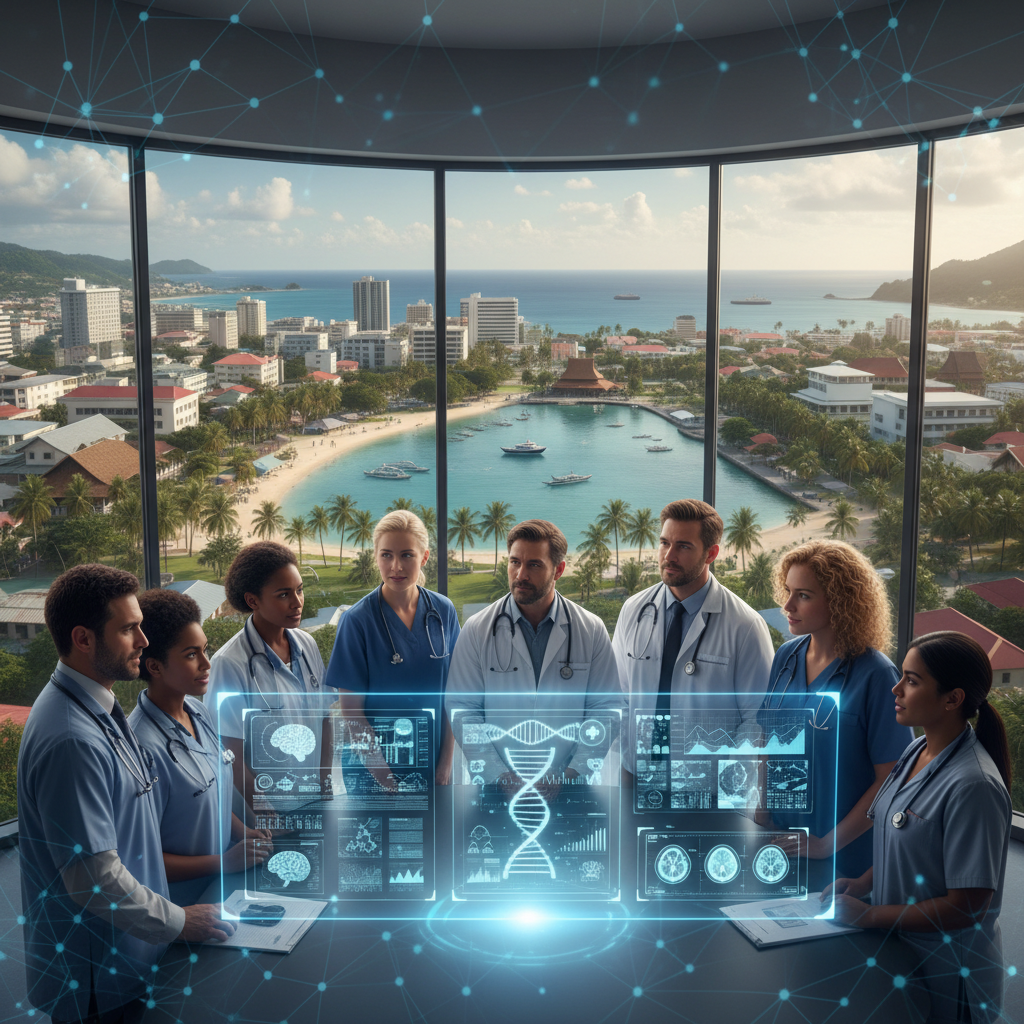
Why should you care? The implications for healthcare are immense, especially for small island nations like ours. Imagine a doctor in a remote Fijian village, perhaps on Kadavu, having access to an AI that can not only diagnose a rare disease but also explain the biological mechanisms behind it and recommend treatments based on the latest global research, even if that research was published yesterday. This kind of AI can democratize access to world-class medical expertise, reduce diagnostic errors, and accelerate the development of new medicines. It is about bringing advanced capabilities to where they are needed most, not just where the big hospitals are. The Pacific way of problem-solving often involves making the most of limited resources, and this technology offers a powerful tool for that.
How did it develop? The journey from simple pattern recognition to reasoning AI has been gradual, building on decades of research. Early AI systems, often rule-based, struggled with the complexity and ambiguity of the real world. The rise of deep learning and neural networks in the 2010s brought unprecedented success in tasks like image recognition and natural language processing. However, researchers quickly realized these systems, while powerful, lacked true understanding. They could identify objects but not grasp their function, or generate text without truly comprehending its meaning. The current breakthrough involves new architectures and training methodologies that integrate symbolic reasoning with neural networks. Companies like Anthropic and Google DeepMind have been at the forefront, exploring ways to embed more explicit logical structures and causal models into their AI systems. This allows them to not just process data, but to build internal representations of the world and manipulate them logically.
How does it work in simple terms? Think of it like learning to cook. A pattern-matching AI might learn to make a perfect kokoda by following a recipe exactly, recognizing the ingredients and steps. A reasoning AI, however, would understand why certain ingredients are used, how they interact chemically, and what substitutions could be made if something is unavailable, all while still producing a delicious dish. It understands the underlying principles. These new AI architectures often combine different approaches: one part might be excellent at recognizing visual patterns in medical scans, while another part uses logical inference to connect those patterns to known diseases and treatment pathways. They learn not just from data, but from simulated environments and explicit knowledge graphs that represent relationships between concepts. This allows them to build a more robust, interpretable model of reality.
Real-world examples are already emerging. In drug discovery, reasoning AI is being used by companies like Recursion Pharmaceuticals to predict how different compounds will interact with biological systems, drastically speeding up the identification of potential new drugs. Instead of trial-and-error in labs, AI can simulate millions of interactions, saving years and billions of dollars. For instance, they can analyze the molecular structure of a compound and reason about its potential efficacy against a specific disease target, rather than just matching it to known successful drugs.
Another area is personalized medicine. Imagine an AI that can analyze your unique genetic code, lifestyle data, and medical history, then reason about the most effective preventative measures or treatments for you. This goes beyond simply flagging risk factors; it involves constructing a personalized health trajectory and interventions. This is a game-changer for chronic disease management, where individual responses to treatments vary widely. Dr. Eric Topol, a leading cardiologist and author, has often emphasized the potential of AI to personalize care, stating, "The algorithms are getting better and better at interpreting medical images, medical signals, and medical data, but the next frontier is really about reasoning and integrating all that information for each individual patient." His insights, often shared through platforms like MIT Technology Review, highlight this shift.
Furthermore, reasoning AI is proving invaluable in complex diagnostic challenges. For instance, in oncology, AI systems are being developed to not only identify cancerous cells but also to reason about the tumor's aggressiveness, its response to different therapies, and the likelihood of metastasis by integrating pathology reports, genomic data, and imaging. This provides oncologists with a more holistic and predictive understanding of the disease. According to researchers at Google DeepMind, their work on medical reasoning aims to "build AI systems that can not only predict outcomes but also explain the underlying causal factors," which is crucial for clinician trust and adoption. You can find more about their research on their official site DeepMind.
Finally, in public health, reasoning AI can model disease outbreaks with greater accuracy, considering not just infection rates but also social dynamics, travel patterns, and environmental factors. This allows for more effective and targeted interventions, which is particularly vital for island nations vulnerable to global health crises. The World Health Organization has been exploring how AI can bolster surveillance systems, moving beyond simple data aggregation to predictive reasoning about disease spread.
Common misconceptions often cloud our understanding of these advancements. One is that reasoning AI is already conscious or sentient. This is far from the truth. While these systems can perform sophisticated logical operations, they do not possess self-awareness, emotions, or subjective experience. They are tools, albeit incredibly powerful ones. Another misconception is that they will replace doctors entirely. Instead, the consensus among experts, including those at TechCrunch covering healthcare AI startups, is that AI will augment human capabilities, acting as an intelligent assistant that handles complex data analysis and suggests options, freeing doctors to focus on patient interaction and ethical decision-making. It is about collaboration, not replacement.
What to watch for next? The next few years will see continued integration of these reasoning capabilities into existing AI platforms. Expect to see more hybrid AI models that combine the strengths of neural networks with symbolic logic. There will be a strong push for explainable AI, where systems can articulate their reasoning process in a way that humans can understand and trust. This is critical in healthcare, where transparency is paramount. We will also see more specialized reasoning AIs tailored for specific medical domains, becoming experts in cardiology, neurology, or infectious diseases. As these systems become more robust and reliable, their deployment in clinical settings will expand significantly. The regulatory landscape will also evolve to keep pace with these advanced capabilities, ensuring safety and ethical use.
In Fiji, we know that technology, when applied thoughtfully, can be a powerful force for good. These advancements in reasoning AI offer a genuine opportunity to uplift our healthcare systems, providing better care and more informed decisions for our people. It is not just about the technology itself, but about how we harness its power to build a more resilient and healthier future for everyone.